
WASHINGTON — White House officials announced plans Thursday to combat what they describe as systematic theft of American artificial intelligence technology by foreign companies, with particular focus on Chinese firms as competition intensifies in the global AI sector.
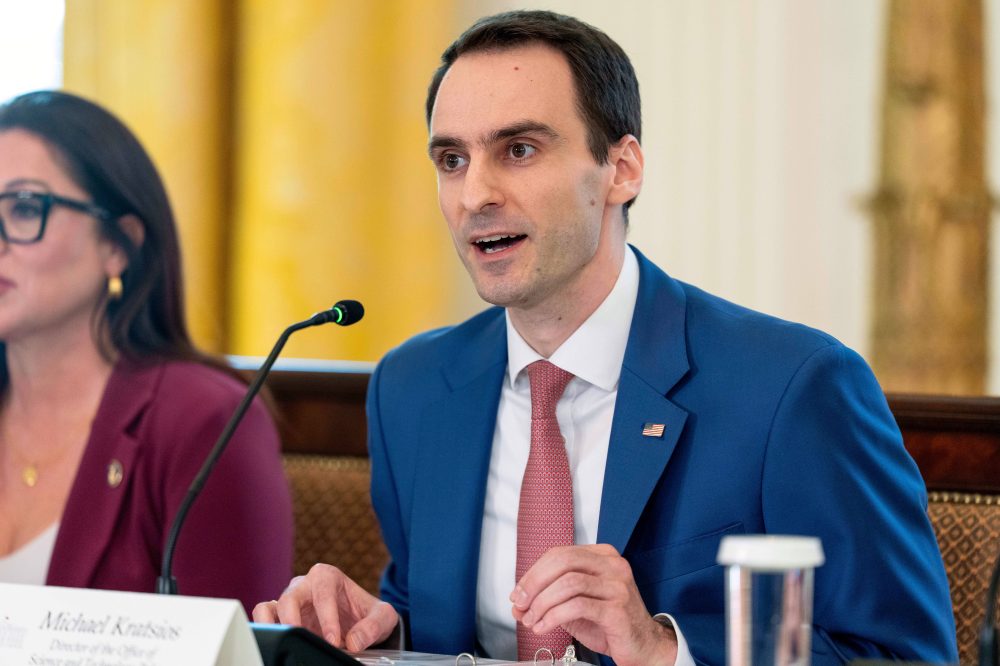
Michael Kratsios, serving as the president’s top science and technology advisor, issued a memo Thursday targeting foreign organizations “principally based in China” for conducting organized, large-scale efforts to “distill,” or steal capabilities from, top-performing AI systems developed in America and “exploiting American expertise and innovation.”
According to Kratsios’ memo, the administration plans to collaborate with U.S. AI developers to detect these activities, strengthen protective measures, and establish penalties for violators.
This announcement comes as China increasingly challenges American leadership in artificial intelligence development, a sector the White House considers crucial for establishing international standards and securing economic and defense advantages. However, recent analysis from Stanford University’s Institute for Human-Centered AI indicates the performance difference between U.S. and Chinese top AI systems has “effectively closed.”
Chinese officials in Washington rejected the accusations, with embassy spokesperson Liu Pengyu stating the country opposes “the unjustified suppression of Chinese companies by the U.S.”
“China has always been committed to promoting scientific and technological progress through cooperation and healthy competition. China attaches great importance to the protection of intellectual property rights,” Liu Pengyu said.
The memo’s release coincided with unanimous bipartisan House Foreign Affairs Committee approval of legislation establishing procedures to identify foreign actors extracting “key technical features” from privately-owned U.S. AI models and impose sanctions as punishment.
“Model extraction attacks are the latest frontier of Chinese economic coercion and theft of U.S. intellectual property,” stated Rep. Bill Huizenga, R-Mich., the bill’s sponsor. “American AI models are demonstrating transformative cyber capabilities, and it is critical we prevent China from stealing these technological advancements.”
The controversy intensified last year when Chinese startup DeepSeek disrupted U.S. markets by launching a competitive large language model at significantly lower costs than American AI companies.
David Sacks, who previously served as President Donald Trump’s AI and cryptocurrency advisor, alleged DeepSeek copied American models. “There’s substantial evidence that what DeepSeek did here is they distilled the knowledge out of OpenAI’s models,” Sacks stated.
OpenAI, which develops ChatGPT, made similar claims in a February letter to Congress, arguing China should not advance “autocratic AI” by “appropriating and repackaging American innovation.”
Anthropic, creator of the Claude chatbot, accused DeepSeek and two additional China-based AI companies in February of conducting operations to “illicitly extract Claude’s capabilities to improve their own models” through distillation methods that involve “training a less capable model on the outputs of a stronger one.”
While Anthropic acknowledged distillation can serve legitimate training purposes, the company expressed concern when competitors “use it to acquire powerful capabilities from other labs in a fraction of the time, and at a fraction of the cost, that it would take to develop them independently.”
However, technology sharing occurs in both directions. San Francisco startup Anysphere, which creates the popular Cursor coding tool, recently revealed its newest product relies on an open-source model developed by Chinese company Moonshot AI, maker of the Kimi chatbot.
Kyle Chan, a fellow at The Brookings Institution and specialist in Chinese technology development, compared detecting unauthorized distillation to “looking for needles in an enormous haystack” among legitimate data requests. Chan suggested information sharing and coordination between U.S. AI companies could help, with federal government facilitation playing a crucial role in anti-distillation efforts across laboratories.
While the House legislation’s ultimate impact remains uncertain, Chan noted Trump may avoid confrontation with Chinese President Xi Jinping before a scheduled mid-May state visit to Beijing.