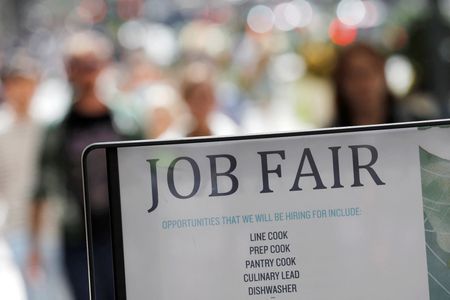

Unemployment benefit applications decreased across the nation last week, signaling that job market stability continues even as Middle East tensions create economic uncertainty for employers hesitant to expand their workforce.
New filings for state unemployment assistance fell by 11,000 to a seasonally adjusted 207,000 during the week ending April 11, according to Thursday’s Labor Department report. Economic forecasters had predicted 215,000 applications for that period.
Application numbers have stayed within the 201,000-230,000 range throughout this year. Although job cuts remain minimal, rising oil costs from the U.S.-Israel conflict with Iran may be discouraging companies from adding staff.
Wednesday’s Federal Reserve Beige Book revealed that “several districts noted increased demand for temporary or contract workers, as firms remained cautious about committing to permanent hires.” The analysis, compiled from early April data, also found the Middle East situation “was cited as a major source of uncertainty that complicated decision-making around hiring, pricing and capital investment, with many firms adopting a wait-and-see posture.”
Petroleum costs have jumped over 35% since fighting began in late February. These elevated energy prices pushed up both consumer and business costs in March, according to recent government statistics. President Donald Trump has established a blockade of the Strait of Hormuz, stopping maritime commerce with Iran.
Employment conditions were already stagnant before the conflict started, which economists attribute to uncertainty from Trump’s extensive import duties and large-scale deportation efforts. The Middle East crisis has added another layer of business uncertainty, economic analysts noted.
Continuing unemployment benefit recipients, which indicates hiring activity, rose by 31,000 to a seasonally adjusted 1.818 million for the week ending April 4, the report indicated.
These ongoing claims have decreased from last year’s elevated numbers, partly because people are using up their benefit eligibility, which is capped at 26 weeks in most states. The statistics exclude some jobless young people who often lack substantial employment history. Finding work remains difficult for this demographic.