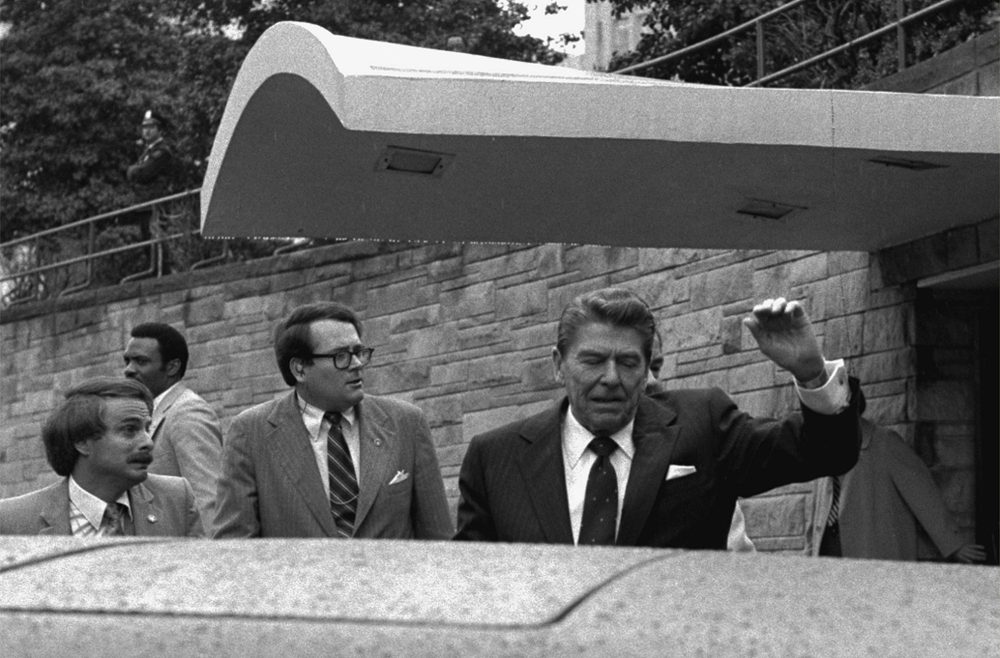

WASHINGTON (AP) — On a dreary March day in 1981, President Ronald Reagan emerged from the Washington Hilton Hotel toward his waiting vehicle, vulnerable for just moments. Those brief seconds were enough for an assailant to take position and open fire.
The bullet struck Reagan in the torso, bringing him dangerously close to death. Four and a half decades later, another armed individual allegedly attempted to breach the identical hotel’s ballroom while the White House Correspondents’ Association dinner was underway Saturday evening. Law enforcement reports the individual discharged at least one round before being overpowered in a frenzied incident that required the emergency removal of President Donald Trump and senior administration personnel. The attacker never gained access to the ballroom nor came near the president.
The Hilton property has welcomed countless major gatherings with presidents and high-ranking officials since its opening in the 1960s. Though the two incidents share the same location and appear similar on first glance, significant differences reveal how dramatically security protocols have evolved since Reagan’s attempted assassination.
“Security is a lot more robust today than it was then,” said Stephen T. Colo, a former assistant director of the Secret Service. “But you still deal with the same tension involving politicians and the public’s access to them.”
The Washington Hilton Hotel and its expansive ballroom were intentionally constructed as an ideal location for presidential addresses and gatherings. To attract prominent speakers, especially presidents, designers created a special VIP entry along the hotel’s side and, one level beneath, a secure waiting area nicknamed the bunker.
During the ten years preceding Reagan’s shooting, presidents made more than one hundred visits to the hotel.
The 1981 attack began when Hinckley boarded a bus in Los Angeles, where he had been attempting to compose and market music, and traveled to Washington. His original plan involved continuing to New Haven, Connecticut, to take his own life in front of actress Jodie Foster, who had become his fixation.
While in the nation’s capital, he discovered Reagan was scheduled to address an audience at the Washington Hilton on March 30th afternoon, prompting him to alter his scheme. He decided to attempt killing the president as a way to gain the actress’s attention.
That afternoon outside the hotel, Hinkley positioned himself just 15 feet from Reagan as the president walked toward his limousine. Standing among a small gathering of spectators and reporters behind a rope barrier, the would-be killer drew his weapon and discharged six rounds in 1.7 seconds, injuring Reagan, White House press secretary Jim Brady, District of Columbia Police Officer Thomas Delahanty and Secret Service agent Tim McCarthy.
The bullet hit Reagan beneath his left armpit, coming to rest one inch from his heart. Reagan’s survival resulted from Secret Service agent Jerry Parr’s swift response and the medical team at George Washington University Hospital. A jury later found Hinckley not guilty by reason of insanity.
Following the shooting, the Secret Service implemented numerous security improvements. The most noticeable change involved establishing screening stations and metal detection equipment for White House visitors and public event attendees. Hinckley had bypassed both types of security measures to get so near the president.
The hotel constructed a fortress-style garage where the armored presidential vehicle could safely arrive and depart at the VIP entrance. The Secret Service and local law enforcement increased their personnel assignments for presidential appearances at the Hilton.
Despite these improvements, former agents noted that protecting the Hilton remains difficult and demonstrates the ongoing challenge between safeguarding politicians while maintaining public accessibility. The hotel contains numerous public spaces that would be difficult to close during events, including high-profile occasions like the correspondents’ dinner.
This explained why the primary security screening occurred near the ballroom rather than at the hotel lobby or entrance — steps that would disrupt hundreds of guests and hotel business. Within the ballroom, additional agents and heavily armed tactical personnel were positioned near the president.
Saturday’s suspect rushed through the checkpoint approaching the ballroom, based on video shared by Trump. The footage depicts officers and agents turning and aiming weapons at the individual as he fled. Officials reported the attacker was quickly restrained without injury. One officer sustained a shot to his bullet-resistant vest but avoided serious harm.
Acting U.S. Attorney General Todd Blanche stated Sunday that the gunman likely intended to target the president and administration members.
The suspect allegedly traveled by rail from California to Chicago, then continued to Washington, where he recently registered as a hotel guest, Blanche reported.
Law enforcement sources identified the suspect to The Associated Press as 31-year-old Cole Tomas Allen from Torrance, California. Allen transmitted writings to family members moments before the shooting, referring to himself as a “Friendly Federal Assassin,” criticizing Trump administration policies and indicating what investigators increasingly view as a politically motivated assault, according to another law enforcement official who requested anonymity due to the ongoing investigation.
The documents contained multiple Trump references without directly naming the president and suggested complaints about various administration decisions, the official stated.