
Citizens of Iran find themselves caught between uncertainty and weariness as their nation’s economy suffers under the strain of warfare and mounting domestic challenges.
U.S. President Donald Trump announced Thursday that he halted planned military strikes against Iran, stating that a peace agreement appeared close at hand. Earlier this week’s exchange of attacks brought a fragile ceasefire dangerously close to breaking down completely, which would cause additional damage to Iran’s already struggling economy.
Previous attacks targeting steel plants, petrochemical facilities, and power infrastructure have triggered widespread business shutdowns and unemployment across Iran, leaving citizens unable to purchase basic food items amid skyrocketing grocery prices that have increased by triple digits.
The combination of economic collapse and the threat of warfare has left many citizens desperately wanting an end to the chaos while feeling deeply worried about what lies ahead. Huraz Ahmadi, a 19-year-old street vendor in the capital of Tehran, expressed concern about the possibility of fighting resuming.
“I don’t think they will reach an agreement, given the way things are going. But I hope they make a deal. An agreement is much better than war,” Ahmadi said. “In wars, innocent and good people die. I personally lost a relative.”
Over the past year, Iranians have endured two separate conflicts – beginning with Israel’s 12-day war in 2025 against Iran followed by a joint assault with the U.S. that began on Feb. 28. Both attacks were launched in the middle of talks about Iran’s nuclear program.
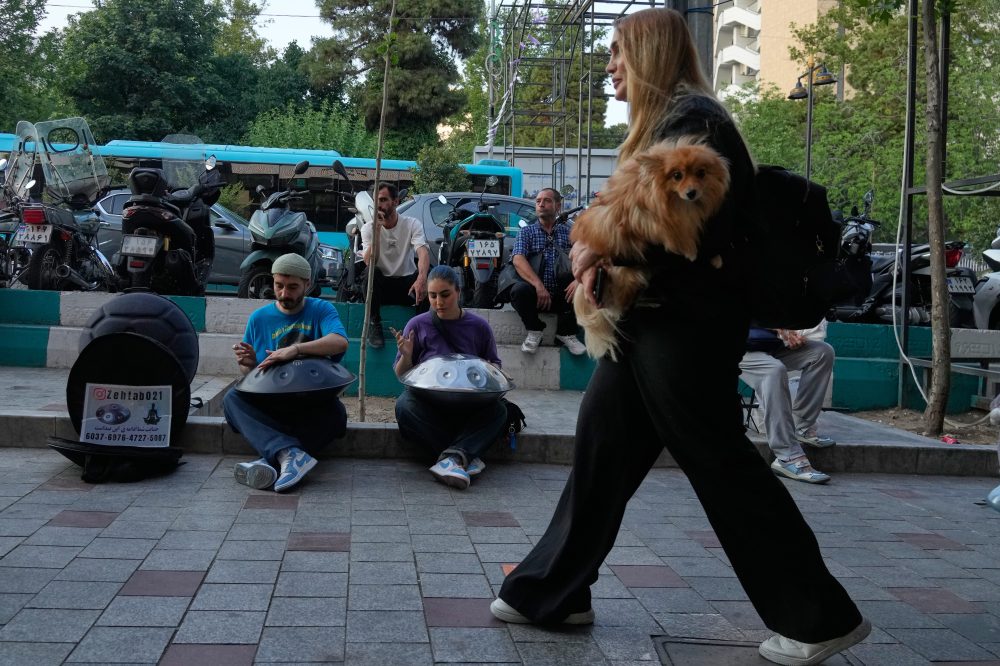
Monday’s renewed U.S. attacks created uncertainty in Iran’s capital after growing hope that Tehran and Washington were close to reaching an agreement. One Tehran resident in his late 20s described how the sound of explosions and air defenses in the capital caused “maybe a half hour of panic.” Extended lines appeared at gas stations, but citizens returned within hours to “living normally,” he said.
“War is also becoming normal. And that is very upsetting,” the resident said, speaking on the condition of anonymity out of security fears.
“Everybody is stressed out for a thousand reasons,” he added. “Our lives are constantly in this political game where we can’t plan anything or know what’s going to happen.”
A key requirement in negotiations for Iranian representatives is that the U.S. provide some form of sanctions or economic relief, in addition to removing a naval blockade that has severely restricted Iran’s oil exports as well as imports of raw materials and other goods.
Numerous business owners are fighting to keep their operations alive, according to a member of a council representing Iranian industrialists.
“The main concern of many industrialists and entrepreneurs is the survival of their businesses and production. The concern is about the disruption of the supply chain of raw materials, parts and machinery due to the cruel U.S. blockade,” Mehdi Bostanchi said.
Tehran-based Bostanchi, who owns a company that makes ventilation systems, is part of a trade group for factory owners across Iran. Its members include textile, food and metal producers and printing firms.
Bostanchi explained that the unclear status of any agreement to end the conflict is preventing businesses from making future plans and working toward recovery.
“Society is tired of instability and does not want a wider war to break out,” he added.
Iran’s rial currency has also lost over half its value in the past year. Exchange rates have crashed to around 1.8 million rials to the dollar, compared with 41,600 rials 10 years ago.
The worsening economic situation has sparked civil unrest in Iran. In January, security forces shot thousands of anti-government protesters in the streets. Arrests of protesters and those expressing support for them has continued through the war.
In addition to fearing their own government, Iranians who oppose the authorities also worry about a return to active warfare, according to a social media influencer and therapist who lives in central Tehran and has participated in past anti-government protests.
“The war isn’t anything but destruction for us. And in reality, the attacks that happened killed a number of ordinary people and destroyed a number of homes and residential buildings,” she said, speaking on the condition of anonymity out of fear of retribution.
Residents contacted by The Associated Press also expressed concerns that renewed conflict would lead Iranian authorities to cut internet service again. Repeated blackouts since the January protests have crippled what was a strong digital economy and stoked job losses. A partial restoration has seen a limited uptick in connectivity.
A few hours after threatening to launch further attacks, Trump posted on social media that significant points in the negotiations “have been brought to the highest level of Iranian leadership and approved.” But a spokesperson for the Iranian Foreign Ministry, Esmail Baghaei, said in a live phone call on state television that mediators were active and nothing had been finalized to end the conflict.
Iran’s ability to withstand U.S.-Israeli assaults and to close the globally strategic Strait of Hormuz has also rallied the Islamic Republic’s hard-liner base. Authorities have organized nightly rallies in past weeks as they try to project popular support for a tough stance in U.S. talks.
Hamid Reza Bani Ebrahimi, a 47-year-old merchant, said he opposed any agreement that would limit what he sees as Iran’s right to enrich uranium and develop nuclear technology. Israel and the U.S. have repeatedly struck sites and figures linked with the country’s atomic program.
“Our scientists worked so hard to acquire this technology, and then they came and martyred them,” Bani Ebrahimi said.
Abdullah Hosseini, a 45-year-old university professor in Tehran, said Iranian strikes on Gulf states and Jordan this past week were part of an effort to deter further attacks.
“I don’t like war. I am extremely worried about people and children being killed,” Hosseini said. “But sometimes war is necessary, and now is the time for Iran to stand against its enemy.”
But Tehran-based analyst Rahman Ghahremanpour said the back-and-forth strikes this week had deepened concerns in Iran that the conflict “could turn into a crisis without end and in reality make running the country more difficult” in the face of economic pressures.
“Both America and Iran are looking for a way out of this situation with honor and claiming victory so they can strengthen their own domestic situation,” he said.