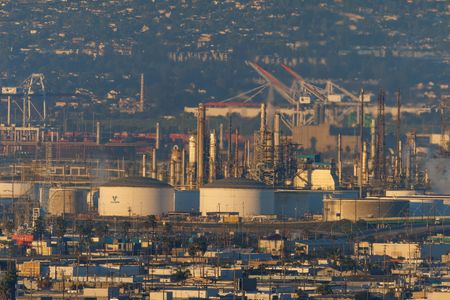

Major American oil refineries are poised to announce dramatically improved first-quarter financial results compared to the same period last year, driven by supply chain disruptions from ongoing Middle East conflicts that have pushed fuel profit margins to their highest levels in years.
The oil refining sector emerged from the first three months of the year with diesel and jet fuel profit margins significantly elevated from January levels. This surge followed the February 28 commencement of U.S.-Israeli military operations against Iran, which resulted in the blockade of the Strait of Hormuz – a critical waterway that handles approximately 20% of global oil shipments and a substantial portion of worldwide fuel exports. Industry experts predict much of the financial benefit will be reflected in later quarterly reports.
Stock prices for leading American refineries including Valero Energy, Phillips 66, and Marathon Petroleum have surged over 20% year-to-date.
“Refiners had a whirlwind Q1’26, as the escalation of the Iran conflict led to global supply restrictions that sent product cracks (margins) soaring,” said Matthew Blair, an analyst at Tudor, Pickering, Holt & Co, noting that distillates is where the strongest margin uplift was coming through.
Diesel profit margins strengthened significantly as oil shipments normally transported from the Middle East through the strait faced severe restrictions. Already depleted inventory levels prior to the global supply disruption amplified the price increases, according to market analysts. Unlike gasoline markets, diesel had limited excess production capacity to absorb the supply shock, positioning refineries outside the Middle East region favorably to meet additional demand.
The ultra-low sulfur diesel futures crack spread, which indicates refinery profit margins, skyrocketed 105% to reach a record peak of $86.25 per barrel on March 20.
Jet fuel profit margins have similarly increased since the conflict began, especially benefiting coastal and export-focused refineries, analysts reported. The Middle East serves as a major jet fuel supplier, and transportation disruptions rapidly affected aviation fuel markets across Asia and Europe.
GASOLINE COSTS SURGE
Gasoline profit margins also received support from supply disruptions, though less dramatically, as earnings were limited earlier in the quarter due to refineries operating at high capacity with adequate supplies available.
The U.S. gasoline futures crack spread climbed to $37.62 per barrel on March 27, marking its highest point in over two years. National average pump prices exceeded $4 per gallon by the end of March for the first time in more than three years, completing the steepest monthly increase in decades.
Phillips 66 will begin the refinery earnings season on Wednesday, with analysts projecting the company will announce a loss of $0.27 per share, an improvement from the $0.90 per share loss reported one year earlier, based on LSEG forecasts.
The Houston, Texas-headquartered refiner previously cautioned that first-quarter performance would be negatively impacted by dramatic commodity price increases, leading to approximately $900 million in pre-tax mark-to-market hedging losses – an issue affecting other refiners as well when crude oil prices rose, counteracting benefits from improved margins.
Refineries utilize hedging strategies to mitigate oil price volatility. Industry analysts indicate these losses are primarily accounting-related and may reverse in future periods, though they still affected first-quarter performance.
Despite short-term challenges, Phillips 66 maintains strong long-term positioning due to its high distillate production capacity, which ranks among the sector’s best, according to Allen Good, a Morningstar analyst.
Market analysts anticipate Valero, America’s second-largest refinery by capacity, will announce earnings of $3.15 per share, increasing from $0.89 per share in the previous year, according to LSEG information. The San Antonio, Texas-based company’s results benefited from strong Gulf Coast margins, though gains were constrained by its California refinery closure and a fire at a diesel processing unit in Port Arthur, Texas.
Marathon Petroleum, the nation’s largest refiner by volume, is projected to report per-share earnings of $0.86, up from a $0.24 per share loss one year ago, LSEG estimated. Marathon is optimally positioned to capitalize on current market conditions given its operations in U.S. midcontinent and West Coast regions, some analysts observed, expecting most surplus cash flow will fund share repurchases.
Investors will closely monitor company guidance for upcoming months as elevated fuel margins begin translating more directly into earnings. Analysts anticipate U.S. refineries will continue benefiting from favorable margin conditions over the next several quarters.
“The market will likely focus more on rest-of-year earnings,” said Jason Gabelman, an analyst at TD Cowen, noting that margin strength materialized only late in the quarter.