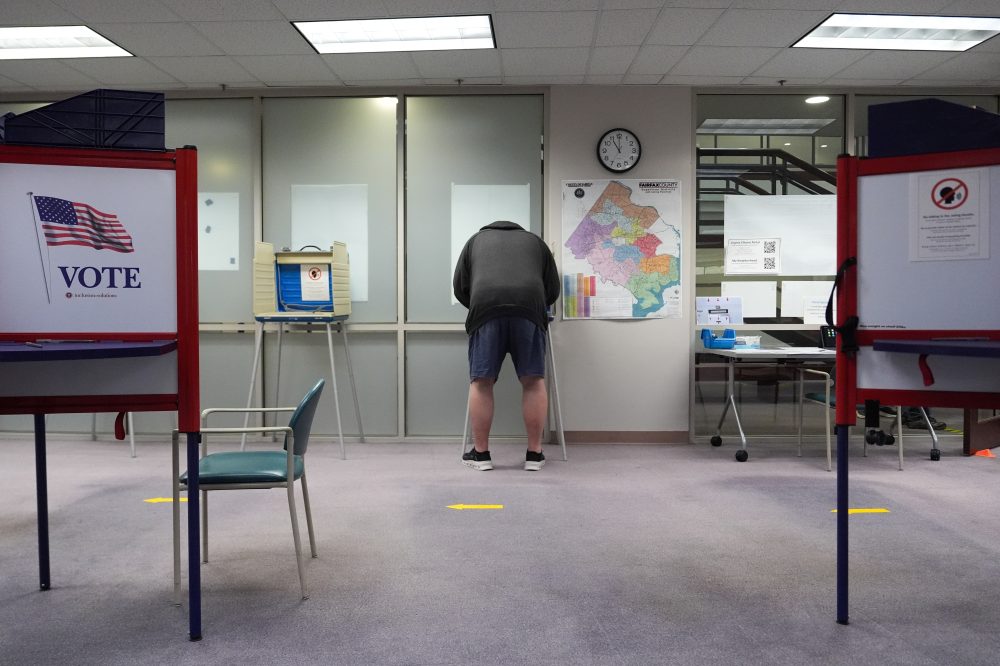

Voters in Virginia headed to the polls Tuesday to weigh in on a contentious redistricting proposal that could significantly improve Democratic prospects for gaining control of the narrowly split U.S. House of Representatives, marking Virginia as the newest battleground in a nationwide fight over congressional maps.
The constitutional amendment, supported by Democratic leaders, would circumvent Virginia’s nonpartisan redistricting commission and implement new congressional boundaries that state legislators approved during this year’s midterm cycle.
This ballot measure evaluates Democrats’ capacity to counter President Donald Trump, who initiated interstate competition over gerrymandering after successfully encouraging Texas Republicans to redraw their congressional maps favorably last year. Virginia represents the second state, following California this past fall, to present this question directly to voters.
The vote also examines voters’ acceptance of politically motivated district boundaries — occurring just six years after Virginians approved changes designed to reduce such partisan manipulation by removing redistricting authority from the legislature.
Should Democrats prevail Tuesday, the public decision may not represent the final outcome. The state Supreme Court is reviewing whether the redistricting proposal violates the law in a case that could nullify the referendum results.
Congressional map redrawing normally occurs once every ten years following each U.S. census. However, Trump encouraged Texas Republicans to redistrict before November elections, hoping to secure several additional seats and preserve the GOP’s slim House majority against political challenges that typically benefit the opposition party during midterm elections.
The Texas strategy sparked redistricting efforts across the nation. Republicans currently believe they can secure up to nine additional House seats through newly drawn districts in Texas, Missouri, North Carolina and Ohio.
Democrats anticipate winning up to five additional seats in California, where voters endorsed mid-decade redistricting last November, plus one more seat through new court-mandated districts in Utah. Democrats aim to close the remaining gap in Virginia, where they dramatically captured 13 state House seats and reclaimed the governor’s mansion last year.
Leadership from both major parties view Tuesday’s election as vital to their prospects for House control this fall. Former Virginia Gov. Glenn Youngkin, a Republican, joined opponents at a Monday night rally, describing the redistricting proposal as “dishonest” and “brazenly deceptive.” House Minority Leader Hakeem Jeffries told reporters at the Capitol earlier that day that approving the redraw “will serve as a check and balance on this out-of-control Trump administration.”
“He said he expected the election to be close,” Jeffries added.
The ongoing congressional district disputes are anticipated to extend to Florida, where the Republican-controlled legislature is set to meet April 28 for a special session that might produce a more advantageous map for Republicans.
Currently in Virginia, Democrats control six of 11 U.S. House seats under districts established by the state Supreme Court in 2021 after a bipartisan commission couldn’t reach agreement on a map using the most recent census information.
The proposed plan could enable Democrats to capture as many as 10 seats. Five would be centered in Democratic-stronghold northern Virginia, including one configured like a lobster that extends into Republican-favoring rural territories.
Changes to four additional districts spanning Richmond, southern Virginia and Hampton Roads would weaken conservative voting strength in those regions. A redesigned district covering portions of western Virginia combines three Democratic-leaning university towns to counterbalance other Republican voters.
The Virginia redistricting proposal is “pushing back against what other states have done in trying to stack the deck for Donald Trump in those congressional elections,” Democratic Gov. Abigail Spanberger stated during an online rally last week.
Television advertisements supporting the “yes to redistricting” campaign and featuring former President Barack Obama have saturated local media.
Opposition groups have circulated campaign literature highlighting previous statements from Obama and Spanberger condemning gerrymandering, though those comments preceded Trump’s push for Republican states to redraw congressional boundaries ahead of this year’s midterms.
Democrats “were all against gerrymandering before they were for it,” Virginia Republican Party Chairman Jeff Ryer stated.
Virginia legislators approved a constitutional amendment permitting their mid-decade redistricting last fall, then passed it again in January as part of a two-phase process requiring an intervening election before an amendment can appear on the ballot.
In February, they approved a new U.S. House map to become effective pending the redistricting referendum outcome. Republicans have filed numerous legal challenges against the initiative.
A Tazewell County judge determined that the redistricting effort was illegal for multiple reasons. Circuit Court Judge Jack Hurley Jr. stated lawmakers failed to follow their own procedures for adding the redistricting amendment to a special session.
He determined that their initial vote failed to occur before the public started casting ballots in last year’s general election and therefore didn’t count toward the two-phase process. He also concluded that the state failed to publish the amendment three months before that election, as legally required.
If the state Supreme Court upholds the lower court ruling, Tuesday’s vote results could become meaningless.