
Violence between Israel and the militant organization Hezbollah escalated Friday as both sides prepare for direct negotiations planned for next week.
Thirteen Lebanese State Security personnel died in an Israeli airstrike in southern Lebanon on Friday, while Hezbollah launched an assault on a naval facility in the Israeli coastal city of Ashdod, located approximately 90 miles from the Lebanese border.
Israeli forces conducted airstrikes on multiple southern Lebanese communities, including a government facility in Nabatieh where the security officials were killed. Hezbollah reported conducting 31 separate attacks against northern Israeli targets and Israeli ground forces operating in southern Lebanon.
The current conflict began when Israel initiated its air campaign and ground offensive in southern Lebanon following Hezbollah’s rocket attacks on northern Israel on March 2, launched in support of Iran, the group’s primary supporter.
Lebanese Health Ministry data shows Israeli strikes have claimed at least 1,888 lives in Lebanon. The deadliest single day occurred Wednesday when 303 people perished in 100 rapid-fire strikes across the country within a 10-minute span, hitting densely populated residential and commercial districts in central Beirut. Emergency crews continue searching for victims buried in debris throughout Lebanon’s capital.
Hospital officials at Beirut’s primary government medical facility on the capital’s southern outskirts worry about potential targeting after Israeli forces issued evacuation orders for nearby suburbs, including the Jnah district where Rafik Hariri University Hospital operates. Israeli attacks have previously struck Jnah, sometimes with advance warning and sometimes without.
The World Health Organization has urged protection for the hospital and advised against evacuation. WHO representatives confirmed Friday they received guarantees the facility would not be targeted. Despite continuing operations, medical staff remain anxious as their commute requires traveling roads that could face strikes at any moment, according to emergency department chief Dr. Mohammad Cheaito.
“The entire zone around the hospital was threatened and deemed dangerous,” he told the AP. “But at the end of the day, we have a humanitarian duty.”
Lebanese officials have not responded to Israeli Prime Minister Benjamin Netanyahu’s Thursday announcement regarding the upcoming negotiations. Netanyahu stated the discussions would focus on dismantling Hezbollah’s military capabilities and establishing “peaceful relations” between the nations.
A Lebanese government source familiar with the situation indicated that ending hostilities remains essential for Lebanon’s participation in direct discussions with Israel, similar to recent U.S.-Iran dialogue. Lebanon has not yet named a negotiation representative, according to the official who requested anonymity due to protocol requirements.
Lebanese President Joseph Aoun had originally suggested direct negotiations early in the conflict under comparable conditions, hoping to prevent Israeli airstrikes from escalating and avoid a ground invasion. That initial proposal, supported only by France, was unsuccessful.
On Wednesday, the United States and Iran declared a temporary halt to fighting that started February 28, covering Lebanon and other nations affected by the broader regional crisis, according to mediator Pakistan. However, Israel and subsequently the United States rejected this announcement, preferring to keep diplomatic efforts for the two conflicts separate.
Hezbollah views Israeli operations in Lebanon as ceasefire violations, while Beirut seeks inclusion in Lebanon-related negotiations as part of efforts to disarm Hezbollah and establish complete national sovereignty.
Hezbollah leader Naim Kassem avoided directly addressing potential Israel-Lebanon talks in Thursday remarks but urged the Lebanese government to “stop giving free concessions” to Israel.
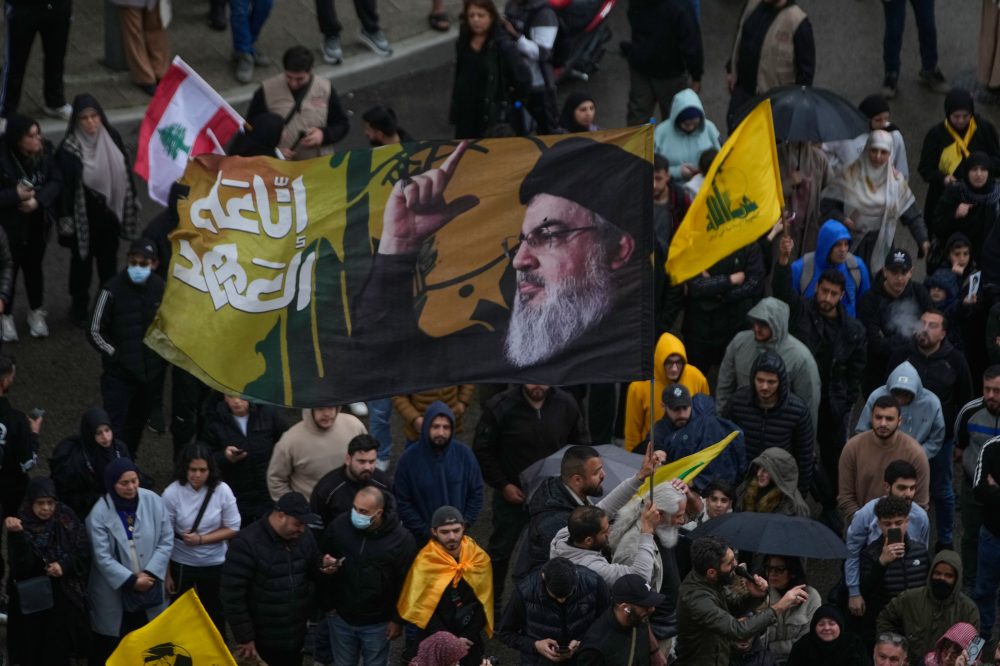
Dozens of supporters of the Iranian-supported organization demonstrated outside the Lebanese prime minister’s Beirut office. The protesters view the planned direct negotiations as capitulation to Israel, which maintains its forces will remain in Lebanon indefinitely.
“Our blood has been spilled on this land, and our state is conspiring against us,” protester Hassan Shuaib said. “Our state wants to kill us; our state wants to strip us of our weapons.”