
HANOI, Vietnam — In a unanimous decision, Vietnam’s National Assembly has selected Communist Party General Secretary To Lam for a five-year presidential term, marking a significant shift in the country’s leadership structure.
This decision breaks with Vietnam’s long-standing practice of distributing power among different officials, instead mirroring the concentrated leadership models seen in China under Xi Jinping and in neighboring Laos.
Political observers had anticipated this outcome following Lam’s reconfirmation as party leader in January, when analysts recognized that his strengthened party position would likely lead to his assumption of presidential duties.
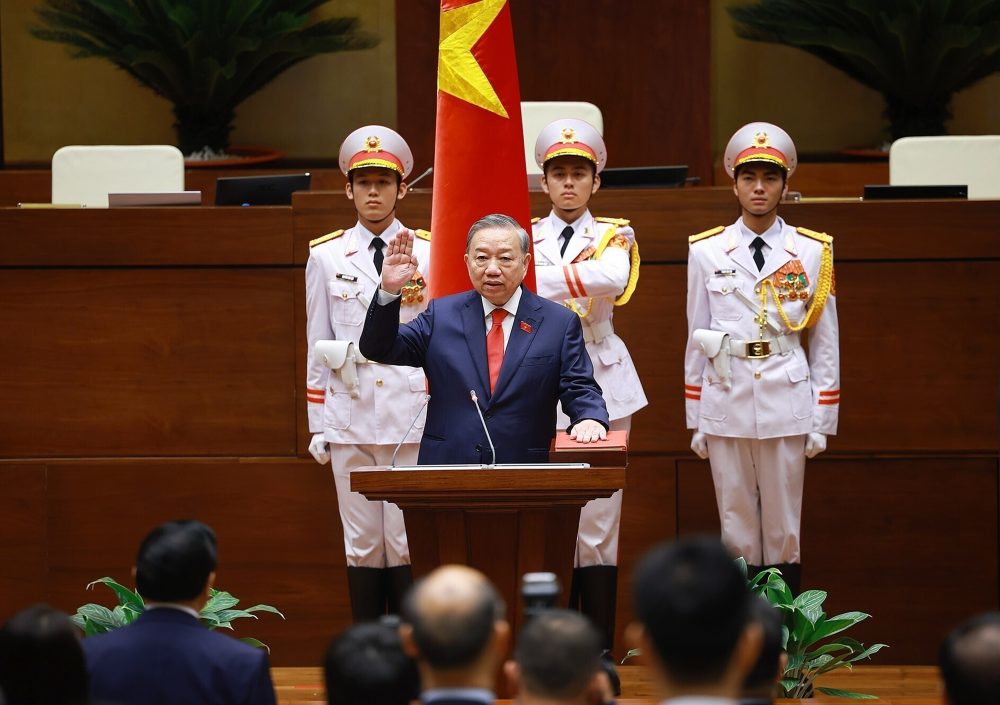
Following his swearing-in ceremony, the 69-year-old leader addressed the National Assembly, emphasizing that maintaining peace and stability would be his primary focus as the foundation for rapid and sustainable economic development. “We aim to improve people’s livelihoods so all can share the benefits of development,” he stated.
This marks Lam’s second period holding dual roles, having previously served in both capacities briefly in 2024 following the death of his predecessor as party chief, Nguyen Phu Trong.
According to Nguyen Khac Giang from Singapore’s ISEAS–Yusof Ishak Institute research center, this power consolidation is particularly noteworthy because it provides Lam with a “stronger mandate and far more political room to push through his agenda than any leaders” since the 1980s, when Vietnam implemented reforms transitioning from a state-controlled economy to a market-based system welcoming foreign investment.
“The opportunity is obvious. Faster decision-making, greater policy coherence, and a better chance of pushing difficult reforms at a pivotal moment. But the risk is that concentration of power can move faster than institutional reform,” Giang explained.
Lam’s ascension represents the culmination of a former police officer’s journey through Vietnam’s security apparatus to the pinnacle of political power. His rise was facilitated by an extensive anti-corruption initiative launched by his predecessor, which he supervised while serving as Minister of Public Security.
In his role as party leader, Lam has spearheaded Vietnam’s most extensive administrative restructuring since the 1980s, eliminating positions, consolidating ministries, reorganizing provincial borders, and promoting significant infrastructure developments.
His agenda emphasizes economic achievement and private sector expansion, seeking to transition Vietnam away from its current labor- and export-dependent framework that has successfully elevated millions from poverty and established a manufacturing-focused middle class. The nation has set ambitious targets of achieving 10% or greater annual economic growth throughout the next five years.
However, significant obstacles persist, particularly the immediate challenge of implementing this bold strategy amid global economic disruption caused by energy market volatility from the conflict in Iran. Vietnam’s economy grew at a 7.8% annualized rate during the first quarter, improving from 7.1% the previous year but falling short of the 9.1% goal and slower than late 2025 performance.
Giang noted that Lam must also navigate political obstacles to secure reform support while preserving Vietnam’s practical foreign policy approach.
Vietnam faces pressure from the United States regarding its trade surplus while simultaneously managing relationships with China, its primary trading partner and competitor in South China Sea territorial disputes.
“It has benefited from a careful balancing strategy in foreign policy, but maintaining that position will become harder in a more turbulent world,” he observed.