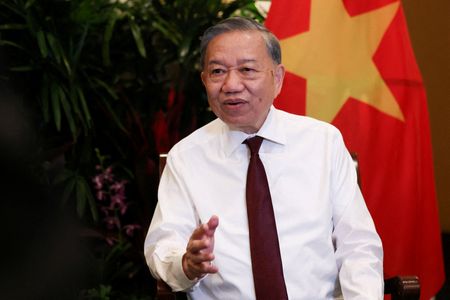

Vietnam’s highest-ranking official believes that strengthening relationships with neighboring China could enhance peace and stability throughout the region, despite ongoing territorial conflicts between the two nations.
Communist Party General Secretary and President To Lam shared this perspective during his inaugural interview with international media in his current position, speaking with Reuters on Friday.
“We do not pick sides,” Lam stated, emphasizing Vietnam’s balanced approach to foreign relations.
The Vietnamese leader explained that pursuing closer ties with China while working to resolve longstanding territorial disagreements in the South China Sea presents no conflict of interest.
“If we can maintain good relations and dialogue, then all disagreements can be resolved,” Lam explained through an interpreter.
“Having good relations with China, safeguarding our sovereignty and settlement of issues in the East Sea are mutually reinforcing, not mutually exclusive,” he added, referencing Vietnam’s terminology for the South China Sea.
Lam restated Vietnam’s established stance of resolving territorial disputes through international law, specifically citing the United Nations Convention on the Law of the Sea.
The territorial tensions between China and Vietnam are significant, with Vietnam claiming the Chinese-controlled Paracel islands and the complete Spratlys archipelago located further south. The Philippines, Malaysia, Brunei and Taiwan also have competing claims over this crucial shipping corridor, where military presence continues to expand, making it an increasingly volatile regional hotspot.
These comments come as Lam works quickly to elevate Vietnam’s international standing, seeking to strengthen relationships with China, the United States and other major nations while pursuing an aggressive economic growth strategy.
Lam characterized the rivalry between the United States and China as an “objective reality.”
“We do not approach our relations with major powers through the prism of security,” he noted, demonstrating Vietnam’s traditional flexible diplomatic approach known as “bamboo diplomacy.”
“We need good relations with major countries so that we can jointly address essential, important issues.”
Now serving in both the party leadership and presidential roles, Lam has become Vietnam’s most influential leader in recent decades, with his dual position enabling him to take a more active diplomatic role.
International diplomatic observers are carefully monitoring his leadership style as he develops a more assertive and adaptable stance for a country previously viewed as diplomatically reserved and careful due to its shared leadership structure.
Some experts have observed that concentrating power in a single individual could push the one-party system toward increased authoritarianism, while simultaneously allowing for quicker policy decisions.
Described as soft-spoken yet decisive, the 68-year-old Lam rose through Vietnam’s domestic security organization, an influential but discrete agency not typically associated with producing diplomatic leaders.
Lam’s Reuters interview occurred following his keynote address on Friday evening at Asia’s premier defense conference, the Shangri-La Dialogue in Singapore — marking the first time a Vietnamese party leader has delivered such a speech.
Speaking to an audience of international defense officials, military personnel, intelligence officers and scholars, Lam identified global challenges including weakening international rules and law, developmental crises involving reduced growth and climate change, and deteriorating trust between nations.
“The three crises confronting our world today are not inevitable realities that we are bound to accept,” Lam declared.
He advocated for strengthening international law, establishing inclusive and sustainable economic drivers, and promoting dialogue and openness.
During the post-speech interview in a hotel meeting room, wearing casual attire with a burgundy tie, Lam acknowledged to Reuters that his administration’s growth objectives were “ambitious and highly challenging” but expressed determination to reach them.
Vietnam aims to achieve developed, high-income nation status by 2045, targeting 10% GDP growth this year and continued double-digit increases in coming years, powered by advances in science, technology and digital innovation.
When questioned about whether the Iran crisis and other global challenges might require adjusting these targets, Lam maintained the core goals remained “within reach.”
“Our answer is clear: we will not adjust this objective downward.
“We believe there is no alternative path. If we fail to achieve this target, we will fall short of the broader development aspirations we have set for our country,” he concluded.