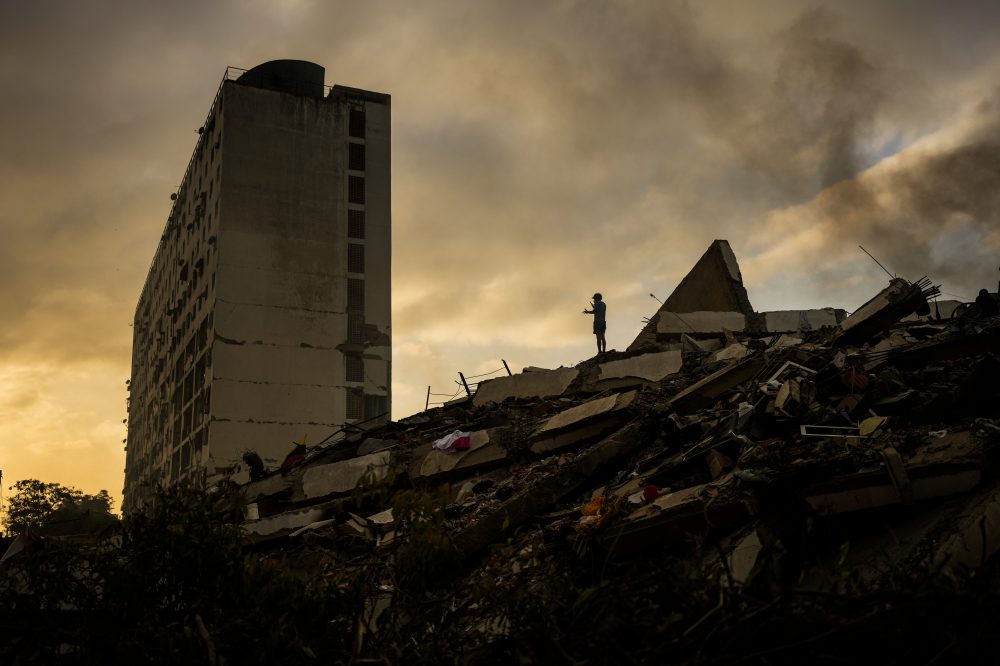

CARACAS, Venezuela — With public criticism growing over how Venezuela has handled its earthquake disaster, acting President Delcy Rodríguez stepped before cameras for the first time to defend her government’s response — all as her 180-day term as interim leader came to an end on Friday.
The two powerful earthquakes struck the northern state of La Guaira on June 24, claiming more than 2,295 lives according to the latest official figures. A separate, non-governmental digital database continues to show more than 38,000 individuals as unaccounted for.
Rodríguez, who previously served as deputy to former President Nicolás Maduro before his January capture by the Trump administration, waited more than an hour after the quakes hit before making any public statement. She then held her first formal news conference addressing the government’s response late Thursday — a full eight days after the disaster struck.
Rescue organizations generally race to find survivors within the first three days following a major natural disaster, as the chances of finding people alive drop sharply with each passing hour. Despite that, weary rescue workers were still digging through devastated neighborhoods in La Guaira on Friday, spurred on by a dramatic rescue the day before — a 43-year-old security guard pulled alive from the basement of a collapsed shopping mall after spending nearly eight days buried in the rubble.
Even as some international rescue teams began packing up and heading home, Rodríguez insisted Thursday night that the government had no plans to scale back its search efforts.
“We have not closed the search-and-rescue phase. We are still in that stage because, according to our overall assessment, there are still active sites where we believe there may be survivors, even if there is only one,” she told reporters during a combative press conference — her first public pushback against criticism of the state’s response since the earthquakes hit.
Rodríguez attributed the public anger over the government’s handling of the crisis to what she described as “narratives manufactured in propaganda laboratories.” She maintained that rescue crews were dispatched immediately with proper equipment — a claim that contradicts widespread accounts from residents who said they were left on their own to search for missing family members, without any official teams or heavy machinery, for the first 48 hours.
“Those propaganda operations, driven by partisan political interests, are despicable,” she said. “We did not wait one day, two days or three days. We activated immediately.”
She also announced that 11 international field hospitals had been set up in quake-affected areas, with medical personnel from 33 countries on the ground. Additionally, she said the government had approved the creation of a fund to collect donations for reconstruction efforts.
The United Nations Development Program has estimated that the earthquakes caused approximately $6.7 billion in physical damage across Venezuela — equivalent to roughly 6% of the country’s gross domestic product — and that figure does not include longer-term recovery and rebuilding costs.
Rodríguez became interim leader with the backing of the Trump administration following Maduro’s removal from power. Her comments appeared designed to project an image of a government firmly in control of the crisis. In recent months, she has pushed through business-friendly changes to Venezuela’s oil industry under U.S. pressure, though she has shown little movement toward restoring democratic governance.
Venezuela’s constitution allows the vice president to fill in during a leader’s temporary absence for up to 90 days. That period can then be extended by the national assembly for another 90 days — bringing the total to 180 days, which expired Friday.
As of Friday, no officials had commented on what steps, if any, would follow the expiration of Rodríguez’s mandate. The National Assembly, which is controlled by Rodríguez’s party, has the authority to call a snap election if lawmakers formally declare the presidency permanently vacant.
No timeline has been set for democratic elections in Venezuela. Before the earthquake, the Trump administration had indicated a vote would happen once the country and its economy were stabilized.
Maduro had claimed victory in a 2024 election from which opposition leader and Nobel Peace Prize winner María Corina Machado was barred from running. An independently verified vote tally conducted by the opposition concluded that Machado’s chosen candidate had actually won.
Machado has said she intends to return from exile to assist with earthquake recovery efforts. Earlier this week, she accused Rodríguez’s government of closing Venezuelan airspace ahead of her scheduled flight in order to prevent her from returning. The Trump administration has repeatedly praised Rodríguez’s earthquake response and has largely distanced itself from Machado.