
CARACAS, Venezuela — The Quintero family found themselves gathered around an unlikely new home this week after two deadly earthquakes forced them out of their apartment building in Caracas.
Francisco Quintero gave up the seats of his small, worn-down car to his children. The trunk became the new living space for Paquito, the family’s green-and-red parakeet, along with a few pet turtles.
Quintero, who works as a musician, said he and the other adults in his family spend each night searching for somewhere to sleep near the vehicle “until we get an answer about what they might do with us.”
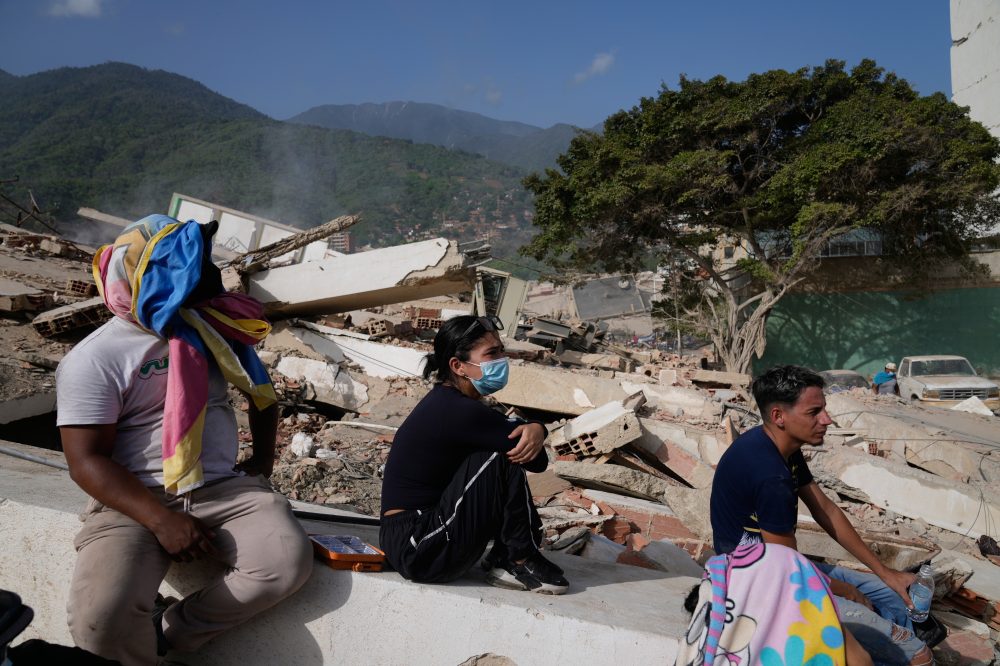
Two earthquakes — measuring 7.2 and 7.5 in magnitude — struck Venezuela on Wednesday evening just 39 seconds apart, toppling buildings in Caracas and surrounding areas and damaging hundreds of homes. The confirmed death toll, already in the hundreds, is expected to climb as search-and-rescue teams continue their desperate work.
Thousands of people left without a place to live have flooded into parks, public plazas, and even the sides of blocked highways in search of somewhere to sleep. The disaster is the latest hardship for a country of roughly 30 million people that has endured decades of economic hardship. More than half the population lives in extreme poverty, and nearly 8 million people were already in need of humanitarian assistance before the quakes hit.
In Guaira — the hardest-hit state, located just north of Caracas — families spread sheets across a dusty baseball field to stake out their spots, their belongings crammed into plastic bags. Others took shelter beneath palm trees. Among them was 35-year-old Alexandra Martínez, who was there with her two children.
“The apartment is completely wrecked,” she said, wiping tears from her face. “The walls, the kitchen, everything, are destroyed. It split right down the middle.”
The same heartbreaking scenes unfolded throughout Caracas.
“We have nowhere to live,” said Desiré Gil. “This is the only option we have for the moment.”
The 37-year-old mother of four, including one daughter who is six months pregnant, is now living with her family on a small grassy plaza. Nearby, people used backpacks as makeshift pillows and propped up colorful beach umbrellas for shade as helicopters circled overhead.
Gil’s home did not collapse, but parts of it are crumbling, and she refuses to return. “Our fear is that the building might collapse on top of us,” she said.
Like many displaced residents, she is waiting for Venezuela’s civil protection agency to assess cracked and deteriorating buildings and determine whether they are safe to inhabit.
But it remains unclear when those inspections will begin. The government is still focused on saving lives, with thousands of people believed missing across Venezuela’s northern region. The quakes killed at least 920 people and left more than 3,300 others injured.
Gil, who earns a living selling mangos and other goods, said her pregnant daughter experienced contractions and went to the hospital Thursday, only to be turned away. Part of the maternity ward had collapsed, and the facility was already overwhelmed with patients transferred from other institutions.
The Ministry of Education announced that some school buildings would be opened as shelters, though the exact number was not specified. In the meantime, Gil said her family plans to remain on the grassy plaza “until the government gives us an answer.”
Experts say the widespread building damage comes as no surprise.
José Rangel, a civil engineer and university professor, pointed out that more than 50% of Caracas was constructed before 1982 — the year the government adopted an updated construction code for earthquake-prone areas.
“Everything that we’ve built before that year is seismically vulnerable,” he told the state television station Venezolana de Televisión.
Rangel said he and fellow engineers had already been working on seismic retrofitting plans and prioritizing evaluations of schools, hospitals, bridges, and other critical infrastructure before the earthquakes occurred.
He urged the government to rebuild using stronger standards and to implement existing safety recommendations, cautioning that assessing the buildings could take weeks.
“It’s a process that lies ahead,” Rangel said. “Right now, the most important issue is rescuing people.”
He also called on engineers, architects, and other professionals to take part in upcoming inspection efforts. “The causes of the collapse must be determined,” he said. “It’s how we learn lessons after an earthquake.”
Magaly Noguera and her family are among those waiting for an inspection. They live in a high-rise that sustained damage. Noguera recalled how she, her son, his wife, and their 3-year-old child huddled together under a kitchen door frame before making their way downstairs to safety.
“That day, the descent seemed endless to me,” she said. “I don’t want to be in my house.”
Her family now sleeps outside near a government building, surrounded by others facing the same uncertain situation.
Across the street, a man carried a mattress over his left shoulder while his partner tucked several pillows under her right arm. A small child walked between them as the family made their way to an unknown destination.