
A Trump administration advisory panel is recommending that the United States move away from the concept of separating church and state — and toward building what the commission calls “bridges” between them.
The proposal, which challenges a deeply rooted principle in American law, is among dozens of recommendations contained in a 224-page draft report released Friday by the Religious Liberty Commission.
President Donald Trump established the commission last year, and its membership consists almost entirely of conservative Christians. The document functions both as a policy proposal and a philosophical argument, reflecting members’ belief that religion and religious expression should play a stronger role in government, schools, and public life.
The report praises recent Supreme Court rulings that have expanded religious expression in public settings — including decisions that allow parents to opt their children out of school lessons based on religious objections.
Among its specific recommendations, the report calls for eliminating the “Johnson Amendment,” which currently prohibits tax-exempt religious organizations from engaging in political activities. Removing that restriction has been a long-held goal of Trump. The report also recommends that military service members who were discharged for refusing COVID-19 vaccines receive financial compensation.
More broadly, the commission is calling for greater religious expression in public spaces, expanded access to public funding for faith-based organizations, and wider exemptions for people who cite conscientious objections to policies — including vaccine requirements, pronoun usage, and certain classroom content.
The report also recommends that federal agencies post “Know Your Rights” materials in various settings and set up hotlines where people can report violations of religious liberty.
Additional proposals include creating new honors — a Presidential Medal of Religious Liberty and First Freedom Hero Awards — as well as exhibits and historical markers at significant sites highlighting religion’s role in American history.
The draft is now open for public comment over the next 15 days and is widely expected to draw strong opposition.
A coalition of organizations — including one that has filed a lawsuit over the commission’s alleged lack of ideological diversity, as required of federal advisory panels — released a preemptive report earlier in June defending church-state separation.
“Religious liberty belongs to all people, not to any single tradition, political party, or administration,” stated that report, published by the Center for American Progress and other groups.
Critics argue the commission’s viewpoint is skewed toward perspectives favored by Trump and his supporters, and that it heard almost exclusively from scholars and activists who share those views. They also say the commission gave inadequate attention to issues such as anti-Muslim efforts in Texas and other states, as well as the rise of antisemitism on the political right, not just the left.
The report arrives as several conservative-led states, including Texas, have moved to bring more religion into public institutions like classrooms — through measures such as Bible lessons and displays of the Ten Commandments.
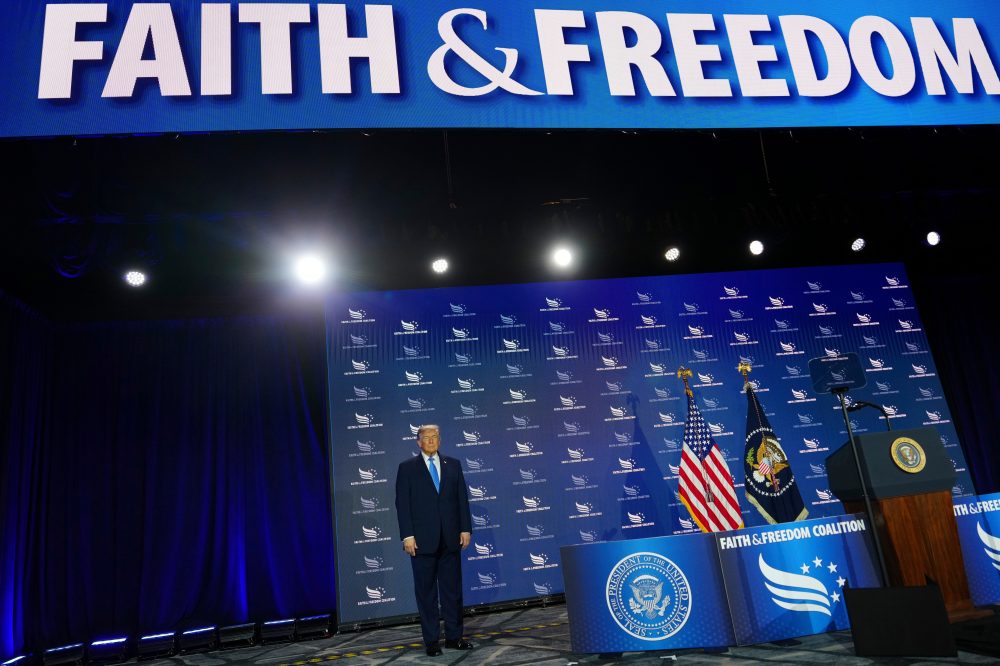
Speaking Friday to supporters at a Faith & Freedom Coalition event in Washington, Trump promoted the newly released document.
“We saved religion, it was going down,” he told the crowd.
Trump also claimed that his predecessor, Democrat Joe Biden, had carried out a “reign of persecution” against religious Americans.
While the commission’s report steps back from the idea of church-state separation, it stopped short of calling that concept a “lie” — a characterization the commission’s chairman, Texas Lt. Gov. Dan Patrick, made in April. Instead, the report largely argues that the idea has been misapplied over time.
“To be clear, this does not involve or require advocating ‘theocracy’ or even the total elimination of any separation between church and state,” the report states. It instead calls for respecting a “tension between the relevant clauses of the First Amendment” — clauses that both protect religious freedom and prohibit the government from establishing an official church.
The phrase “a wall of separation between church and state” does not appear in the U.S. Constitution, though it has been embedded in Supreme Court precedent. Thomas Jefferson coined the expression in a letter to a Baptist congregation, expressing support for their opposition to government-sponsored churches — a practice that soon disappeared from American life.
During the 20th century, the Supreme Court used the “separation” concept to apply the First Amendment’s restrictions on establishing a national church to state and local governments as well, drawing on the 14th Amendment’s protections of citizens’ rights. That legal framework led to rulings banning official prayers and Ten Commandments displays in public schools. In recent years, however, the Court has shifted direction — allowing things like a public school coach praying on the field after games and permitting parents to remove their children from a lesson on transgender issues for religious reasons.
The draft report argues that even Jefferson did not intend to completely remove religion from public life, but rather sought a kind of balance between church and state.
“In reality, the church and state strengthen and support one another,” the report asserts.
The document highlights religion’s contributions to society, including humanitarian work, family stability, and serving as a moral check on government.
“In many cases the law protects the religious expression of Americans, but government officials and employers often use fear tactics to silence individuals into believing that they don’t have the right to publicly express their faith,” the report argues.
The report also draws on the views of one of its own members — a Catholic media figure and bishop — to argue that the idea of strict church-state separation can be traced to a European “God is dead” ideology that viewed traditional religion as a threat to individual freedom. “This way of thinking made its way … into the American culture and courtroom,” the report states.
Notably, the report gives little attention to the significant portion of Americans who have no religious affiliation. Many atheists and secular humanists argue that people can live ethically without religious belief, and that religion does not hold exclusive claim to virtue.
A lawsuit filed against the commission by the Interfaith Alliance and other religious organizations contends that the panel lacks ideological balance, pointing to the fact that commissioners have described the United States as specifically a Judeo-Christian or Christian nation, and that most of the commission’s meetings were held at the Museum of the Bible in Washington — an institution with Christian leadership.
The Trump administration is seeking to have the lawsuit dismissed, arguing on legal grounds that the law does not specify how a commission must be balanced or which viewpoints must be represented.
This latest draft report follows another document released two months ago by the Task Force to Eradicate Anti-Christian Bias — a separate body also created by Trump. That report claimed Christians faced discrimination under the Biden administration in areas including education, tax law, and the prosecution of anti-abortion demonstrators. Progressive critics argued that report failed to substantiate its claims and read more like advocacy than a genuine investigation.