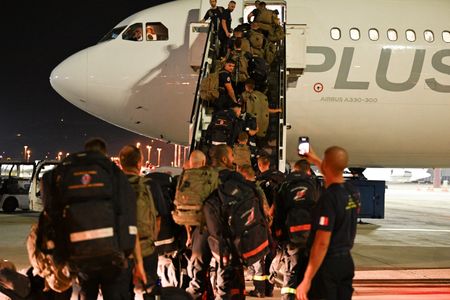

Venezuela’s government announced Saturday that 1,600 rescue personnel from foreign nations have arrived to assist in the search for survivors following two devastating earthquakes that claimed more than 900 lives earlier this week. At the same time, officials moved to restrict access to the most severely damaged parts of the country.
La Guaira, a well-known beach destination where at least 100 structures — including numerous residential high-rise buildings — were either destroyed or heavily damaged, has been at the center of the crisis. For days, local residents and volunteers there have complained about a lack of heavy machinery and an insufficient official response.
In an overnight address broadcast on state television, Venezuela’s interim President Delcy Rodriguez announced that 10 additional countries were still preparing to join the rescue mission. She also said 14,000 military and police personnel had been deployed to La Guaira to maintain order and carry out sanitary measures.
Foreign ministry official Oliver Blanco shared details of the international response early Saturday morning on X. “In recent hours, Venezuela has received 17 flights carrying more than 1,600 members of rescue teams, and over the next 24 hours, the arrival of 25 additional flights is expected,” Blanco stated. He added, “We thank the international community for its support and solidarity during these moments of uncertainty for Venezuelans.”
Rescue teams have been fanning out across La Guaira state and the capital city of Caracas. However, as of Friday, some areas were still largely without any official assistance, leaving families and neighbors to search through rubble on their own — in some cases using nothing but their bare hands — hoping to find missing loved ones.
On Friday evening, authorities shut down the main road connecting La Guaira and Caracas, citing heavy civilian traffic that was slowing emergency vehicles and official rescue crews. As of Saturday morning, anyone without an official credential was being turned away at police checkpoints. Reuters journalists reported being blocked from using the main road, while a secondary older route was severely congested.
The government had previously expressed gratitude to civilians who delivered supplies — often by motorcycle — to people in desperate need. Venezuelan state television aired footage showing thousands of pairs of shoes, clothing items, and other donated goods being gathered by authorities.
Power remained completely out near the earthquakes’ epicenter in Moron and throughout La Guaira as of Friday, though Rodriguez said electricity had been restored to about 60% of other affected areas. Venezuela’s electrical grid has long struggled due to years of underinvestment and economic sanctions, resulting in regular multi-hour blackouts across various regions.
While the government has acknowledged that hundreds of people are missing or trapped, an opposition-run website lists more than 54,000 individuals as unaccounted for. The U.S. Geological Survey has estimated that the magnitude 7.2 and 7.5 earthquakes could ultimately result in more than 10,000 deaths — a toll that would rank them among the deadliest earthquakes in Latin America over the past century.
The United Nations estimated that nearly 7 million people could be affected by the disaster, with direct damage projected at approximately $6.7 billion.
The catastrophe may also carry political implications for Rodriguez, who has sought to position herself as a reformer despite having served as vice president under Nicolas Maduro, who was removed from power and taken into U.S. custody in January. On Friday, Rodriguez spoke by phone with President Donald Trump and Secretary of State Marco Rubio, following a meeting with the U.S. military’s Northern Command and disaster relief specialists.
The United States announced it was releasing $150 million in humanitarian aid, easing certain sanctions, and deploying two naval vessels, with helicopters and aircraft also committed to supporting rescue operations.
Among the international teams on the ground in La Guaira is a group from El Salvador. That country’s president, Nayib Bukele, has been posting updates on X celebrating successful rescues, including the recovery of a 15-year-old girl.
Reuters journalists on the scene also reported instances of looting at multiple locations throughout La Guaira.
Venezuela’s Oil Minister Paula Henao said Friday that the country’s oil production was not disrupted by the earthquakes and that fuel distribution would continue without interruption. Executives and workers in the oil sector confirmed that critical infrastructure had largely been spared from major damage.