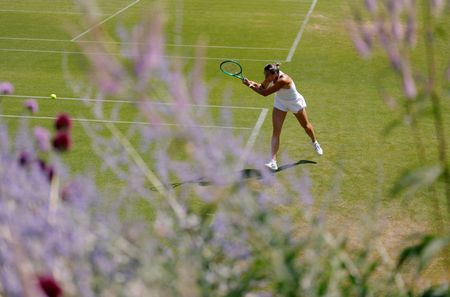

Top-ranked tennis player Aryna Sabalenka is standing behind a prize money protest at Wimbledon, even after the prestigious grass court Grand Slam announced the biggest increase in its payout history — a 20% boost this year.
Sabalenka, the world number one, is part of a group represented by former WTA chief executive Larry Scott. The group is pushing for a greater percentage of Grand Slam revenue to go toward players, along with better player welfare conditions.
Wimbledon’s prize pool this year stands at £64.2 million, which amounts to roughly 15% of the tournament’s total revenue. Players had been seeking 16% — approximately £70 million — leaving a gap between what was offered and what was requested.
Just as she did at the French Open, where Sabalenka and fellow players scaled back their pre-tournament media commitments in protest, the Belarusian held a shortened press conference at Wimbledon.
“It’s a great start they raise the prize money. It’s an amazing start. If you look over the last 10 years, if you compare the prize money to 2016, it’s kind of like the same (as a percentage) because it went down,” she told reporters.
“I really hope we can finally get to the table and really get it done, come to a conclusion that everyone’s going to be happy with. Hopefully we’ll never have to do it again,” she added.
Should Sabalenka win her first Wimbledon title, she would take home £3.6 million — an increase from the £3 million awarded to the 2025 champions Iga Swiatek and Jannik Sinner. Players eliminated in the first round will now receive £80,000, up from £66,000.
When asked whether wealthy top players making such demands might seem tone-deaf to a public already dealing with rising costs for tickets and food, the four-time Grand Slam singles champion pushed back.
“We do it for the tour, we don’t do it for ourselves,” she said. “We do it for the rest of the players who are suffering to even hire a coach. It’s not an easy life for lower-ranked players.”
“I’m more than sure the crowd understand. I mean, we’re playing matches, we’re there, we’re competing, we’re bringing the show. Now we are just limiting our media. We’re just trying to get to something that everyone is happy with,” Sabalenka continued.
The All England Club responded to the protest this week, saying it was “surprised and disappointed” by the action and noting that a proposed player council it offered as a way to work through concerns had been turned down by the players.
“This year’s total prize money is the largest increase in our event’s history. This is alongside investing hundreds of millions of pounds in upgrades to our player facilities as part of a three-year transformation to create a world class player performance environment,” the club said in a statement.
Sabalenka, 28, arrives at Wimbledon having struggled late in the French Open, where she collapsed and lost the final 10 games of her quarter-final match against Russian player Diana Shnaider. She said she has worked through that difficult experience with the support of her psychologist.
“Overall I feel like things are clicking back together,” she said.