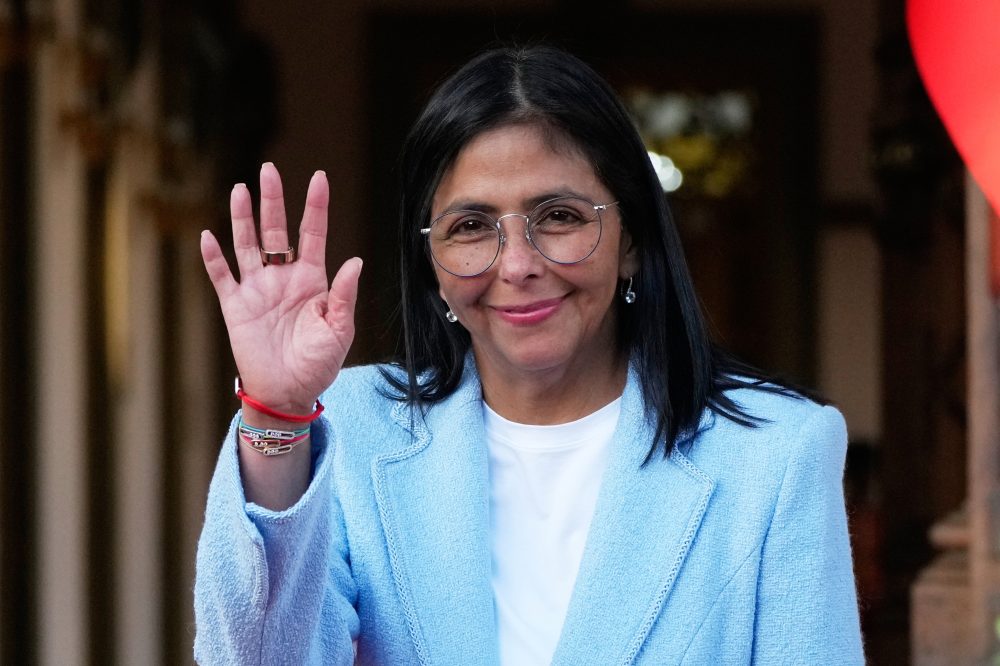

CARACAS, Venezuela — President Donald Trump has floated the idea of making Venezuela America’s 51st state on two occasions this week. His most recent suggestion appeared Tuesday on Truth Social, featuring a map that depicted the South American nation covered with the American flag.
In years past, when U.S. officials questioned Venezuela’s sovereignty over the last quarter-century, top government leaders including the president would respond with immediate scorn. The ruling party even staged rallies in Caracas as recently as January 3, just hours after then-President Nicolás Maduro was taken into U.S. custody, featuring crowds shouting “Gringo go home.” This time, however, Venezuelan leadership has remained largely silent, except for brief remarks made to the press Monday by acting President Delcy Rodríguez.
This restrained response highlights the delicate balancing act Rodríguez faces in managing foreign relations and domestic concerns after the January U.S. military operation in Caracas. The Trump administration has rolled out a step-by-step strategy aimed at rehabilitating the crisis-stricken nation and has compelled Rodríguez’s political faction, Chavismo, to set aside the anti-American rhetoric that has traditionally defined its ideology.
“This is probably the most public and sharp manifestation of the government’s transactional, self-survival approach above everything else right now, above even that sort of basic tenet of Chavismo,” said Christopher Sabatini, senior fellow for Latin America at the London-based Chatham House think tank. “It’s better that they hold their tongue, not offend the U.S. right now. Why overreact to a ridiculous claim by Donald Trump?”
When speaking to reporters Monday, Rodríguez stated that Venezuela had no intention of becoming America’s 51st state, though her remarks were far more measured than previous presidential speeches that condemned such U.S. statements. Her comments followed Trump’s declaration that he was “seriously considering” the proposal. Trump has made comparable statements regarding Canada.
“We will continue to defend our integrity, our sovereignty, our independence, our history,” Rodríguez said. Venezuela, she emphasized, is “not a colony, but a free country.”
The Trump administration surprised Venezuelans by choosing to collaborate with Rodríguez rather than the nation’s political opposition after Maduro’s removal. She has since spearheaded cooperation with the administration’s gradual plan, promoting her petroleum-rich country to global investors and opening its energy industry to private investment and international arbitration. Rodríguez has also dismissed key officials, including Maduro’s loyal defense minister and attorney general.
Trump has commended her efforts, and his administration has removed economic sanctions targeting her personally while relaxing sanctions on the country, though some restrictions continue. The U.S. now acknowledges her as the “sole” leader of Venezuela.
The U.S. ceased recognizing Maduro as Venezuela’s rightful leader in 2019, one year after he declared electoral victory in a race widely deemed fraudulent as opposition parties and candidates were prohibited from participating.
Maduro and his wife, Cilia Flores, were transported to New York to face drug trafficking charges following their January 3 arrest. Both have entered not guilty pleas and remain detained at a Brooklyn facility.
In Caracas, some citizens on Wednesday interpreted the government’s response as yielding to Trump, though they also recognized that Rodríguez lacks the position to deploy Chavismo’s typical anti-American messaging.
“She knows that it’s wise not to engage in direct confrontation because she knows she’s bound to lose,” college student Adonai Osoria said. “Now, are there some who disagree, who don’t like it? Well, yes, of course. But I consider her reaction right now to be a common, understandable reaction.”
Government backers last displayed their hostile stance toward the U.S. in the period following Maduro’s capture, setting American flags ablaze and holding signs declaring “Gringo go home.”
Among the government’s most devoted supporters nationwide are the armed factions called colectivos. These groups are fixtures at pro-ruling party rallies. Local leader Jorge Navas described Trump’s remarks as “irresponsible acts of provocation” and commended Rodríguez for her diplomatic handling.
“We are bending, strategically, but we will not break,” Navas said of Chavismo’s current stance toward U.S. pressure. “We continue to resist, that is, realistically, given the country’s economic situation.”