
WASHINGTON – Venezuela became an unexpected source of investor enthusiasm during last week’s International Monetary Fund and World Bank meetings, despite the South American nation facing Western sanctions and carrying enormous debt burdens, according to financial professionals and government officials.
Discussions about potential economic recovery for the former Socialist nation, whose previous President Nicolas Maduro was imprisoned in New York this past January, took center stage in private conversations throughout the Washington gatherings, meeting participants reported.
“The permafrost is melting. And that is why investors are optimistic,” explained Rodrigo Olivares-Caminal, a Queen Mary University professor who provides debt advisory services to governments and participated in the Spring Meetings.
While Venezuela wasn’t featured on any official meeting schedules beforehand, no fewer than six major financial institutions and organizations conducted well-attended investor briefings in the nation’s capital, including presentations by Bank of America, Barclays, JPMorgan and Morgan Stanley, according to three attendees and meeting schedules reviewed by news sources.
In a significant development Thursday evening, both the IMF and World Bank announced they had reestablished relations with Caracas for the first time since 2019 – marking a crucial move toward international re-engagement that could unlock approximately $5 billion in IMF special drawing rights, which serve as reserve assets distributed by the Fund.
MIDDLE EASTERN CONFLICT CAST SHADOW OVER DISCUSSIONS
During other portions of last week’s Spring Meetings at the institutions’ Pennsylvania Avenue headquarters, declining economic projections took precedence in conversations, as international financial leadership reluctantly calculated the economic impact of Middle Eastern warfare.
A significant portion of these costs stems from rising global oil prices that will fuel worldwide inflation.
For Venezuela, which possesses the world’s largest confirmed oil reserves, elevated oil prices mean additional revenue that could assist in rebuilding infrastructure following years of insufficient investment.
Last week’s most significant excitement, however, centered on Venezuela’s defaulted debt obligations.
Six meeting participants who provided information, including bondholders and legal representatives, expressed hopes that improved U.S. relations would facilitate sovereign debt restructuring, potentially returning at least partial investments to creditors. Such an achievement would rank among history’s largest restructuring efforts.
Venezuela and its state petroleum company PDVSA hold approximately $60 billion in outstanding defaulted bonds, though total external debt anticipated for restructuring reaches roughly $150-$170 billion when including additional energy company obligations, bilateral loans and arbitration settlements.
The defaulted bonds have experienced significant gains since U.S. President Donald Trump returned to office early last year.
This development had encouraged speculation about government change even before the January U.S. military action that resulted in Maduro’s capture.
Subsequently, strengthened relationships between Trump’s administration and interim Venezuelan President Delcy Rodriguez have boosted market confidence, pushing certain bond prices to approximately decade-high levels.
“I gave three different talks. All three were packed,” stated Juan S. Gonzalez, a Georgetown Americas Institute resident fellow who previously served as Deputy Assistant Secretary of State for the Western Hemisphere during 2016 and 2017.
Gonzalez presented at Bank of America, JPMorgan and Eurasia Group events; a separate Morgan Stanley panel addressing debt restructuring that included Venezuela discussion also drew crowds of interested investors, three sources confirmed.
A Barclays roundtable agenda reviewed by reporters included advisers to opposition leader Maria Corina Machado, who indicated she anticipates returning to Venezuela before 2026 ends and advocates for prompt elections.
ESTABLISHING FOUNDATIONS
Although markets anticipated the Fund’s acknowledgment, it enhanced positive sentiment because it should enable technical assistance and Article IV surveillance, which represents the Fund’s comprehensive economic analysis covering a nation’s financial condition, advantages and weaknesses.
Future IMF economic evaluations can also establish sustainable debt levels.
“Rejoining the IMF and getting access to the SDRs allows Delcy Rodriguez to lay the groundwork for debt restructuring,” Gonzalez explained.
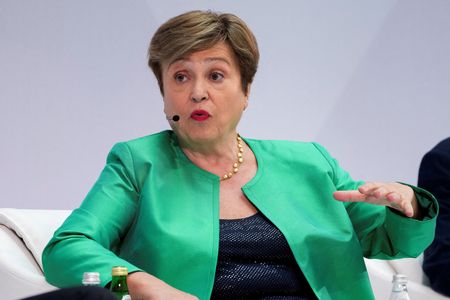
IMF Director Kristalina Georgieva indicated Friday that the Fund would likely offer Caracas a financial support program as part of renewed engagement, though she noted it represents “a very tough road” toward restoring macroeconomic and financial stability.
Some market observers maintain equal caution. JPMorgan analysts noted that while arguments exist for Caracas pursuing rapid international bond restructuring, limited evidence suggests this is occurring.
“While the bonded debt is the largest and most well-defined claim, we do not yet have any sense a narrow restructuring of bonded claims would move forward quickly and separately from a more comprehensive restructuring,” JPMorgan analysts stated.