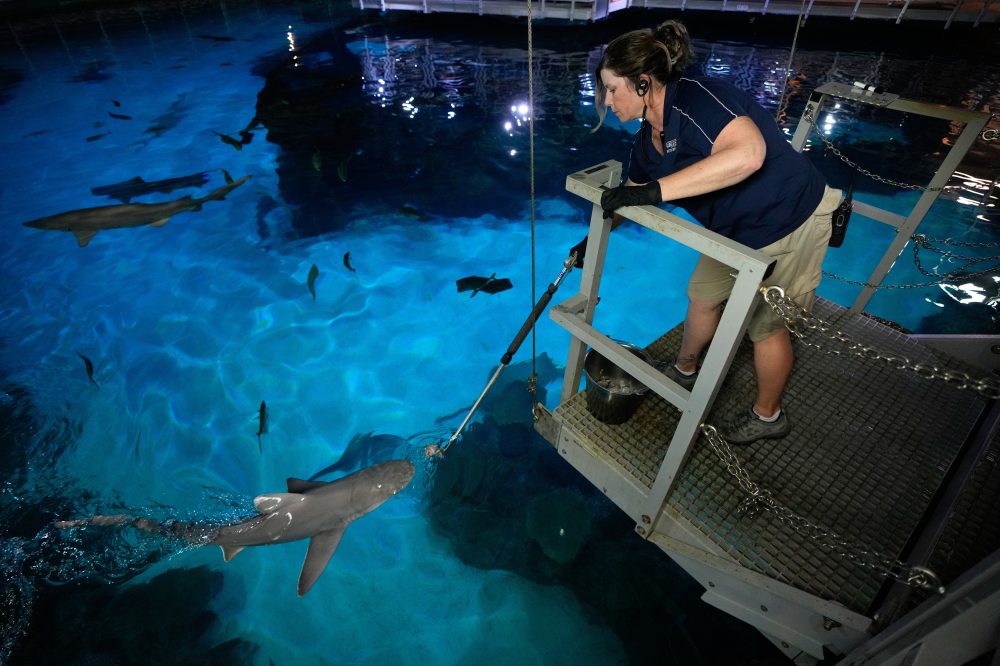

LAS VEGAS — At the Mandalay Bay Resort’s massive aquarium, lead aquarist Becky O’Brien holds herring above a tank filled with more than a dozen sharks, watching as a zebra shark quickly grabs the fish from her feeding tongs within moments.
O’Brien never imagined she’d become a shark nutritionist at a Las Vegas casino when she dreamed of working with ocean animals. Now she and her team provide meals for 15 different shark species three times weekly at the Shark Reef Aquarium, caring for more than 3,400 creatures in the resort’s centerpiece attraction.
“They eat, I would say, better than the tourists on the Strip,” O’Brien commented, comparing the sharks’ diet to the upscale dining options available throughout Las Vegas’ primary entertainment district.
Since opening its doors in 2000, the aquarium has become a premier destination, attracting more than 21 million guests to the resort and casino, Mandalay Bay reports.
According to Samantha Leigh, a California State University, Dominguez Hills professor specializing in marine animal nutrition, sharks require diets rich in proteins and fats to support their fatty livers, which enable them to control their depth in water.
Wild sharks consume an incredibly varied range of food sources throughout ocean ecosystems, from tiny zooplankton to large seals and even fellow sharks, Leigh explained. Captive sharks typically receive high-quality seafood comparable to what’s served in fine restaurants.
O’Brien’s team provides the Mandalay Bay sharks with a diverse menu including mackerel, herring, blue runner, and sardines to replicate the variety they would encounter in natural habitats. The fish comes from both wild-caught sources and environmentally responsible fisheries.
Weekly fish consumption at the facility exceeds 300 pounds, O’Brien noted.
Staff members insert vitamins into the fish, concealing the supplements to prevent the animals from rejecting them — similar to hiding a dog’s medication in peanut butter, O’Brien explained.
Like domestic pets, the sharks receive training and food rewards for desired behaviors. Zebra sharks learn to touch designated targets to earn their meals, while various species are conditioned to visit specific tank areas during feeding times.
Feeding sessions allow staff members to monitor the animals’ health closely. The team can assess shark conditions based on eating patterns — refusing food might indicate illness or breeding interest, O’Brien said.
While sharks become extremely hungry before mating season, many males barely eat during the actual breeding period from March through June.
“Once you get to work with these guys on a daily basis, you do learn little nuances of how each one feeds a little bit differently,” O’Brien observed. “Each species is a little bit different.”
Among the aquarium’s residents are zebra sharks, an endangered species whose numbers have dropped dramatically due to commercial fishing and coral reef destruction. The facility collaborates with international organizations to ship zebra shark eggs to Indonesia for release programs aimed at rebuilding wild populations.
O’Brien hopes visitors observing the feeding demonstrations will inspire future generations to “care about the ocean and then hopefully protect it, to love it as much as we do.”
General curator Jack Jewell noted that many aquarium sharks live significantly longer than their wild counterparts.
Jewell identified an elderly sand tiger shark moving at a leisurely pace, estimating its age between 33 and 36 years — approximately a decade beyond their typical maximum lifespan in nature.
Aging sharks struggle to hunt effectively in the wild, Jewell explained, comparing his team’s role to meal delivery services that bring food directly to customers’ homes.
During a recent visit, guests observed sharks, sea turtles, and lookdown fish — silver species named for their distinctive swimming posture — swimming around an ornamental shipwreck in the massive 1.3 million gallon habitat.
Bow mouth guitarfish, equipped with specialized mouths designed for crushing shellfish, approached the tank’s surface platform where aquarist Lukas Seoane offered fish from his feeding tongs. One dominant female guitarfish consumed more than 4 pounds of fish during a single feeding while a younger male patiently awaited his opportunity.
“Every time I’m done feeding these guys, I think I want to go out and get some sushi,” Seoane remarked. “If it’s good enough for them, it’s good enough for me.”