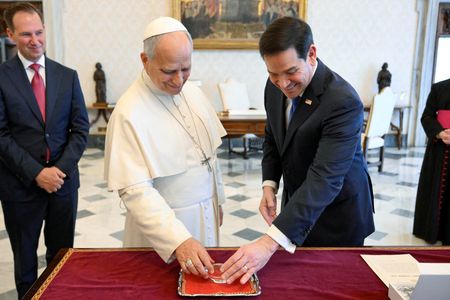

VATICAN CITY – Diplomatic experts are reading between the lines of a Vatican statement following Pope Leo’s Thursday meeting with U.S. Secretary of State Marco Rubio, suggesting the carefully chosen words reveal unusual strain in U.S.-Vatican relations.
The 45-minute discussion between the American-born pontiff and Rubio marked the first encounter between Pope Leo and a Trump administration official in nearly a year, coming amid ongoing public disputes between President Trump and the Vatican over the Iran conflict.
Following their meeting, Vatican officials released a statement noting that both leaders had “renewed the shared commitment to fostering good bilateral relations” – language that diplomatic observers say signals underlying problems.
“(The) statement makes it clear that, at present, there is work to do,” explained Peter Martin, who previously served as a diplomat at the U.S. Embassy to the Holy See under both Democratic and Republican presidents.
Vatican expert Austen Ivereigh, who collaborated on a book with the late Pope Francis, interpreted the emphasis on building bilateral ties as an indication “that they are at the moment not good.”
The diplomatic messaging stood in stark contrast to other Vatican encounters that day. When Pope Leo met with Polish Prime Minister Donald Tusk, Vatican officials specifically “expressed satisfaction for the good relations” between Poland and the Holy See – notably different phrasing.
Following the papal audience, the U.S. embassy posted on social media that Leo and Rubio had discussed “topics of mutual interest in the Western Hemisphere.” Rubio later wrote on X: “The United States and Holy See partnership in advancing religious freedom is strong,” referring to his additional meetings with senior Vatican officials.
However, the official Vatican statement covering both the papal meeting and Rubio’s other Vatican discussions made no mention of either Western Hemisphere issues or religious freedom concerns.
The Vatican’s release only acknowledged an “exchange of views” on global matters without identifying any areas of mutual understanding beyond the commitment to strengthen diplomatic ties.
Kenneth Hackett, who directed the U.S. Catholic Church’s international relief operations for 18 years before becoming Ambassador to the Holy See during the Obama presidency, interpreted the Vatican’s language as indicating “there were no substantive agreements.”
Martin, who witnessed Trump’s 2017 Vatican visit with the late Pope Francis while serving at the U.S. embassy, noted that the statement from that encounter had “expressed satisfaction for the good relations” between America and the Vatican – using identical language to Thursday’s Polish statement.
“In the world of diplomacy – especially Vatican diplomacy – every word matters,” emphasized Martin, who currently teaches at Boston College.
The current tensions stem from Pope Leo’s criticism of the U.S.-Israeli military actions against Iran and the Trump administration’s strict immigration enforcement policies. Trump has maintained an unusual pattern of public criticism directed at the pontiff in recent weeks, drawing condemnation from Christian leaders across political lines.
Pope Leo, who assumed the papacy one year ago, and President Trump have not met in person.
The Vatican’s decision to reveal specific discussion details from the papal meeting also broke with standard protocol. Typically, such statements only disclose topics addressed during a visiting official’s meetings with Vatican diplomats, not content from papal audiences.
Ivereigh suggested the Vatican felt compelled to issue a detailed statement due to significant media attention and “in anticipation of any White House spin.”
The last instance of the Vatican disclosing such papal meeting specifics occurred in September following Pope Leo’s encounter with Israeli President Isaac Herzog, when officials revealed the pontiff had discussed the “tragic situation in Gaza” during their conversation.