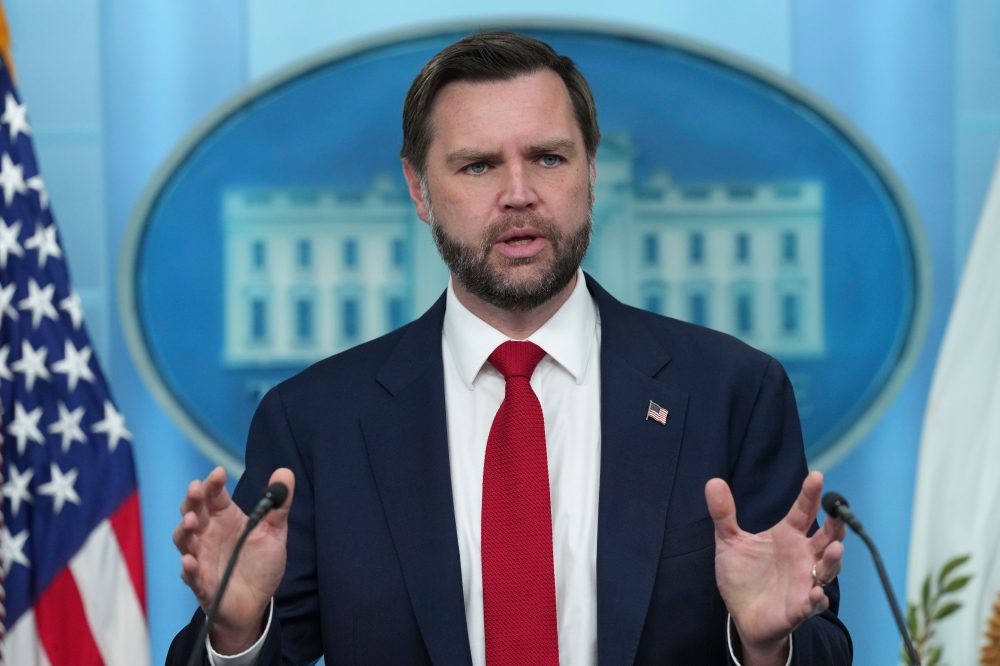

WASHINGTON — Vice President JD Vance announced Thursday that the U.S. Navy has cleared a path for more than a dozen ships to reach Iranian ports, effectively ending a naval blockade as part of a newly reached agreement to bring the war to a close.
Speaking at a White House press briefing, Vance said oil is once again flowing through the Strait of Hormuz. He noted that more than 12.5 million barrels passed through that critical shipping channel on Wednesday night alone.
“So we’re also honoring our end of the early part of the agreement on the military side,” Vance said, calling it an early and tangible benefit of the deal. He pushed back against critics who argue the agreement favors Iran.
Vance also revealed plans to travel to Switzerland for follow-up discussions on the Iran deal, though he was uncertain about the exact timing. He had previously been expected to lead negotiations focused on reducing Iran’s stockpile of highly enriched uranium and restoring oil traffic through the Strait of Hormuz.
Earlier in the week, on Tuesday, two oil tankers departed Iran and crossed through the U.S. military blockade without being intercepted. A merchant shipping tracking service reported the vessels were carrying a combined 3.8 million barrels of Iranian crude oil.
Iranian state media described shipping at the country’s southern ports as having returned to normal, though officials noted the Strait of Hormuz remains under the supervision and control of the Iranian military, with transit through the waterway still requiring coordination.
Maritime data firm Lloyd’s List Intelligence reported that major shipowners have begun routing vessels through the strait since the agreement was signed. Richard Meade, editor in chief of Lloyd’s List, said during a media briefing that for the first time in 110 days, ships belonging to major companies are moving through the strait after being effectively stranded there since February.
Among the companies with vessels now transiting the strait are Grimaldi Group, Cosco, Knutsen, and NYK. Lloyd’s List also reported that two crude oil tankers flagged under Iran and owned by the National Iranian Tanker Company — both under sanctions — have entered the strait.
However, Phillip Belcher, marine director of Intertanko, a trade organization representing independent tanker owners worldwide, cautioned that the main central route through the Strait of Hormuz remains closed, with an estimated 80 mines still needing to be cleared. Ships have instead been using a smaller Northern route through Iranian waters and a Southern route through Omani waters.
The agreement calls for a permanent halt to hostilities and opens a 60-day negotiating period to finalize a deal on Iran’s nuclear future, though the door has been left open to resume military action. Critics say the deal appears to hand Iran several early concessions while requiring little in return at this stage.
Under the terms, Iran’s highly enriched uranium stockpile — believed to be buried under rubble — must at minimum be diluted under international oversight. Iran also commits to not acquiring or developing nuclear weapons, a pledge it has made before. Beyond those points, the specifics of the nuclear program’s future remain to be negotiated.
Much of the agreement is aimed at restoring conditions that existed before the war, including a ceasefire, renewed diplomatic talks over Iran’s nuclear activities, and the reopening of the Strait of Hormuz — a vital passage for global oil and natural gas supplies whose closure triggered a significant worldwide energy crisis.