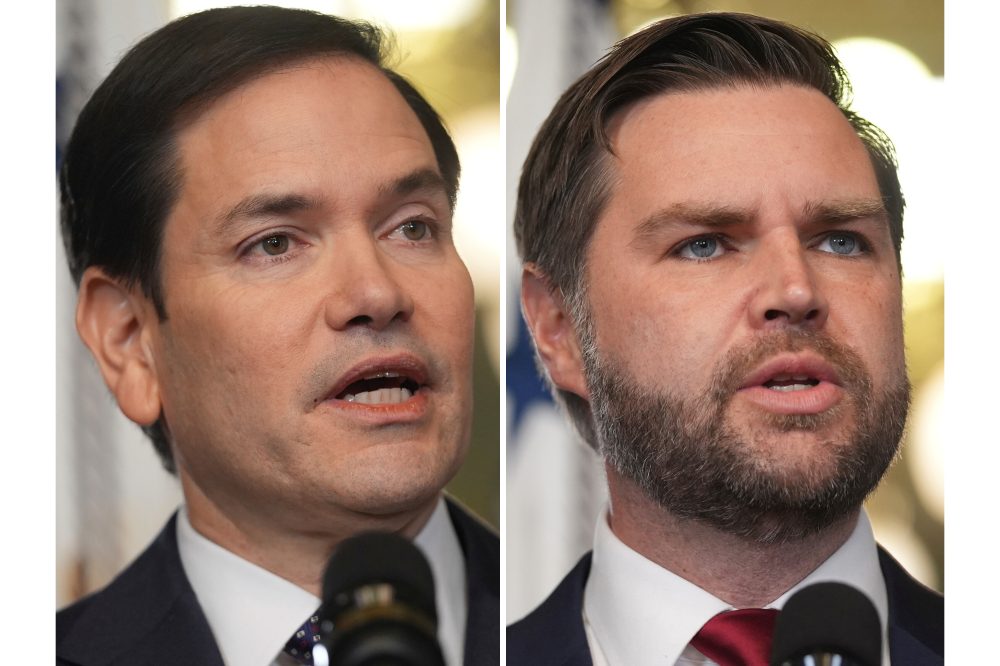

WASHINGTON — Vice President JD Vance and Secretary of State Marco Rubio appear to be charting separate courses when it comes to President Donald Trump’s national security agenda, even as both men publicly insist they are on the same page — and speculation grows about a potential rivalry heading into 2028.
The two men bring very different backgrounds to their roles. Rubio is the son of Cuban immigrants with extensive Senate experience and a deep focus on Latin America. Vance, a Midwest native and Marine Corps veteran, served only two years in the Senate before being chosen as Trump’s running mate in 2024, largely on a platform of opposing foreign military entanglements.
Their most visible difference has emerged over the Middle East. Vance has on multiple occasions voiced criticism of Israel and its military actions in Lebanon, stating that Trump has grown frustrated with Israeli strikes against the Iranian-backed militant group Hezbollah — moves that, in Vance’s telling, have complicated efforts to reach a deal with Tehran.
Rubio, by contrast, has either backed Israel or stayed quiet on the Lebanon situation — a portfolio he has personally taken the lead on — and that effort produced a preliminary framework agreement last week.
Foreign policy observers say the differences are real. “The talk about differences is not idle speculation,” said Dan Fried, a former assistant secretary of state and ambassador to Poland who now works with the Atlantic Council, a Washington think tank. “There is definitely something to it.”
The White House pushed back hard against any suggestion of a divide. “Why is the legacy media obsessed with driving a wedge between Vice President Vance and Secretary Rubio that does not exist? There is one camp — President Trump’s camp — and the entire administration is fully behind the president’s efforts to ensure Iran can never possess a nuclear weapon,” said White House spokeswoman Anna Kelly.
State Department spokesman Tommy Pigott echoed that sentiment, saying “Rubio and the entire administration is 100% in lockstep behind President Trump.”
Behind the scenes, however, the picture is more complicated. According to Trump administration officials familiar with the situation, Rubio was skeptical enough about reaching a workable deal with Iran that he passed on leading the U.S. delegation to the first ceasefire talks held in April in Islamabad, Pakistan.
Vance, seeing the episode as a chance to build his foreign policy résumé, reportedly asked Trump twice for the assignment before the president agreed, according to those officials, who requested anonymity to speak about internal deliberations.
Vance went on to lead the U.S. team at those inconclusive Pakistan talks and again this month at negotiations in Switzerland, which followed the signing of a memorandum of understanding between the U.S. and Iran. That agreement remains fragile, with both sides exchanging fire in recent days.
“It’s rather unusual for the VP to be given the lead role in a negotiation, but it’s quite possible that Rubio is happy to let him. It’s a pig in a poke. It’s a loser job,” said Ian Kelly, a retired career diplomat and ambassador during the first Trump administration.
Ian Kelly also noted that both men appear to harbor ambitions to succeed Trump, and that the president’s recent semi-joking suggestion that he would blame Vance if the Iran talks collapse may indicate Vance is being “set up for failure.”
Vance has expressed cautious optimism about the Iran negotiations, while Rubio has publicly supported the effort but repeatedly struck a more noncommittal tone — all while rejecting any talk of division.
“We’re all focused on the jobs in front of us. I think the president loves to stir the pot a little bit and loves the entertainment of it,” Vance said. He also spoke warmly of his relationship with Rubio: “I love Marco. I think he’s a great secretary of state. He’s become a very, very dear friend. I think both of us are very much focused on accomplishing the American people’s business right now.”
Rubio likewise dismissed the notion of any conflict. “When it comes to foreign policy and national security, we have no drama. We have no games,” he told reporters last week during a stop in Bahrain, the final leg of a three-nation tour of Arab Gulf countries most directly impacted by the Iran conflict.
“We have a group of people that work very well together and closely to execute on the president’s directives, which is why I think we’ve had good outcomes and good achievements, and we’re going to continue to have good outcomes and good achievements,” Rubio said. “Everyone has an important role to play, and everyone is playing that role and doing it in a collaborative process.”
Trump, meanwhile, has not shied away from stoking the rivalry, repeatedly asking supporters at rallies which of the two men they would prefer to see succeed him, and even floating at one point that the pair could form an unbeatable ticket.
Foreign policy analysts say the two men genuinely see the world differently. “Rubio speaks within the rubric of the Ronald Reagan construct of the free world and its importance,” Fried said. “Vance is not interested in the free-world construct. He speaks in the language of not wanting to fight what he believes are abstractions.”
Fried cautioned that the current direction on Iran concerns him. “We’re headed toward a bad place in Iran, which is giving up any support for Iranian civil society and not being terribly good at containing Iran,” he said. “Instead, we seem to be allowing ourselves to be backed into a ‘sphere of influence’ situation where Iran is weaker but ends up better off than before. I can’t imagine Rubio agreeing to that.”
Aides to Rubio have noted that he has repeatedly said he would step aside for Vance if the vice president decides to seek the 2028 Republican nomination. At the same time, Rubio has used his dual role as the nation’s top diplomat and national security adviser to reshape the National Security Council, placing several close allies in senior White House positions in recent weeks. Those include his former State Department counselor, Mike Needham, now serving as deputy national security adviser; Jeremy Lewin, who oversaw the dismantling of the U.S. Agency for International Development and is set to join the NSC as a deputy for the Western Hemisphere; and Dylan Johnson, who heads NSC communications while also serving as assistant secretary of state for public affairs.