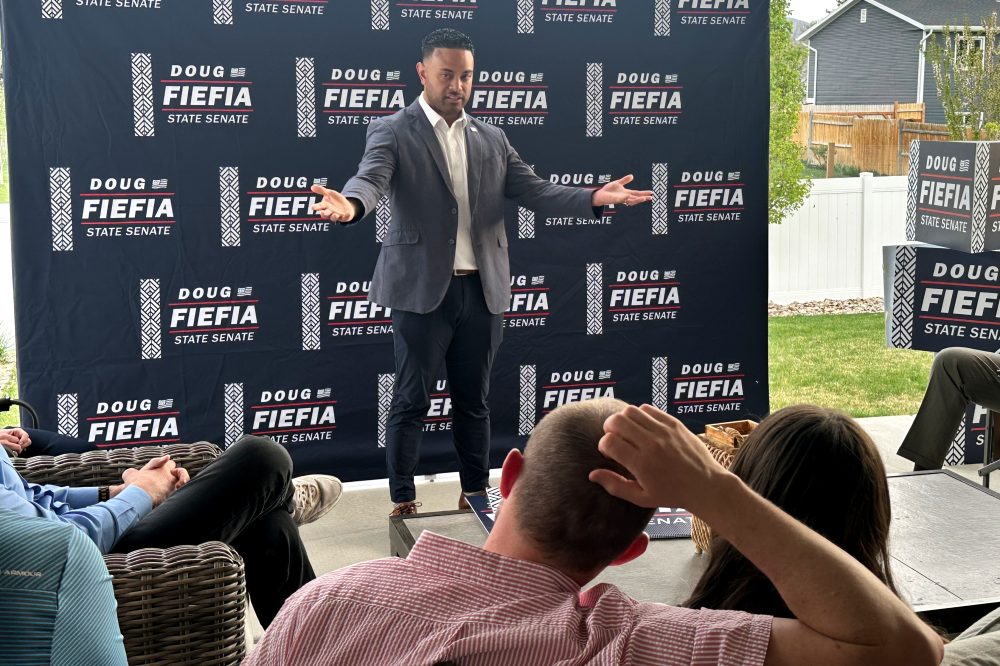

RIVERTON, Utah — At a suburban gathering outside Salt Lake City, a dozen Republican activists discussed typical conservative concerns including water shortages, immigration issues, and conspiracy theories. However, state representative Doug Fiefia, who’s seeking a Senate seat, prioritized a different topic: artificial intelligence regulation.
The former Google employee has centered his campaign around technology oversight, joining other tech industry veterans who’ve entered politics with similar goals.
“I know it sounds like ‘Doug, this is all you talk about,’” Fiefia explained. “That’s because it’s coming, it’s here and it’s going to be our biggest fight.”
This emphasis has created tension with President Trump’s administration, which blocked Fiefia’s state legislation mandating child safety measures for AI companies. The federal government advocates for unified national AI standards, contending that varied state regulations could weaken America’s competitive position against China.
With congressional inaction on the issue, state legislators nationwide are tackling AI concerns independently. Florida’s Republican Governor Ron DeSantis has added AI to an upcoming special legislative session, while Democratic-controlled New York mandated that major AI developers report dangerous incidents.
More than 1,000 state legislative proposals currently address artificial intelligence, demonstrating widespread public anxiety about the technology.
“None of us are really sure,” said Brett Young, a structural engineer attending Fiefia’s backyard event. “Is this something we should be scared about, or is it no so big a deal and it’ll enhance our lives?”
Trump has consistently opposed state-level AI policies, issuing executive orders with legal warnings and funding threats to discourage new regulations.
The White House recently unveiled a congressional framework that would override “too burdensome” state laws while permitting certain protections for children and copyrighted material.
These federal efforts haven’t reduced state legislative activity. Common proposals include requiring chatbots to disclose their non-human nature and prohibiting AI-generated nonconsensual pornography, including digitally altered clothing removal from online photos.
“There’s a lot of state lawmakers looking at what the federal government is doing and saying, ‘We want to take action because we’re not satisfied,’” explained Craig Albright, senior vice president for government relations at the Business Software Alliance, representing software companies.
Recent Quinnipiac polling shows approximately 80% of Americans express concern about AI, with three-quarters believing government regulation is insufficient. About 90% of Democrats and 60% of Republicans favor increased government oversight.
California and New York, both Democratic strongholds, have enacted the most comprehensive regulations, focusing on catastrophic risk disclosure, such as AI-controlled nuclear facility failures or AI systems ignoring human commands.
Republican-led states also face regulatory pressure. DeSantis supported legislation implementing parental controls for minors using AI and prohibiting unauthorized use of personal likenesses. The measure passed the state Senate overwhelmingly but failed in the House. Similar bills in Republican-controlled Louisiana and Missouri stalled due to Trump administration opposition.
Fiefia belongs to a network of former technology workers turned state legislators advocating stronger regulations. He co-chairs the Future Caucus AI task force alongside Vermont Democrat Monique Priestley, also a tech industry veteran.
Priestley described using video conferences and group chats to share legislative ideas and counter industry lobbyists opposing their bills. Last year, 166 of Vermont’s 482 registered lobbyists commented on her data privacy legislation, which the governor ultimately vetoed.
“It’s like you’re running around against an army of full-time lobbyists,” Priestley noted. Like many state lawmakers, she maintains separate full-time employment.
Alex Bores, a former Palantir data scientist who resigned after the company contracted with Trump’s first administration on immigration enforcement, also participates in the AI task force. The Democrat authored New York’s successful AI legislation last year.
Currently competing in a crowded Democratic primary to replace retiring U.S. Representative Jerrold Nadler in Manhattan, Queens, and Brooklyn, Bores faces industry retaliation. A pro-AI campaign committee has spent $2.3 million opposing his candidacy.
Bores believes tech companies are using him as an example to discourage further state and federal regulation.
“It’s one reasons it’s so important for me to win this race is because, if I don’t, that intimidation they’re trying on Congress will be successful,” he stated. His June 23 primary opponents include Jack Schlossberg, former President Kennedy’s grandson, and George Conway, a former Republican turned prominent Trump critic.
Fiefia hasn’t attracted similar attention while transitioning from House to Senate after one legislative session. His district encompasses subdivisions and shopping centers between Utah’s mountain ranges, with neighborhoods filled with children on bicycles and scooters.
The son of Tongan immigrants, Fiefia grew up in Utah before relocating to Silicon Valley for a Google sales position.
Rising to manage teams implementing Google’s early AI models, Fiefia became troubled by industry practices.
“What I realized is Big Tech cares about their bottom line, and they were worried about making money, not doing right for the human race,” said Fiefia, now employed at a Utah cloud computing and AI company.
His legislation passed a House committee unanimously this year before the Trump administration labeled it “unfixable” in a Senate letter. The measure subsequently failed.
Daniel McCay, the incumbent senator Fiefia challenges in the primary, considers this outcome positive.
“I’ve been around long enough to recognize the invention of fire, the wheel, cars and the internet did not ruin society and I’m very skeptical of anyone trying to scare society into regulations,” McCay stated.
He emphasized the bill extended beyond child safety, incorporating whistleblower protections for AI workers and public risk disclosure.
“It would have driven Utah out of the AI innovation business,” McCay argued.
At the cottage meeting — Utah’s term for small home gatherings discussing important issues — Fiefia addressed multiple technology-related questions.
When asked about opposing the Trump administration, Fiefia emphasized the importance of defending states’ rights, particularly when challenging fellow Republicans to demonstrate principled governance.
“The Trump administration is, ‘We want zero regulations on AI,’” Fiefia said. “I think that’s wrong. I agree with a lot of what Trump says on taxes. I disagree with him on this.”