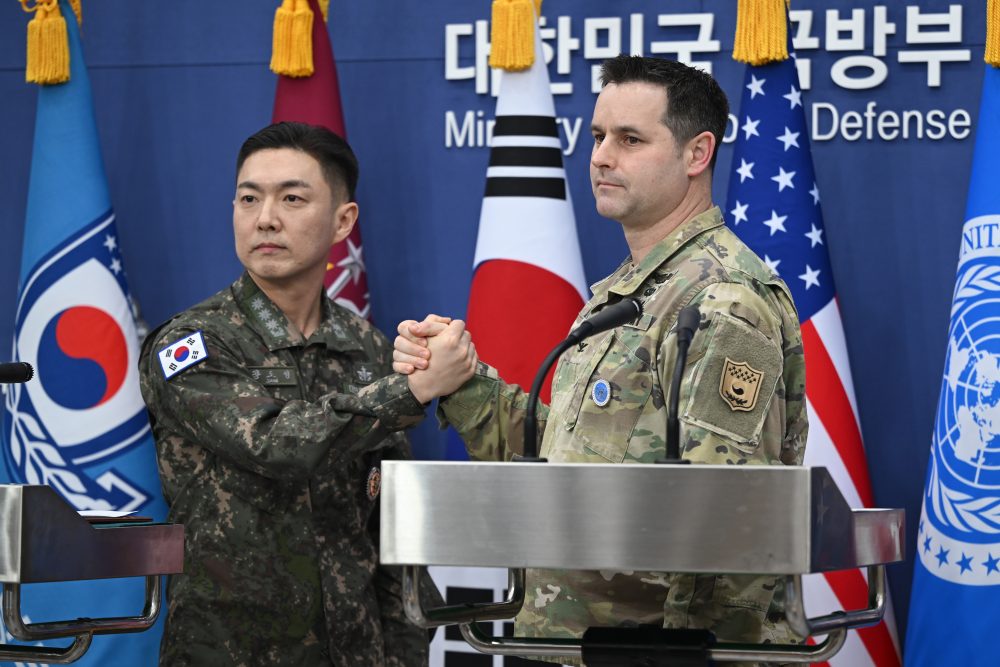

SEOUL, South Korea — American and South Korean military officials announced Wednesday they will move forward with their yearly spring training exercises in March, aimed at strengthening their joint defense capabilities while diplomatic relations with nuclear-armed North Korea remain at a standstill.
The Freedom Shield training exercises are scheduled to run from March 9-19, military officials confirmed.
Pyongyang has consistently characterized these allied military exercises as practice runs for invasion and has used them as justification to ramp up its own weapons testing and military displays. The allied nations maintain these training exercises are purely defensive.
The announcement comes during a significant political gathering in North Korea where dictator Kim Jong Un is anticipated to present his major domestic, international, and military objectives for the coming five years. So far, North Korean government media has not published any direct statements from Kim regarding relationships with Washington or Seoul during the ruling Workers’ Party congress that started last week.
Military experts believe Kim may use this congress to solidify his aggressive approach toward South Korea, repeat demands for Washington to abandon denuclearization requirements before resuming negotiations, and reveal plans to strengthen and merge his nuclear and traditional military forces, based on his recent public statements.
Freedom Shield represents one of two “command post” training programs the allies hold annually, with the second being Ulchi Freedom Shield in August. These exercises primarily use computer simulations to evaluate the allies’ combined operational readiness while incorporating new warfare scenarios and security threats.
The March training will include a field component called Warrior Shield designed to improve “training realism and combat readiness,” Col. Ryan Donald, public affairs director of U.S. Forces Korea, explained during a press briefing.
Neither South Korean nor American officials disclosed troop participation numbers for the exercises, though these events typically include thousands of military personnel.
Some observers suggest the allies may be looking to scale back these drills to encourage dialogue opportunities with North Korea.
South Korean President Lee Jae Myung, who holds liberal political views, has indicated interest in renewed inter-Korean cooperation, while some of his senior advisors have expressed optimism that President Donald Trump’s anticipated China visit in late March or April might create openings for renewed Washington-Pyongyang discussions.
Col. Jang Do-young, public affairs director for South Korea’s Joint Chiefs of Staff, stated the March exercises will exclude scenarios addressing potential North Korean nuclear attacks but will incorporate training focused on “deterring nuclear threats.” He noted that allies continue working out details for the field training component.
Kim’s nuclear weapons program has grown rapidly in recent years, now including systems that threaten American allies across Asia and intercontinental missiles potentially capable of reaching American territory, which has increased South Korea’s security worries while diplomatic efforts with Pyongyang remain stuck.
South Korea also faces challenges from escalating U.S.-China regional competition, leading Washington to push its ally to shoulder more defense responsibilities against North Korea as America shifts greater attention toward China.
North Korea has consistently refused Washington and Seoul’s appeals to restart diplomatic talks aimed at dismantling its nuclear program, which collapsed in 2019 after Kim’s second summit with Trump during the former president’s initial term ended unsuccessfully.
Kim has now prioritized Russia in his international strategy, deploying thousands of soldiers and substantial military equipment to assist Moscow’s Ukraine conflict, likely in return for assistance and military technology.