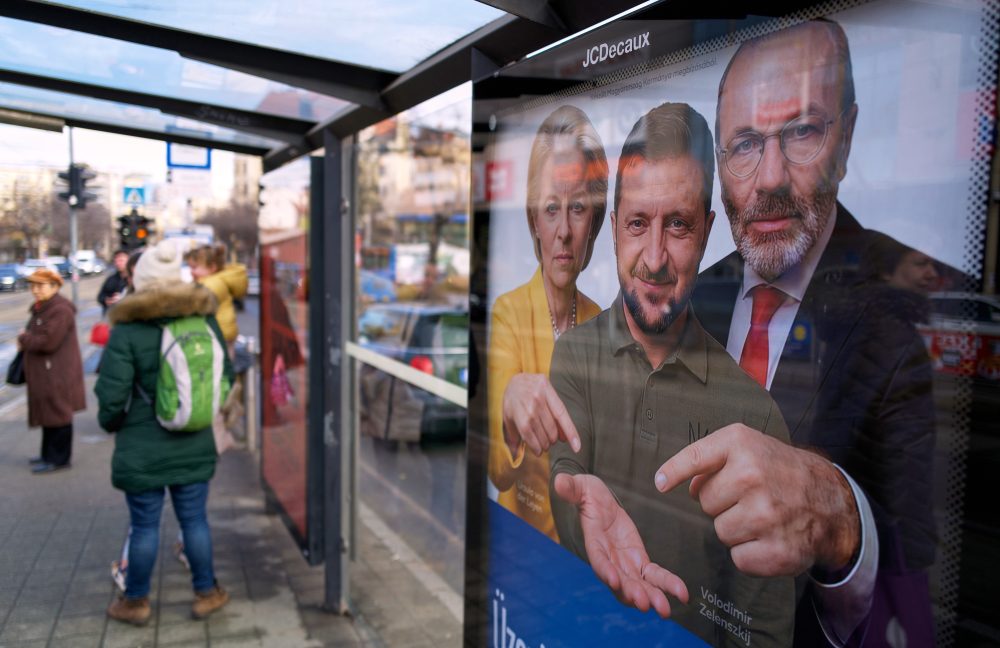

BUDAPEST, Hungary — Hungary’s Prime Minister Viktor Orbán is betting his political future on a controversial strategy: convincing voters that Ukraine, not Hungary’s struggling economy, represents the biggest danger to their nation.
With his approval ratings slipping ahead of the April 12 election, the pro-Moscow leader has launched an extensive propaganda campaign warning Hungarians against joining the rest of Europe in backing Ukraine’s fight against Russian aggression. Orbán claims this support could drain Hungary’s finances and send Hungarian soldiers to die in combat.
Across Hungary, government-funded billboards display computer-generated pictures of Ukrainian President Volodymyr Zelenskyy alongside European leaders, with Zelenskyy’s hand extended as though asking for cash. The imagery targets the European Union’s financial assistance to Ukraine as the conflict approaches its fifth year.
“Our message to Brussels: We won’t pay!” declare the state-sponsored advertisements.
The stakes of Hungary’s election became evident Monday when the country prevented new EU penalties against Russia after Moscow disrupted oil deliveries flowing through Ukraine. Orbán’s administration threatened to block additional pro-Ukraine measures until the energy supplies restart.
Among EU members, Orbán stands as Putin’s most reliable supporter. While the bloc’s other 26 countries have distanced themselves from Moscow since the February 24, 2022 invasion began, Hungary has strengthened its Russian ties.
Orbán defends his Putin relationship as practical, pointing to Hungary’s dependence on Russian energy imports. However, his anti-LGBTQ+ legislation, restrictions on journalists and civic groups, and branding of opponents as “foreign agents” mirror Putin’s authoritarian tactics, critics argue.
The election presents Orbán’s toughest political battle since returning to power in 2010. Independent surveys show the EU’s longest-serving leader and his Fidesz party losing ground to center-right newcomer Péter Magyar.
Magyar, a 44-year-old attorney who left Fidesz in 2024, has built his campaign around addressing inflation, strengthening public services, and fighting government corruption. The former party insider also pledges to restore Hungary’s Western partnerships and rebuild democratic institutions weakened during Orbán’s 16-year tenure.
Political scandals have boosted Magyar’s Tisza party, particularly public outrage over a presidential pardon granted to someone involved in child sexual abuse, forcing both the president and justice minister to step down.
Facing Magyar’s challenge, Orbán and Fidesz have shifted focus through a massive media blitz funded by taxpayers. Radio, television, and online advertisements accompany the billboard campaign, while a petition sent to every eligible voter claimed EU aid to Ukraine would devastate Hungary economically.
Additional advertisements, financed by a mysterious pro-government group connected to Fidesz, portray Magyar as Zelenskyy and EU manipulation, suggesting he would betray Hungarian interests and involve the country in warfare.
Hungary’s state media and government-friendly outlets echo these narratives, claiming Ukraine seeks to extend the deadly conflict that has claimed tens of thousands of lives, working with the EU to achieve this goal.
Orbán recently declared the EU, rather than Russia, poses Hungary’s greatest threat. He points to increased European defense budgets — driven by Russian aggression and American pressure for higher NATO spending — as proof the EU is preparing for war with Moscow and planning to force Hungarians into military service.
A disturbing AI-created video released by Fidesz on social media shows a young girl asking her sad mother in Hungarian: “Mommy, when is daddy coming home?”
The following scene depicts the fictional father — tied up, blindfolded, and kneeling in battlefield mud — being executed by a soldier. “We won’t allow others to decide on the fates of our families,” the voiceover states. “Let’s not take a risk. Fidesz is the safe choice.”
While some EU nations have suggested peacekeeping forces for Ukraine to oversee potential ceasefires, these troops wouldn’t engage in fighting, and participation would remain optional, explained András Rácz, a Russia specialist at the German Council on Foreign Relations.
Despite the misleading nature of many claims, Rácz noted that Fidesz has won two previous elections by stoking fears about opponents dragging Hungary into war.
“They are trying to max this out. They have nothing else,” Rácz observed. “Populists often try to define an enemy, often an imaginary one, and then offer protection to the society from that enemy. Ukraine has been ideal from this perspective.”
For years, Orbán has worked to undermine EU financial and military support for Ukraine while strongly opposing sanctions on Russian energy and officials.
Relations with Ukraine deteriorated recently when Russian oil shipments to Hungary stopped; Ukraine attributed the interruption to a Russian drone attack in late January that damaged pipeline infrastructure. Orbán characterized it as extortion.
His government responded last week by stopping diesel exports to Ukraine and threatening to reject a 90-billion-euro ($106-billion) EU loan package for Kyiv. Monday’s blocking of the 20th round of EU sanctions against Russia followed.
The anti-Ukraine messaging has found support among loyal Fidesz voters. Despite Tisza’s polling lead, victory remains uncertain.
However, many Hungarians reject Orbán’s anti-Ukraine rhetoric. Sunday saw hundreds of Hungarians and Ukrainians, including many refugees, gather in central Budapest to mark the four-year anniversary of Russia’s invasion. Marching toward a protest at the Russian embassy, participants carried Ukrainian and Hungarian flags while chanting, “Stop Putin, stop the war!”
Budapest’s liberal mayor, Gergely Karácsony, told The Associated Press that Orbán’s messaging and policies represent “a betrayal not only of Ukraine, but of Hungary’s national interest.”
“I hope that this will go into history as a failed policy, but that history will also remember that there were some who stood up for what is right,” he stated.
Among the demonstrators was Ester Zhivatovska, a 19-year-old veterinary student from the Ukrainian port city of Odesa studying in Budapest. She called the billboards featuring her country’s president ridiculous.
“The main message of these billboards is that Ukraine will steal Hungarian money,” she said. “But come on, you’re using these AI images from the Hungarian budget to do what? To win elections.”