
A congressional advisory panel issued a warning Monday that Chinese artificial intelligence companies are establishing a powerful competitive position through open-source technology, potentially undermining America’s leadership in the field despite ongoing restrictions on chip exports to China.
The U.S.-China Economic and Security Review Commission released findings showing that affordable Chinese language models from companies like Alibaba, Moonshot and MiniMax now lead global usage statistics on major platforms including HuggingFace and OpenRouter.
According to the commission’s analysis, China’s strategy of implementing AI across multiple industries – from manufacturing plants to logistics systems and robotics – is creating valuable real-world information that helps improve their models.
“This open ecosystem enables China to innovate close to the frontier despite significant compute constraints,” the commission stated in Monday’s report.
The panel added that “Chinese labs have narrowed performance gaps with top Western large language models.”
Since 2022, American legislators have implemented multiple waves of export controls targeting China, preventing the country from obtaining the most sophisticated AI processing chips. However, Washington did authorize sales of Nvidia’s second-tier chip technology in December.
Meanwhile, American firms such as OpenAI, which developed ChatGPT, and Anthropic, the company behind Claude, along with established technology corporations, have poured billions into maintaining their technological edge.
However, their market position may face challenges.
“Open model proliferation creates alternative pathways to AI leadership,” according to the report’s findings.
Research indicates that approximately 80 percent of American AI startup companies now utilize Chinese open-source artificial intelligence models.
DeepSeek’s innovative R1 model, released in the previous year, rapidly surpassed ChatGPT to become the top downloaded application on America’s App Store. Additionally, Alibaba’s Qwen model series has exceeded Meta’s Llama in worldwide download totals, based on HuggingFace data.
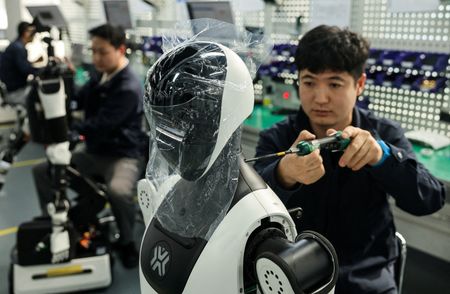
The report suggests that as artificial intelligence evolution moves beyond language models toward autonomous AI systems and physical robotics applications, China may be better positioned to leverage its extensive data gathering capabilities for developing humanoid robots, self-driving vehicle technology, and dual-use applications.
“There’s a bit of a deployment gap in the embodied AI space between the U.S. and China. That’s something that over time compounds itself … We’re starting to see that compounding now,” Michael Kuiken, the commission’s vice-chair, explained in a Reuters interview.
Kuiken noted that the commission is also monitoring China’s AI applications in biotechnology, quantum computing, and advanced materials sectors.
Chinese leadership has identified embodied AI as a critical strategic industry for the future, with numerous prominent Chinese robotics companies planning to go public this year.
Despite concerns raised by Western research institutions about potential security vulnerabilities and political biases in Chinese open-source AI systems that favor Beijing’s governmental positions, many corporations continue adopting these technologies.
Siemens CEO Roland Busch stated Monday that his company sees “no disadvantages” in using Chinese open-source AI for training their industrial automation models, highlighting cost benefits and flexible customization options.