
American military forces have begun using Ukrainian-developed anti-drone technology at a critical air base in Saudi Arabia following a series of Iranian attacks, according to five sources familiar with the situation.
The Sky Map command system, created by Ukrainian company Sky Fortress, has been installed at Prince Sultan Air Base in recent weeks. Ukrainian military trainers have arrived to instruct U.S. personnel on operating the platform, which Ukraine’s forces use extensively to identify approaching drone threats and coordinate defensive responses.
This marks a significant development as Ukraine’s experience fighting Russia for four years has advanced their drone warfare capabilities. The Sky Map system specializes in detecting Iranian-made Shahed drones and directing interceptor drones to neutralize them.
Timothy Walton, a senior fellow at the Hudson Institute, noted persistent weaknesses in American air defense systems. “There’s been longstanding gaps in U.S. air missile defense coverage around the world,” Walton stated. “This has been well understood. However, it hasn’t been addressed.”
The deployment contradicts President Trump’s earlier dismissal of Ukrainian assistance. In March, Trump told Fox News, “We don’t need their help in drone defense,” after Ukrainian President Volodymyr Zelenskyy offered support against Iranian drone attacks.
Neither the Pentagon nor Central Command, which oversees Prince Sultan Air Base, provided comments. Sky Fortress and Zelenskyy’s office also declined to respond.
The Pentagon’s anti-drone division recently allocated $350 million to strengthen defenses under Operation Epic Fury. Adam Scher, spokesman for Joint Interagency Task Force 401, emphasized that multiple technologies including sensors, cameras and interceptors are being deployed.
“There is no ‘silver bullet’ tool that will stop every drone threat,” Scher explained.
Sky Fortress launched in 2022 when Ukrainian engineers connected to the military installed over 10,000 acoustic sensors nationwide to detect Russian drone attacks. The company received backing from Brave1, Ukraine’s military innovation division, to create Sky Map as a software platform coordinating anti-drone operations.
Prince Sultan Air Base, located approximately 400 miles from Iran, has also tested other new counter-drone systems. Merops interceptor drones, developed by Project Eagle with backing from former Google CEO Eric Schmidt, have been deployed at the facility. However, testing hasn’t gone smoothly – earlier this month, a Merops interceptor malfunctioned during trials and crashed into a bathroom facility on base.
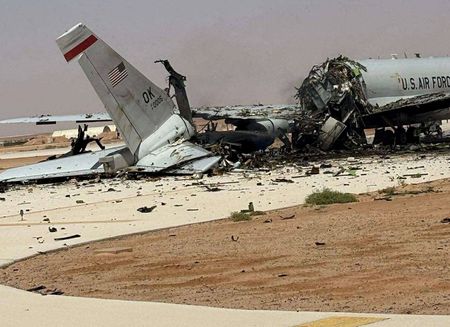
The air base has endured multiple waves of Iranian drone and missile attacks since the conflict began. A valuable E-3 AWACS radar aircraft was destroyed on March 27, while several KC-135 refueling tankers sustained damage in separate strikes. One attack destroyed a tent reportedly housing radar equipment supporting the base’s THAAD missile defense system.
The base previously relied on Northrop Grumman’s Forward Area Air Defense (FAAD) system, first deployed in the 1990s, to track incoming threats ranging from mortars to drones. For close-range drone attacks, the facility primarily used RTX-manufactured Coyote interceptors – winged drones that can either carry warheads or use microwave technology to disable enemy drone electronics.
A Northrop Grumman representative said FAAD “is consistently dependable in theater today and we are confident in the competitive advantage FAAD provides to the warfighter.”
RTX spokesman Chris Johnson noted the Coyote system has “proven highly effective, defeating hundreds of aerial threats during combat operations.”