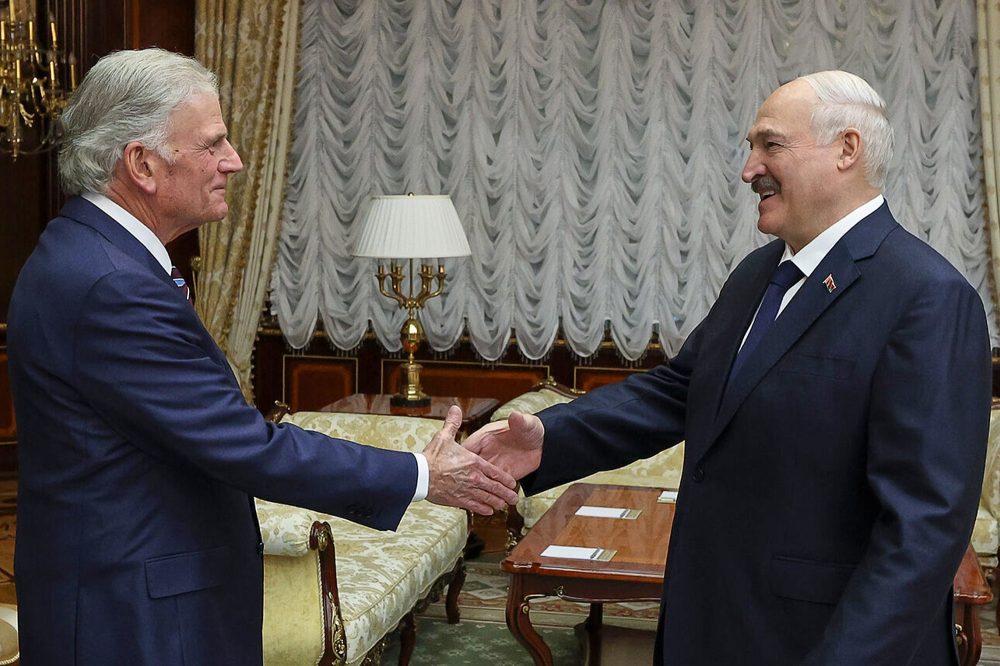

An American evangelical minister has arrived in Belarus to conduct what organizers say will be the nation’s biggest Christian gathering ever, meeting Friday with the country’s long-time authoritarian ruler.
Alexander Lukashenko, Belarus’ president, asked Rev. Franklin Graham to deliver warm regards to President Donald Trump and inform him that he has “reliable friends and supporters in Belarus.”
Following Trump’s return to office, Lukashenko has freed hundreds of political detainees through agreements facilitated by the United States that resulted in the removal of certain American sanctions, as the isolated leader works to strengthen relationships with Western nations.
“Without the U.S. president, it might have been more difficult for us to establish our relations,” Lukashenko said to Graham, who heads Samaritan’s Purse and the Billy Graham Evangelistic Association. Graham traveled with Greta Van Susteren, a Newsmax TV host whose husband is Trump’s special envoy for Belarus, John Coale.
For over thirty years, Lukashenko has maintained strict control over the country of 9.5 million people, and Belarus has faced repeated Western sanctions due to its suppression of human rights and its role in allowing Moscow to launch operations from its soil during the 2022 full-scale invasion of Ukraine.
Graham plans to conduct what organizers are calling the Festival of Hope at a covered sports facility in the capital city of Minsk, with thousands anticipated to participate in this unprecedented evangelical event in Belarus’ history.
Mass protests erupted following Belarus’ 2020 presidential contest, with hundreds of thousands demonstrating against what they considered fraudulent results. The government’s harsh response led to tens of thousands of arrests, with many protesters suffering police violence. Key opposition leaders either left the country or faced imprisonment.
Five years following those widespread protests, Lukashenko secured a seventh term in last year’s election, which opposition groups dismissed as illegitimate.
Through a March agreement that Washington helped facilitate, Lukashenko authorized the freedom of 250 political detainees, while America lifted restrictions on two state-owned Belarusian banks and the nation’s Finance Ministry, and removed leading Belarusian potash companies from sanctions lists.
A subsequent April arrangement freed well-known journalist Andrzej Poczobut through an exchange with Poland involving ten individuals total.
Despite these releases, the Viasna human rights organization reports that 845 political prisoners remain incarcerated in Belarus, including 22 media professionals.
Exiled opposition figure Sviatlana Tsikhanouskaya expressed optimism that Graham’s presence might contribute to freeing all political detainees. “We continue to push for a complete end to the harsh political repressions in Belarus,” Tsikhanouskaya stated to The Associated Press.
The government’s approval of this large evangelical assembly represents a notable change after years of targeting religious leaders across Catholic, Orthodox and Protestant denominations, resulting in dozens being jailed, silenced or forced to flee following their opposition to the 2020 election. Among the nation’s 9.5 million residents, approximately 80% practice Orthodox Christianity, nearly 14% are Catholic and concentrated in western, northern and central regions, while roughly 2% belong to Protestant denominations.
New legislation passed in 2024 mandated that all faith-based organizations register again with government officials or risk being banned if their allegiance to the state appears questionable.
Belarus appears on the U.S. Commission on International Religious Freedom’s list of nations with religious liberty violations, with particular emphasis on its restrictive laws.
Natallia Vasilevich, who coordinates the Christian Vision monitoring organization, observed that while Graham’s Belarus visit represents a “mega-important event” for the country’s evangelicals, they still operate under oppressive conditions.
“Some believers view Graham’s visit as a miracle and a window of opportunity, while others see a risk that they will have to turn a blind eye to repression and take part in something that makes the regime looks nice,” Vasilevich explained.