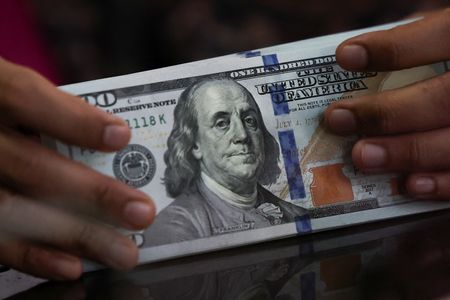

The US dollar weakened during Monday’s Asian trading session as speculation about a potential agreement to reopen the Strait of Hormuz drove oil prices down below $100 per barrel, despite the Trump administration cautioning against expectations of a quick deal with Iran.
The dollar fell 0.2% against the yen to 158.87, while the euro climbed 0.3% to $1.1642 and the British pound increased 0.4% to $1.3485.
Trading volume remained light across the region as numerous global markets were closed for Monday holidays.
The Australian dollar rose 0.4% to $0.7160, while New Zealand’s currency added 0.5% to $0.5877.
“There are early signs that risk sentiment remains supported, early Sydney trade revealing a broad-based selloff in the USD, with ‘riskier’ currencies like the AUD benefitting as a result,” analysts from Westpac wrote in a research note.
Weekend developments suggested fragile optimism for a lasting peace agreement. U.S. President Donald Trump posted Saturday that a memorandum of understanding on a peace deal with Iran had been “largely negotiated,” with both nations and Pakistani mediators reporting advancement.
Nevertheless, the U.S. blockade on Iranian ships in the Strait of Hormuz would “remain in full force and effect until an agreement is reached, certified, and signed,” Trump posted on Truth Social Sunday. Iran’s government had not immediately responded.
Energy markets dropped sharply, with Brent crude falling 5.1% to $98.29 per barrel and U.S. West Texas Intermediate declining 5% to $91.76 per barrel.
Market participants showed cautious doubt about whether any agreement would hold.
“Markets have become conditioned to be incredibly patient on a tangible breakthrough, but the base case of a deal remains firm, with the weekend news providing further conviction, even if the timing remains unclear,” said Chris Weston, head of research at Pepperstone Group Ltd in Melbourne.
Bitcoin increased 0.6% to $77,043.60, while ether gained 0.4% to $2,099.77.