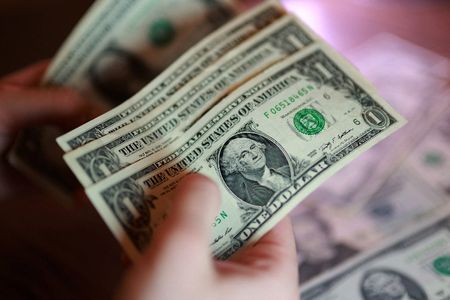

The US dollar strengthened on Friday and is on track for its strongest weekly performance in more than two months, driven by mounting inflation concerns that are increasing speculation about a Federal Reserve interest rate increase this year.
Rising energy costs and ongoing shipping disruptions have intensified inflationary pressures, contributing to the greenback’s rally.
Financial markets are also closely monitoring the second day of crucial talks between US President Donald Trump and his Chinese counterpart Xi Jinping, as Trump pursues economic concessions from Beijing amid the ongoing Iran conflict.
According to US officials, the discussions have centered on both leaders’ mutual goal of reopening the critical Strait of Hormuz shipping route, which Iran has essentially blocked since hostilities began in late February. The talks also highlighted Xi’s apparent willingness to purchase American oil as a way to decrease China’s reliance on Middle Eastern energy sources.
While investor response to the summit has been relatively subdued as markets wait for additional details, the offshore yuan reached near its strongest position in over three years, trading at 6.7874 against the dollar.
“The meeting is broadly in line with market expectations and slightly constructive at the margin,” said Cliff Zhao, chief economist at CCB International.
“A better tone is helpful, but markets will still look for more clarity on trade, business access and specific policy arrangements.”
Across broader markets, the dollar gained momentum, climbing to a two-week peak of 98.98 against a collection of major currencies.
The dollar index is positioned to increase more than 1% for the week, marking its most significant gain since early March.
The dollar’s strength pushed the Japanese yen beyond 158 per dollar, keeping traders watchful for potential intervention from Tokyo. The yen was trading at 158.45 during early Asian sessions and appeared set to decline more than 1% for the week.
The euro dropped 0.04% to $1.1662, also moving toward a weekly decline exceeding 1%.
The dollar’s upward momentum has accelerated throughout the week, supported by indicators showing rising domestic inflation even as the US economy demonstrates resilience despite the continuing Middle East crisis.
Thursday’s economic data revealed that US retail sales continued to grow in April, while weekly unemployment claims figures suggested labor market stability.
Market participants now see a 44% probability that the Fed might increase rates in December, up significantly from the 22.5% chance calculated a week earlier, based on CME FedWatch tool data.
“While we are still cognizant of the softer domestic demand conditions that are being weighed down by rising energy costs, our U.S. CPI forecasts have been revised higher in 2026 again with risks still biased towards the upside,” said Alvin Liew, senior economist at UOB.
“We now expect an extended period of pause to cover the remainder of 2026 before the Fed resumes easing in 2027.”
Among other currencies, the British pound fell to a one-month low of $1.3385, having dropped 0.9% in the prior session following British health minister Wes Streeting’s resignation, which has intensified the political turmoil there.
“The prospect of a potentially disruptive leadership transition and yet another challenging fiscal backdrop heading into the autumn is likely to weigh on sentiment,” said Henry Cook, senior Europe economist at MUFG Bank.
“We see the balance of risks to the UK outlook as firmly skewed to the downside.”
The Australian dollar retreated from its recent four-year high due to the greenback’s strength, declining 0.04% to $0.7217.
The New Zealand dollar weakened 0.14% to $0.5903.