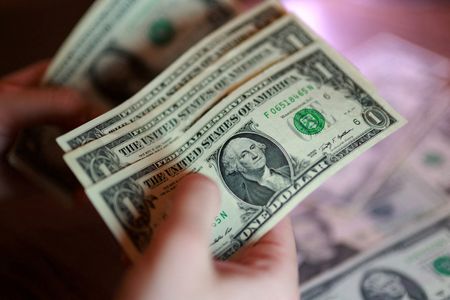

The US dollar is on track for its steepest weekly decline since January as global currencies strengthen amid growing optimism that a Gulf region ceasefire will persist and oil transportation will return to normal levels.
Market direction in the coming days will likely depend on weekend negotiations between the United States and Iran taking place in Pakistan’s capital.
Throughout March, the dollar had surged as investors sought safety during the US and Israeli conflict with Iran, which caused oil prices to soar, damaged stock markets, and created inflation concerns that hurt bond values.
However, since Tuesday’s fragile ceasefire agreement, these market positions are reversing, with the US dollar index dropping 1.3% during the current week.
The euro has climbed past its 200-day moving average this week, reaching $1.1690 and breaking through technical resistance that could lead to additional gains.
Risk-sensitive currencies from Australia and New Zealand are posting weekly gains of nearly 3% against the dollar, with the Australian dollar trading just over 70 cents and New Zealand’s currency at $0.5847. The British pound has surged 1.8% this week, rising above its 200-day moving average to $1.3424.
Even Japan’s yen, which faces pressure from the country’s low interest rates, government spending initiatives, and reliance on oil imports, remains just above recent lows at 159.2 against the dollar.
“People were buying the U.S. dollar when the war was at its most intense moment and now they’re selling as the tail risk of a really bad outcome has faded quite a bit,” explained Jason Wong, senior strategist at BNZ in Wellington.
“Even though it still looks a bit shaky, the ceasefire removing that tail risk is important from a sentiment point of view,” Wong noted, while warning that conditions could change rapidly if this weekend’s anticipated peace discussions fail to show progress.
During the ceasefire’s first day, only one oil tanker and five cargo ships passed through the Strait of Hormuz, a dramatic decrease from the pre-war traffic of approximately 140 vessels daily carrying about one-fifth of global oil and liquefied natural gas supplies.
Iranian representatives reached Pakistan’s capital on Thursday, while a US delegation headed by Vice President JD Vance is scheduled to arrive Friday for discussions that investors hope will establish permanent peace.
“If there’s positive talks, that would be dollar negative. And if we get to Monday and talks went badly and there’s still a lack of ships…things could turn around quickly,” Wong warned.
South Korea’s central bank maintained its benchmark interest rate unchanged Friday as anticipated, keeping the won at 1,478 per dollar after recovering from levels beyond 1,500.
This week’s dollar weakness has pushed China’s yuan to its highest levels since 2023, trading at 6.83 per dollar in offshore markets. The yuan has remained relatively stable since the conflict began in late February.
“The CNY has been a surprising winner of the Iran war, despite China’s role as the largest oil importer in the world,” observed ING economist Lynn Song.
“At least a few market participants have mentioned re-evaluating the ‘China risk premium’ amid rising global uncertainty elsewhere, which has led to China looking more and more like the adult in the room.”