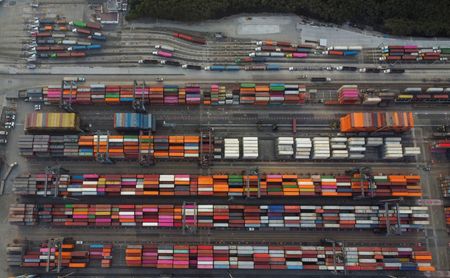

U.S. and Mexican officials are heading back to the negotiating table, with a fourth round of talks on the North American trade deal scheduled for early September, according to Mexico’s economy ministry. The announcement came Thursday following a third round of discussions this week aimed at bringing the two countries closer together on key disagreements.
U.S. Trade Representative Jamieson Greer traveled to Mexico this week, where he met with Mexican President Claudia Sheinbaum and Economy Minister Marcelo Ebrard as part of the ongoing effort to renew the U.S.-Mexico-Canada Agreement, known as USMCA.
Ebrard described the latest discussions as productive in some areas. “The conversations were constructive and produced advances on topics like steel, aluminum” and the replacement of imports from Asia, he said in a written statement Thursday.
The three countries are working to renegotiate the six-year-old agreement, which supports nearly $1.6 trillion in regional trade that was previously duty-free. However, the process is at risk of dragging into next year — a delay that Mexico and Canada have been eager to avoid, given the uncertainty it creates for businesses and investors.
Despite the progress noted by Ebrard, two sources with knowledge of the negotiations — who requested anonymity due to the sensitive nature of the talks — say the two sides are still far apart on several critical issues.
A major point of contention is Washington’s push to require that vehicles contain at least 50% U.S.-made content in order to qualify for favorable trade terms. That proposal has been flatly rejected by Mexico. One source said Mexico is unwilling to accept “even 1%” of a U.S.-specific content requirement, warning that such a rule “opens the door for a potential increase in the future” and would set a troubling precedent.
Under the current USMCA rules, vehicles must be made with 75% North American content to qualify for duty-free treatment, with 40% of production coming from workers earning at least $16 per hour — a standard met in both the U.S. and Canada. Notably, the existing agreement does not require that any set portion of a vehicle’s content come from a single country.
Mexico, for its part, is pressing Washington to roll back so-called “Section 232” national security tariffs — currently 25% on automobiles and 50% on steel and aluminum from Mexico and Canada — before agreeing to give ground on other issues. So far, President Donald Trump has shown no indication he intends to ease those tariffs.
During testimony before the Senate on Wednesday, Greer expressed hope that interim trade agreements with Mexico and Canada could be reached this year, with more complicated changes to the USMCA addressed in 2027.
Kevin Brady, a former Texas congressman who once led the powerful U.S. House Ways and Means Committee and is a supporter of the North American trade pact, offered a measured assessment of where things stand. “At this point, every (negotiation) round adds value,” he said. “The negotiations are not in a bad place.”