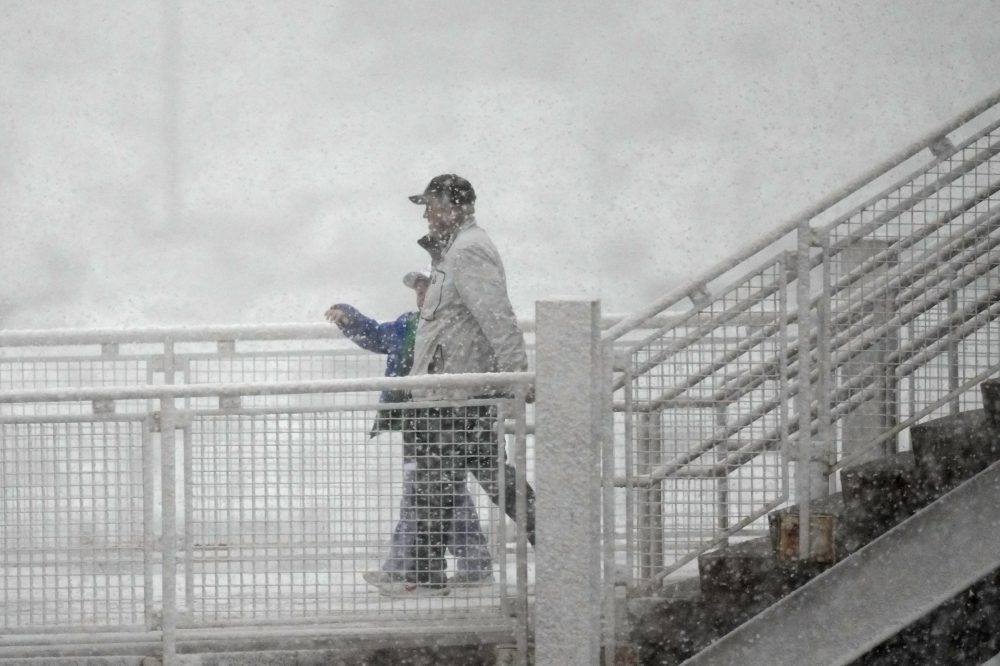

FORT COLLINS, Colo. (AP) — An unexpected spring snowstorm battered Colorado on Wednesday, forcing educational institutions to cancel classes, grounding flights, and creating treacherous driving conditions across the region.
The weather system moved through the Rocky Mountains and onto the High Plains starting Tuesday, with forecasters predicting it would diminish by Wednesday evening after depositing heavy, moisture-laden snow at higher altitudes.
Weather officials issued winter storm warnings lasting through the afternoon, forecasting an additional 2 to 4 inches of accumulation for Fort Collins, Boulder, Denver metropolitan region, and Castle Rock, according to the National Weather Service.
“We expect roads to be slick during heavier snow showers, but for the lower elevations, any road accumulations will melt quickly as snow showers subside,” the weather service office in Denver posted online Wednesday.
The mountain community of Jamestown, Colorado, located near Boulder, measured 16.3 inches of snow by early Wednesday morning, weather officials reported. Estes Park, situated close to Rocky Mountain National Park, documented 17 inches of accumulation by Tuesday evening.
Boulder municipal authorities, after receiving nearly 6 inches of snow by Tuesday’s end, warned residents about fallen trees and limbs, urging people to stay away from areas with heavy snow-laden branches.
The Mile High City confronted what could become its heaviest snowfall this season. Denver International Airport, which experienced delays and flight cancellations early Wednesday, measured 3.7 inches of snow by 2 a.m., meteorologists confirmed.
Cold temperatures also dropped dramatically. Denver, experiencing temperatures in the low 30s Wednesday morning, implemented its emergency cold weather shelter protocols.
Milder conditions are anticipated to return Thursday, forecasters indicated.
Denver Public Schools, the state’s most extensive educational district, along with other major regional school systems and universities, suspended Wednesday instruction because of dangerous weather conditions.
The threatening weather predictions didn’t prevent thousands from attending David Guetta’s performance at Red Rocks Amphitheatre Tuesday evening, though event organizers moved the starting time earlier by one hour hoping to get attendees home before conditions worsened.
Concert attendees wrapped themselves in heavy winter jackets and knit caps while queuing to enter the open-air venue.
The weather system forced the Colorado Rockies to postpone two matchups against the New York Mets. However, such rescheduling occurs frequently during Denver’s spring baseball calendar, including four occasions in 2015, MLB records show.
May snowfall isn’t unusual for Colorado. Such weather happens even more frequently in Cheyenne, Wyoming’s capital, which sits almost 1,000 feet higher than Denver and maintains cooler year-round temperatures. Wyoming also experiences stronger winds than Colorado, creating snow drifts requiring repeated plowing when gusts continue.
April brought warmer than typical temperatures and limited moisture, with Denver receiving an inch less rain and 2.8 inches less snow last month compared to average conditions.
For certain agricultural producers dealing with Colorado’s persistent drought conditions, the snowfall presented an opportunity.
Adam Jones, who operates Unsung Family Farms in Longmont, told KMGH-TV that he had planted carrot seeds several days earlier to capitalize on the incoming precipitation.
“You can’t get as even distribution with driplines or sprinklers,” he said. “There’s nothing like starting seeds with snow or water.”
Jones needed to relocate his more temperature-sensitive plants indoors, using heating equipment to maintain proper growing conditions.
The unstable weather patterns extend beyond the Rocky Mountain region.
Dangerous thunderstorms with tornado potential threatened the Southeast on Wednesday.
The most intense storms were anticipated from Arkansas extending through Georgia.