
Two senior United Nations officials are sounding the alarm, urging Western countries to re-engage with Afghanistan before the nation slips deeper into instability — with consequences that could ripple across the globe.
“The lesson of (the) recent past is that ignoring Afghanistan is not a good thing to do,” said the United Nations High Commissioner for Refugees, Barham Salih, speaking to The Associated Press during a joint visit to the country alongside the head of the United Nations Development Program, Alexander De Croo.
Salih, speaking via video link, said it is wiser “to engage, to support and promote the right type of policies to making sure that Afghanistan remains safe and secure.” He warned that without such engagement, “we may well risk instability, with all the implications of that instability” — including drug trafficking, extremism, criminal activity, and refugee flows.
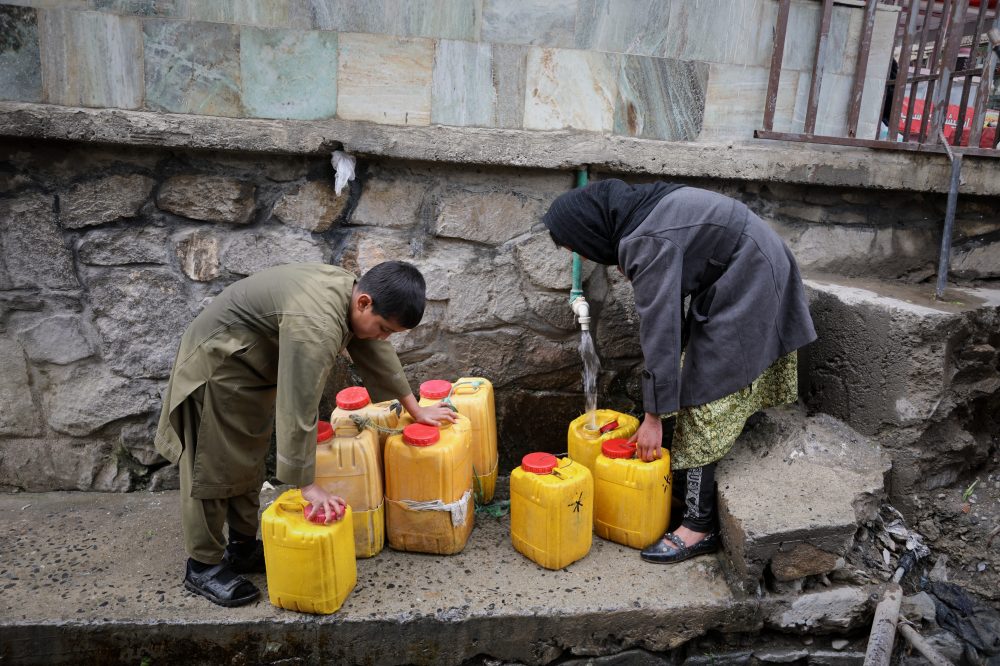
Afghanistan, a country battered by four decades of conflict, is now facing a convergence of crises — natural disasters, climate change, and one of the largest waves of returning refugees seen anywhere in decades.
“In Afghanistan, there is never a crisis just on its own. It’s always crisis on top of crisis,” De Croo told the AP. “And that you see here.”
Nearly 6 million people have returned to Afghanistan since 2023, most of them from neighboring Pakistan and Iran after those countries launched crackdowns on migrants. Another roughly 2 million are expected to arrive back this year, according to the U.N. officials.
These returnees are putting enormous pressure on local communities that already have very limited resources in a country where poverty is widespread and malnutrition threatens the most vulnerable residents.
The situation has been made worse by steep cuts in international aid and a Taliban government that has excluded women and girls from education beyond primary school and barred them from most jobs.
Afghanistan also remains cut off diplomatically. No Western nation has formally recognized the Taliban government since it took power following the chaotic withdrawal of U.S.-led forces in August 2021. Russia became the first country to officially extend recognition, doing so in 2025.
Last month, a Taliban government delegation traveled to Brussels to meet with European Union staff for discussions on diplomatic services and the return of Afghan nationals from European countries — a small but symbolic step toward breaking Afghanistan’s international isolation.
Despite the daunting challenges, U.N. officials noted that Afghanistan has made meaningful gains in certain areas, particularly in security, fighting corruption, and reducing drug production.
“I wouldn’t close my eyes to the fact that there is progress, and maybe progress that no one would have expected five years ago,” De Croo said. He pointed out that drug production has fallen by 95% in a country that was once one of the world’s leading producers of opium and heroin.
“If now the international community turns its back to Afghanistan, the consequences will not only be in Afghanistan. The consequences will be much, much broader,” De Croo warned.
He added: “The message to Western countries is: if you want to have a stable and peaceful society, you are not only achieving that with domestic policy. If you want to live in peace and stability, your neighborhood also needs to be at peace and stability.”
The Taliban’s severe restrictions on women and girls remain a major sticking point between Afghanistan’s government and the international community. Both De Croo and Salih said they raised the issue directly with Afghan officials during their visit, and both believe that continued engagement — not isolation — is the path to progress.
“We hope that constructive engagement will show the way forward in that regard,” Salih said. “It’s important that there is progress, there is tangible reforms that will allow for an inclusive system in this country.”
The cuts in international aid have had “a very tangible impact” on the Afghan people, De Croo said. He noted that 422 medical centers shut down in Afghanistan in just one year due to a loss of funding. “Closed because the funding just disappeared. That is more than 3 million people that are impacted, that just lose their access to basic medical services,” he said.
Earlier this year, the World Food Program revealed that funding shortfalls had forced it to turn away three out of every four severely malnourished children seeking help because it no longer had the resources to feed them.
The Taliban launched a poppy eradication campaign after taking power, but De Croo noted that the dramatic drop in drug production was also tied to programs that gave farmers alternative crops to grow. Funding for those programs, he said, has been sharply reduced — raising the risk that drug cultivation could return if support disappears.
“If we cannot continue working together with farmers in giving them an alternative for producing drugs,” drug cultivation could come back, he said.
Salih acknowledged that global attention has largely shifted away from Afghanistan, but said the current moment presents a real opportunity for the world to step back in.
“It is vital to remind the world that the price of inaction far outweighs action,” Salih said. “You cannot ignore Afghanistan, and what happens in Afghanistan does not necessarily stay in Afghanistan.”