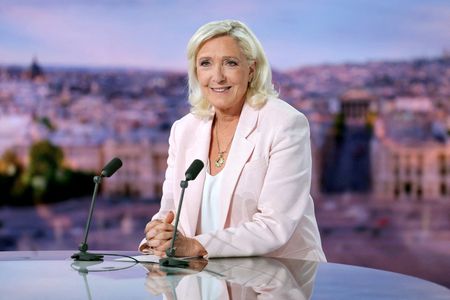

PARIS — Marine Le Pen wasted no time declaring her fourth run for the French presidency, making the announcement within hours of a Paris appeals court ruling that cleared her path to the 2027 election.
Speaking during a prime time appearance on TF1, Le Pen framed her candidacy as the story of a fighter who had pushed through a lengthy legal battle that many thought would finish her political career for good.
“There are many French people who are going through hardships, and we too are going through hardships,” she said. “These trials, I believe, have strengthened us.”
Until Tuesday’s ruling, Le Pen’s chances of ever reaching the Élysée Palace had appeared finished. A court had previously handed her a five-year ban from holding office back in March 2025 after finding her guilty of embezzling European Parliament funds to pay staff at her anti-immigrant National Rally party in France. The appeals court on Tuesday reduced that ban, allowing her to run — though it did not overturn the underlying conviction.
Le Pen confirmed she intends to pursue a final appeal against the guilty verdict at the same time she campaigns for the presidency, a bold and risky dual strategy.
The move is a significant gamble. She must hope that France’s highest court sides with her in that last-resort appeal, and she must also convince voters to elect someone two separate courts have now found guilty of embezzlement. Le Pen appears to believe French voters will look past her legal troubles to make her the country’s first far-right leader in modern times.
“I think you should never impose anything on the French people; they must have the final say, and now the French people will have the final say,” she said.
Brigitte Barèges, a former lawmaker from a right-wing party aligned with the National Rally, said she understood Le Pen’s decision to press forward.
“I know her character and I’m a bit like that,” Barèges said. “You want to show those who caused you this setback that you are not dead because of it, that you are still there.”
The announcement comes at a moment when the National Rally has never been closer to wielding real power in France. Polling data indicates Le Pen should comfortably advance to the second-round runoff in next year’s election, though winning the final vote is considered less certain.
Le Pen told TF1 she is confident she will be able to campaign without the restrictions of an electronic monitoring tag, which had been a condition attached to her release. She also confirmed that Jordan Bardella, the 30-year-old party president she has mentored, will run alongside her as a candidate for prime minister should she win.
Bardella had previously been positioned to run for the presidency himself if Le Pen remained barred, and current polling actually shows him performing more strongly than Le Pen for the top job. Le Pen dismissed any suggestion that this arrangement might breed resentment between them.
“Jordan Bardella and I are fighting for France. We are fighting for the French people. This cause clearly goes beyond us,” she said. “And therefore our personal ambitions do not come into consideration at all.”
Barèges agreed that the National Rally’s chances are stronger with both figures running together, noting that over recent years the pair have built a powerful political partnership that blends fresh energy with seasoned experience, helping transform a once-fringe movement into a party that could realistically form a government.
“We have offered the French people a partnership, a partnership that I believe is complementary, balanced, coherent, and solid,” Le Pen said.
Challenges remain, however — particularly on economic policy. Critics have long accused the National Rally of lacking a credible plan to address France’s significant public debt and sluggish economic growth. While Le Pen dealt with her court battles, Bardella began moving toward a more free-market economic stance than his mentor on issues such as pension reform.
Among the unresolved questions is whether the party will hold to its pledge to lower the retirement age back to 62, a promise that some insiders within the party now view as financially unsustainable.
A senior party official acknowledged that several major policy questions remain unanswered, with tough decisions still ahead on issues including pensions and taxation.
Gilles Ivaldi, a political scientist at Sciences Po, said resolving the party’s internal tensions over economic policy will be critical to its prospects going forward.
“To govern and secure a parliamentary majority, the RN ultimately needs to win over right-wing voters and, at some point, reach accommodations with the mainstream right,” he said. “A broad alliance of right-wing forces is a prerequisite for the RN to take power.”