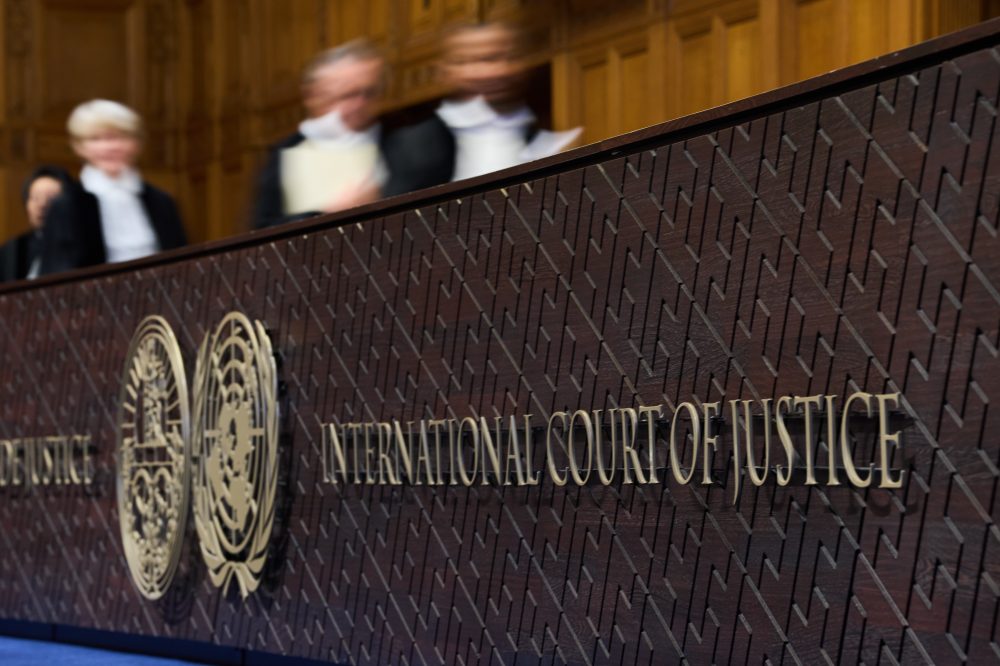

THE HAGUE, Netherlands — During Friday’s commemoration marking eight decades of the World Court’s existence, the United Nations Secretary-General delivered a sobering message about the deteriorating state of international law across the globe.
Speaking to assembled officials in the elaborate Great Hall of the International Court of Justice in The Hague, António Guterres declared that “The force of law must always prevail over the law of force.”
The milestone celebration highlighted the growing pressure facing the global legal system. Recent threats by U.S. President Donald Trump to destroy Iranian infrastructure, including bridges and power facilities, represent actions that military law specialists suggest could amount to war crimes. Meanwhile, Sudan has entered its fourth year of conflict between military and paramilitary groups, and Russia persists in its Ukrainian offensive despite ICJ directives to cease.
Oxford University international law scholar Janina Dill explained to The Associated Press that “Powerful states have thrown out the rule book and perform disdain for international law.”
Currently experiencing its most active period in history, the tribunal is handling complex matters including the Gaza situation, Ukraine conflict, and environmental issues.
During Friday’s ceremony, Chief Justice Yuji Iwasawa stated that the court meets these obstacles by fulfilling its role of “interpreting and applying international law rigorously and in good faith.”
Established following World War II’s conclusion, the ICJ serves as an arbitrator for international disagreements. The court’s panel of 15 justices can also provide legal guidance to specific U.N. organizations, including the General Assembly.
While all 193 U.N. nations hold ICJ membership, not every country automatically accepts its authority.
The court’s first session in 1946 included just 51 member nations, with Queen Juliana of the Netherlands in attendance. Her descendant, King Willem-Alexander, participated in Friday’s anniversary event.
The tribunal’s inaugural case came in 1947 when Britain filed complaints against Albania regarding naval vessel damage in the Corfu Channel.
Current proceedings include genocide accusations against Myanmar concerning Rohingya minority persecution and against Israel regarding Gaza military operations. Both nations reject these claims.
Some disputes predate the court’s establishment, including Guyana’s request for resolution of its Venezuelan border disagreement, a conflict ongoing since 1899.