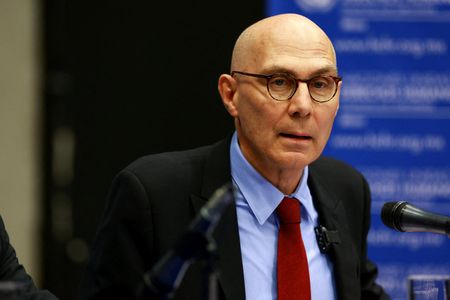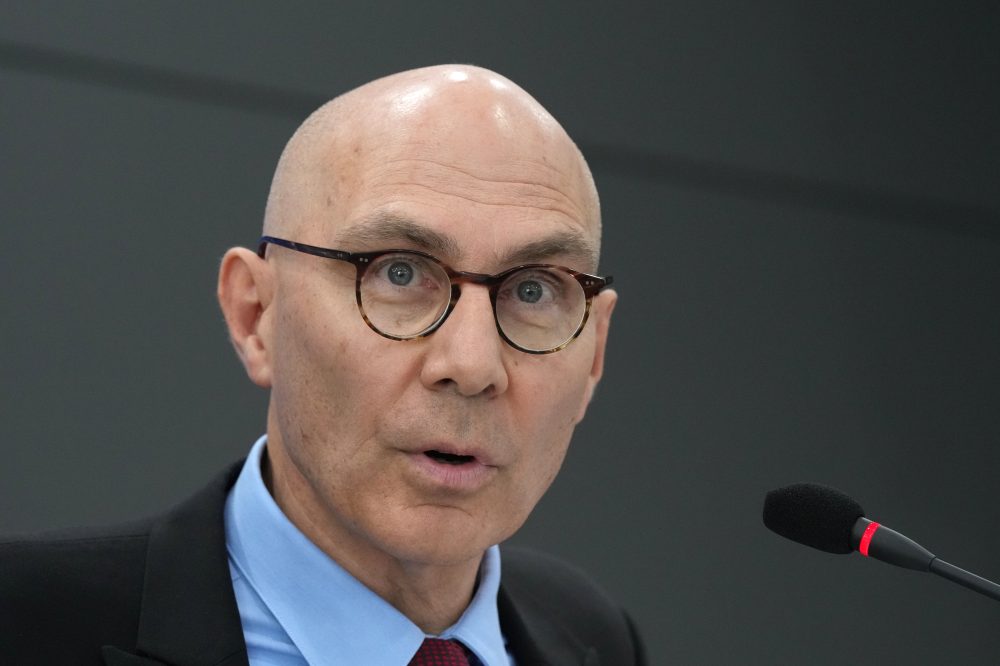

UNITED NATIONS — The United Nations’ top human rights official, Volker Türk, faced a vote Friday on whether he would be reappointed to a second four-year term, with significant pushback coming from multiple countries and critics who take issue with how he has handled crises in Gaza and China.
Secretary-General Antonio Guterres quietly put forward the Austrian lawyer’s name for reappointment. With little public debate, the 193-member General Assembly set a Friday afternoon vote on the matter.
The U.S. State Department sharply criticized the speed of the process, calling it “another example of the U.N.’s inherent corruption and incompetence.”
“Volker Turk has turned a blind eye to real atrocities and instead pursued a radical ideological agenda,” the department said. “We will not allow the UN Secretary General (SYG) to reward his crony with a cushy job extension he has done nothing to earn.”
The role of U.N. human rights chief is inherently challenging — it demands speaking out against rights abuses committed by the very governments that make up the world body’s membership. Türk, for example, has been outspoken in condemning Russia’s 2022 military invasion of Ukraine.
Türk’s current term is set to expire on October 11. Russia’s U.N. Mission has suggested limiting any extension to December 31 — the same day Guterres’ second five-year term as secretary-general concludes.
Russia described Guterres’ push to give Türk four additional years as U.N. High Commissioner for Human Rights as “unprecedented,” noting that none of Türk’s predecessors have completed two full terms since the position was established in 1993.
A shorter extension through the end of the year would effectively hand the decision of selecting a new human rights chief to the next secretary-general. Six candidates are currently competing to lead the U.N.
Earlier this month, Guterres sent letters to regional groups within the U.N. announcing his intention to reappoint Türk. While African member nations raised no objections, Latin American countries — including Nicaragua, Argentina, and Paraguay — expressed several concerns.
Israel’s Foreign Ministry described Guterres’ push for Türk’s reappointment as the secretary-general’s “latest moral failure,” posting on social media that the decision should be left to his successor. “After years of bias against Israel, the answer is accountability — not rewriting the rules,” the ministry stated.
U.N. spokesman Stephane Dujarric defended the process, saying Guterres is acting within the framework of the 1993 resolution that created the human rights commissioner role and permits a second term.
“The secretary-general is doing things in a very transparent manner, following the rules and his authority,” Dujarric told reporters Friday. “Consultations were had with member states prior to this and with regional groups.”
A spokesperson for the human rights office, Ravina Shamdasani, confirmed that Türk “is ready to serve” another term. She emphasized that the role involves “promotion and protection of human rights everywhere” and that Türk views engaging with all nations as part of his responsibilities.
During his tenure, Türk — a longtime U.N. official who previously worked for Guterres at U.N. headquarters in New York — has raised concerns about a range of human rights issues in China. These include the cases of detained individuals such as artist Gao Zhen, lawyer Yu Wensheng, and media mogul Jimmy Lai, as well as counterterrorism and assimilation policies affecting ethnic minorities including the Uyghurs in Xinjiang, Inner Mongolia, and Tibet.
Some critics argue Türk should have done more to publicly build on a report issued by his predecessor, former Chilean President Michelle Bachelet, which found that China’s detention of Uyghurs and other predominantly Muslim ethnic groups in Xinjiang may rise to the level of crimes against humanity.
Türk has also declined to join independent U.N. rights experts who have accused Israel of committing genocide against Palestinians during its military campaign against Hamas in Gaza — a charge Israel strongly denies.
Former Human Rights Watch director Ken Roth called Türk “a disaster” and said “the biggest stain on Turk’s reputation is his utter abandonment of the Uyghurs,” describing them as victims of the most serious state persecution Türk has chosen to ignore.
China’s government denies any persecution of the Uyghur population, maintaining that its policies in Xinjiang were aimed at eliminating terrorism and religious extremism following a series of violent incidents in the region over previous decades.
Türk’s office said he has engaged Beijing both privately and publicly on human rights concerns. Roth dismissed that approach, saying it amounts to “an admission that he is doing nothing, that he’s putting the plight of the Uyghurs on the deep back burner, and is just pretending to care.”
Roth argued the human rights commissioner’s job “should be about stirring up public pressure, and you do that by being tough, provocative, timely.” He said Türk “has succeeded in making a powerful position largely innocuous,” addressing issues in a manner “that makes people’s eyes glaze over.”