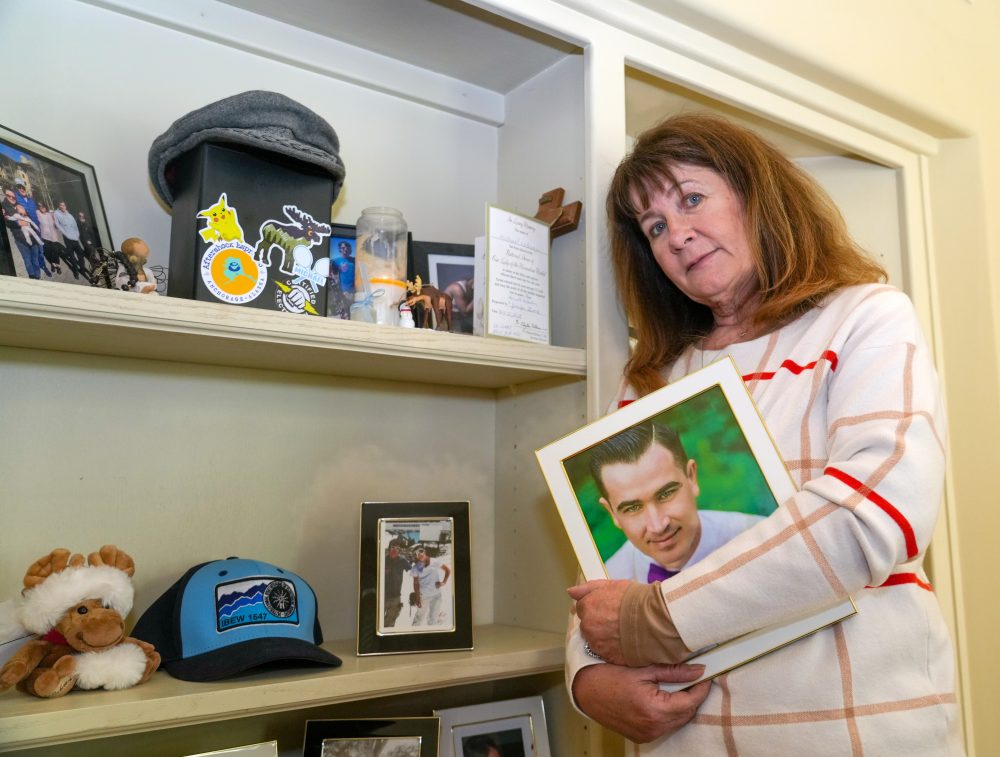

Michael Nalewaja had rebuilt his life after battling addiction as a teenager. The 36-year-old electrician was living peacefully in Alaska, nearly two decades removed from his struggles with substance abuse.
But just before Thanksgiving 2025, his life ended tragically when he and a friend unknowingly consumed a deadly mixture of fentanyl and carfentanil, possibly believing they were using cocaine.
“I heard the word ‘autopsy’ and I literally just collapsed to the floor,” his mother, Kelley Nalewaja said, describing the devastating phone call from his wife. “Even if somebody had been there prepared with Narcan — even if somebody had called 911 in time — he was not going to survive.”
Law enforcement officials describe carfentanil as a military-grade substance that is 10,000 times more powerful than morphine and 100 times more potent than fentanyl. This extremely dangerous chemical is experiencing a dramatic comeback throughout the United States, claiming the lives of hundreds of unsuspecting users.
This alarming trend appears connected to recent enforcement actions by Chinese authorities targeting the chemicals used to produce fentanyl. These new restrictions are likely forcing Mexican drug traffickers to turn to carfentanil as a way to strengthen their weakened fentanyl products, according to intelligence reports from the U.S. Drug Enforcement Administration that The Associated Press obtained.
The return of this extraordinarily lethal substance comes at a time when fentanyl confiscations and drug overdose fatalities have been decreasing for multiple years. An amount smaller than a poppy seed can prove fatal to a human being.
“You’re talking about not even a grain of salt that could be potentially lethal,” said Frank Tarentino, the DEA’s chief of operations for its northeast region, which stretches from Maine to Virginia. “This presents an extremely frightening proposition for substance abuse dependent people who seek opioids on the street today.”
Ten years ago, carfentanil first appeared in significant quantities in the North American illegal drug market, leading to hundreds of fatal overdoses among users who had no idea what they were consuming. The crisis subsided after China prohibited the substance, eliminating a significant regulatory gap in the United States.
However, the landscape has changed drastically in recent years.
DEA laboratory analysis identified carfentanil in U.S. drug confiscations 1,400 times during 2025, a massive increase from 145 instances in 2023 and just 54 in 2022, according to DEA documentation reviewed by the Associated Press.
Mexican drug organizations may be attempting to manufacture carfentanil on their own, law enforcement believes, while others might be obtaining it from Chinese suppliers who are circumventing their country’s restrictions by advertising the substance on international online platforms.
The extreme hazards involved in producing carfentanil create additional challenges for criminal organizations, Tarentino explained.
“You can’t just dabble in this,” he said. “This is not some mad scientist on Reddit you’re going to get to go out to a rudimentary laboratory in Mexico to make carfentanil.”
American overdose fatalities have declined for more than two years, marking the longest sustained decrease in decades. Researchers attribute this improvement to several factors, including greater availability of the overdose-reversing medication naloxone and expanded access to addiction treatment programs. Some also connect it to the regulatory modifications the United States has advocated for in China.
Medical professionals warn that even multiple large doses of naloxone may prove insufficient to counteract an overdose involving carfentanil.
Confiscations of fentanyl and other illegal substances have also decreased. U.S. Customs and Border Protection data shows fentanyl seizures dropped to approximately 12,000 pounds in 2025, less than half the quantity confiscated in 2023.
Despite declining fentanyl statistics, it continues to be a primary concern for the DEA. The agency’s recent budget proposal included a $362 million funding increase specifically targeting cartel-related fentanyl trafficking operations.
“Anyone who takes a pill that is not prescribed to them by their doctor is playing a game of Russian roulette with their life,” said Sara Carter, President Donald Trump’s drug czar. “But if those terrorists think they can continue this chemical warfare without consequences, they are wrong.”
Although carfentanil’s presence remains much smaller compared to fentanyl, experts express serious concern about the increase of a compound that has been studied for years as a chemical weapon and was used by Russian military forces against Chechen separatists in 2002.
The DEA’s yearly allowance for legally produced carfentanil is only 20 grams, an amount small enough to hold in one’s palm. Veterinarians use it to sedate elephants and other massive animals.
“It’s like a biological weapon,” said Michael King Jr., founder of the Opioid Awareness Foundation. “If the world thinks we had a problem with fentanyl, that’s minute compared to what we’re going to be dealing with with carfentanil.”
Fatal overdoses involving carfentanil nearly tripled in 2024 compared to the year before, with 413 deaths recorded across 42 states and Washington, D.C., based on the latest information from the Centers for Disease Control and Prevention.
“Carfentanil definitely has that potential of spreading throughout the United States unless law enforcement really focuses in on carfentanil and they develop intelligence as to how these drug addicts are getting it,” said Mike Vigil, a former chief of international operations at the DEA.
Federal agents have documented multiple major carfentanil seizures in recent months. In October, the DEA Los Angeles Field Division discovered 628,000 pills containing carfentanil, while in September, authorities confiscated more than 50,000 fake M30 pills from an individual at a Washington state gas station that contained a combination of carfentanil and acetaminophen.
Some chronic drug users have developed tolerance to fentanyl and are actively seeking carfentanil, despite its dangers, because of the intense high it produces, explained Rob Tanguay, senior medical lead for addiction services with Recovery Alberta, a Canadian health organization. The substance attracts dealers because such small quantities can supply a large market.
“The toughest part about all of this,” he said, “is that this is all about money.”
Following Michael Nalewaja’s death, his mother chose not to hold a large funeral service.
Instead, she organized a community meeting in her hometown of El Dorado Hills, California, gathering local leaders and other mothers who had experienced similar tragedies.
While mourning her son, a talented salesman with natural charisma who had recently received a national recognition from the electrical union, she is advocating for significant legislative and judicial reforms to prevent other families from enduring what she experienced due to a substance she says was never intended for human consumption.
“It’s not an OD; it’s not an overdose,” she said. “It’s a murder weapon.”