
LEXINGTON, Mass. — When Charlie Price attended school, his Revolutionary War education covered the basics: George Washington, Bunker Hill, and the patriots’ victory. What he didn’t discover until joining a Revolutionary War reenactment group was how much history had been left out of those lessons.
This Saturday, the Lexington Minutemen will commemorate the anniversary of the Battle of Lexington in Massachusetts, just as they have for decades. Among the historical figures they’ll honor is Prince Estabrook, an enslaved man who stood alongside his white neighbors on Lexington Green on April 19, 1775, when British forces advanced. Though wounded in the fighting, Estabrook continued serving through multiple military campaigns during the war.
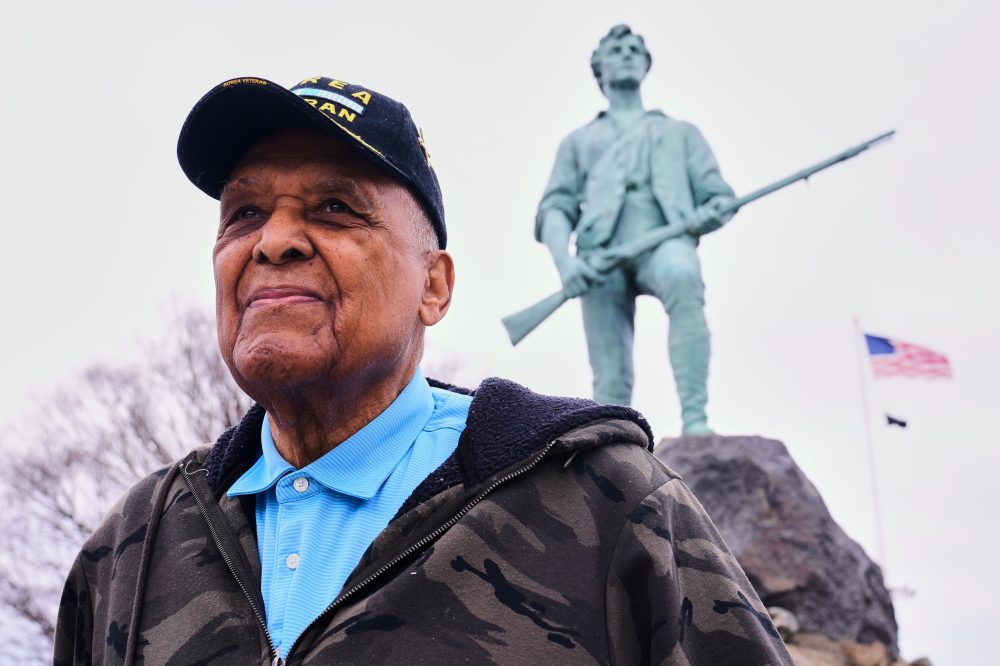
“I wasn’t surprised that we didn’t know about it,” said Price, a 95-year-old Black Korean War veteran who portrayed Estabrook for five decades. “I was surprised that there was one Black soldier out here.”
With America’s 250th birthday approaching, Estabrook and other patriots of color are gaining recognition through nationwide initiatives designed to present a fuller picture of the nation’s founding.
Traditional museum displays, documentaries and educational programs have typically highlighted white Revolutionary leaders like Washington, Benjamin Franklin and Paul Revere.
Christopher Brown, who studies British Empire history at Columbia University, explained that the Revolution has historically been presented as a “simple story and a moral story that celebrates American origins and that looks to the American past in a kind of idealized version of what the present is.”
However, recent decades have brought “a more accurate view of the past” that reveals the diverse group of men and women who played vital roles in America’s fight for independence.
“There were Black men in the ranks who were fighting in Concord and Lexington and fought on Bunker Hill,” he said. “They knew all of the work that women were doing to support the revolutionary effort. The fact that we didn’t know that is more of a sign of our lack of curiosity and the need for greater research.”
According to National Park Service data, more than 5,500 patriots of color — both Black and Indigenous people — served with colonial forces by the Revolution’s end, while numerous runaway slaves joined British ranks.
These Black patriots’ experiences cannot be separated from slavery, which was legally practiced across all 13 colonies. Some Black fighters were enslaved while others enlisted hoping to earn their freedom. Indigenous warriors faced similar choices while their tribes battled for survival.
Despite documented evidence of this military diversity, efforts to share these narratives face challenges. The Trump administration has mandated removal or censorship of certain exhibits focusing on slavery history, enslaved individuals, the Civil Rights Movement and Indigenous mistreatment.
Roger Davidson, Jr., who teaches history at Bowie State University, warns that ignoring this crucial historical chapter affects communities of color today.
“If you’re not seen as having contributed to society, to the military, to any of it, then people can sort of overlook you,” Davidson said. “It plays into, and I hate to put it this way, but it plays into some people’s biases. Why should we pay any attention to you in the present day, politically, socially, economically, if you have not contributed?”
MA250 has distributed millions in grants to commemorate Massachusetts battles that sparked America’s independence. Grant recipients include the Black Heritage Trail in Concord, which spotlights Black residents’ lives during the Revolutionary period.
Museums celebrating Black patriots have also secured funding. Featured figures include Crispus Attucks, a sailor with African and Indigenous heritage who died March 5, 1770, when British soldiers opened fire on civilians in the Boston Massacre. Another is Salem Poor, who bought his freedom from slavery before fighting at Bunker Hill.
American Ancestors, a Boston-based nonprofit history organization that received MA250 funding, launches its “Patriots of Color” exhibition next week, focusing on 26 Black and Indigenous men and women who participated in the American Revolution. Featured individuals include Prince Ames, a Black and Narragansett man from Andover who was forced into Continental Army service in his enslaver’s place, and Paul Cuffe, a Black and Wampanoag businessman who petitioned Massachusetts officials against taxation without representation.
Descendants of some featured patriots will attend the exhibition opening.
“By telling these lesser known stories, we want to highlight that ordinary people made a tremendous difference in the arc of the country’s history,” Ryan Woods, president and CEO of American Ancestors, said.
Historical documentation about Prince Estabrook’s life remains limited, but National Park Service records suggest he was born around 1740 in the Lexington vicinity. Since his father was enslaved by landowner Benjamin Estabrook, Prince was born into bondage.
Details about his pre-military life are unclear. Park Service records show he served under Colonel John Parker’s command on April 19, 1775, when a musket ball struck his left shoulder. Following his recovery, he served eight years with both militia and Continental Army units.
Post-Revolution, he gained his freedom and returned to Lexington, where 1790 tax documents list him on Benjamin Estabrook’s payroll as ‘a non-white freeman.’ Whether he married, had children or owned land remains unknown.
Family records indicate he died in 1830 at approximately age 90 and was buried in the same Ashby, Massachusetts cemetery as Benjamin’s son, Nathan.
Price, who has passed reenactment responsibilities to a younger participant but continues attending annual morning commemorations, emphasizes the importance of preserving the soldier’s memory.
“Keep the story alive to make sure that everybody knows, everybody that we can get in touch with, everybody knows that Prince Estabrook was here,” Price said. “He was a viable person. He did his role, he did his part in fighting for the country.”