
KYIV, Ukraine — Ukrainian military forces carried out extensive long-distance strikes against targets located far within Russian territory on Wednesday, as part of Ukraine’s strategy to increase the war’s costs for Moscow by attacking energy infrastructure and military production facilities.
President Volodymyr Zelenskyy announced that Ukrainian troops successfully hit multiple military and energy infrastructure locations, including a military production facility that he stated provided components for Russian drones and missiles.
Through a social media announcement, Zelenskyy revealed that Ukrainian FP-5 Flamingo long-range missiles successfully struck the target in Cheboksary, situated in the Chuvashiya region over 900 kilometers (more than 560 miles) away from the battle front.
Russia’s Defense Ministry reported that air defense systems intercepted 326 Ukrainian drones during nighttime operations.
Oleg Nikolayev, the head of Chuvashiya, verified the missile strike occurred but provided no additional information. The Astra online news outlet indicated that the Ukrainian attack targeted the VNIIR-Progress plant that manufactures antennas for drones.
Zelenskyy additionally reported that Ukrainian troops attacked a refinery in Russia’s Samara region, where Gov. Vyacheslav Fedorishchev stated that multiple industrial facilities sustained damage from drone attacks and three individuals were wounded.
Fedorishchev declined to identify the specific damaged facilities, though Astra published photographs showing a major fire at the Samara refinery.
Zelenskyy further noted that Ukraine’s Security Service (SBU) had targeted two oil infrastructure sites in Russia’s Vladimir region, approximately 700 kilometers from the battle zone.
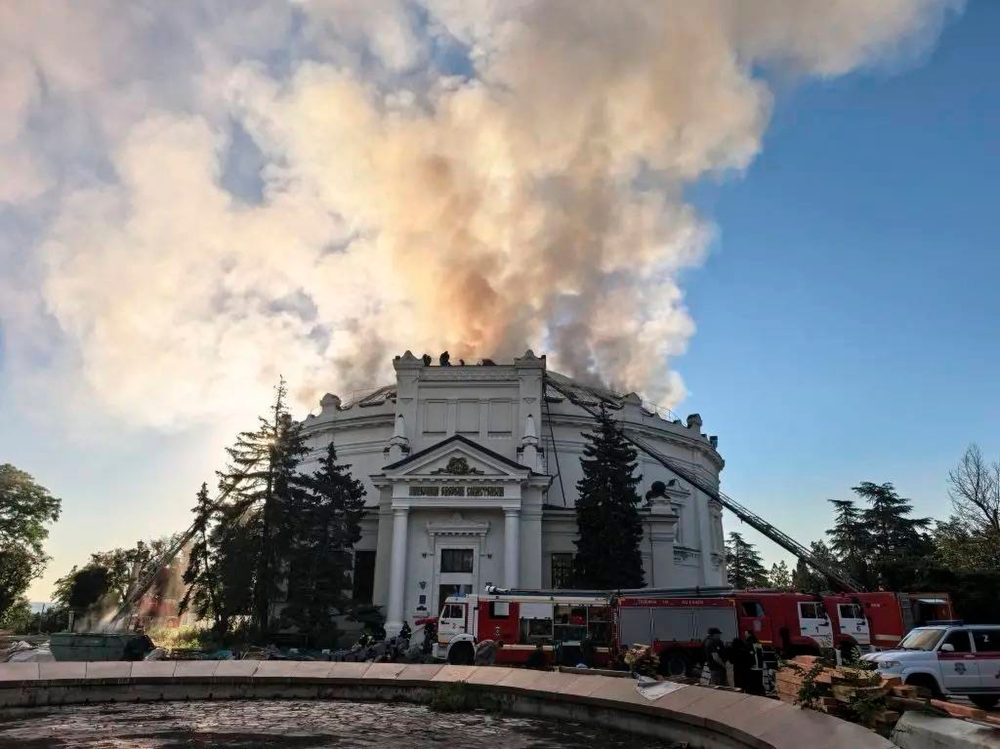
In Russian-controlled Crimea, a Ukrainian drone struck the structure containing a massive panorama artwork depicting the city’s defense during the 19th century Crimean War. Mikhail Razvozhayev, the Kremlin-appointed head of Sevastopol, stated the painting by artist Franz Rubo was essentially destroyed.
With the more than 1,000-kilometer battle front in the four-year conflict remaining mostly unchanged as drone swarms prevent territorial gains, both nations have increasingly turned to long-distance attacks.
The progressively deeper and bold Ukrainian attacks have presented a challenge to Russia’s President Vladimir Putin, contradicting his assertion that Moscow was prevailing in the war now in its fifth year.
Last week, Putin promised to enhance Russia’s air defense capabilities following Ukrainian strikes that ignited an oil terminal in St. Petersburg and struck a nearby naval facility, overshadowing his prominent economic forum in his home city.
The St. Petersburg attacks represented another setback for the Russian leader, occurring weeks after he scaled back an annual Victory Day parade in Moscow due to concerns about Ukrainian drone strikes.
Ukraine’s Air Force reported air defenses intercepted 181 of 207 Russian drones.
A wave of 26 drones attacked Kharkiv early Wednesday, wounding at least four individuals, according to regional administration head Oleh Syniehubov. He reported one person died and 15 others sustained injuries in the region during the previous 24 hours.
In Zaporizhzhia and surrounding areas, 10 people were wounded overnight during multiple Russian aerial strikes, according to regional head Ivan Fedorov.
In Odesa, a mother and two children, ages 8 and 10, needed medical care after Russian drones damaged two residential structures, according to regional administration head Oleh Kiper.