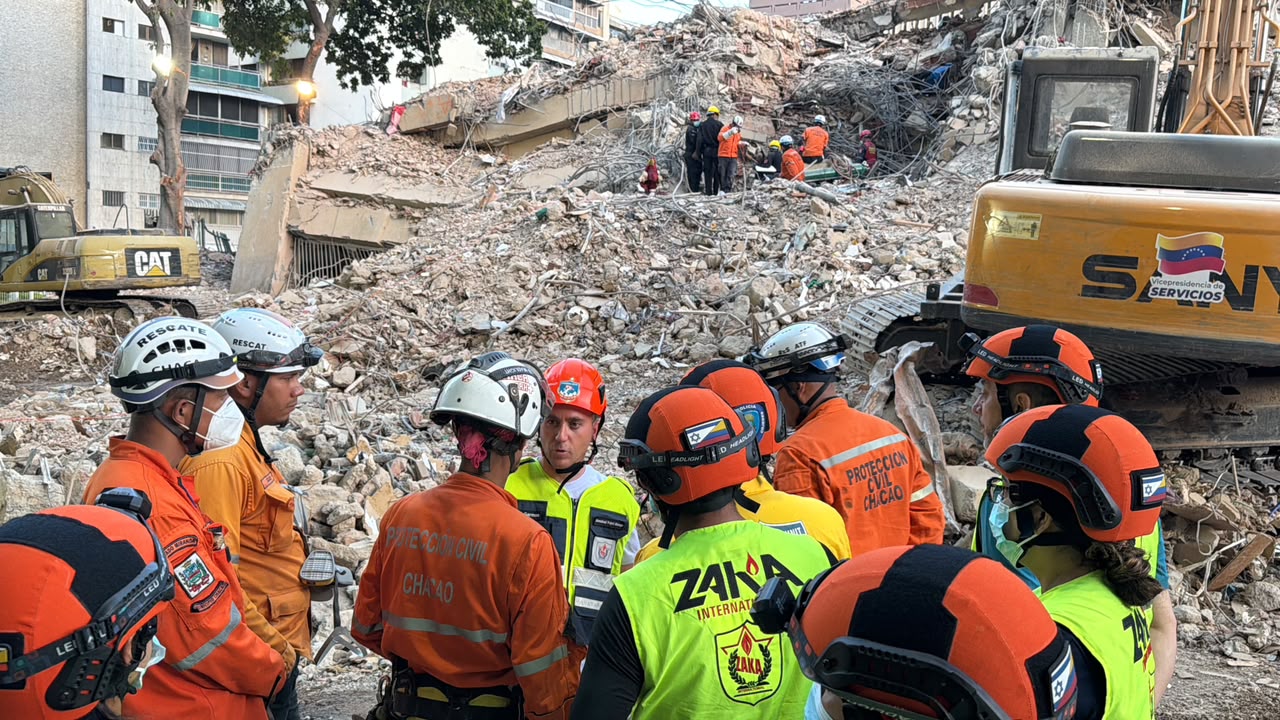

A team that would have seemed almost unthinkable in Caracas just weeks ago has arrived in Venezuela: Israeli army officers, engineers, and Foreign Ministry staff from a nation that has had no formal diplomatic relationship with Venezuela since 2009.
Leading the delegation is Yoed Magen, Israel’s ambassador-designate to Mexico, who told The Media Line the group includes roughly 30 Israelis on the ground — most from the military and Foreign Ministry. An additional 20 specialists are working remotely from Israel, reviewing field data and helping develop recommendations for a national emergency response plan. The team is expected to remain in Venezuela for approximately 10 days.
Magen said the delegation’s role is not traditional search-and-rescue. Instead, their focus is on answering a critical question for local authorities and displaced residents: which buildings are still safe? Drawing on the Israel Defense Forces Home Front Command’s experience in disaster zones around the world, the team is conducting a structure-by-structure assessment — identifying which buildings can be re-entered, which pose a collapse risk, and which may be salvageable once engineers determine what repairs are needed.
Magen characterized the Israeli presence as humanitarian in nature and was careful not to frame the visit as a political gesture. He acknowledged that the two countries have no diplomatic ties, but said the scale of the disaster made some form of cooperation unavoidable.
Much of the team’s work has been concentrated in Caracas, but Magen said the coastal city of La Guaira, just north of the capital, presents a different and more severe picture. Entire neighborhoods show damage from one building to the next. Some structures have been completely destroyed, others remain standing but are severely compromised, and thousands of families are still waiting to learn the fate of missing loved ones. Magen said the number of missing could be in the thousands, possibly higher.
Venezuelan authorities have released sobering official figures: 3,535 people killed, 16,740 injured, and close to 18,000 left without homes. Officials have also recorded 855 damaged buildings and 189 total collapses.
Prof. Shmuel Marco, a geologist at Tel Aviv University, explained to The Media Line that the destruction stemmed from a combination of geological, structural, and human factors. He noted that what struck Venezuela was not a single earthquake but two, occurring roughly 40 seconds apart.
“This was a double earthquake, and that means the ground was hit twice in a very short period of time,” Marco said. “The second shock came before buildings, infrastructure and people had any real time to recover from the first.”
Marco added that Caracas sits in a valley that can amplify seismic waves, compounding the damage. He also pointed to the direction of the forces involved as a key factor.
“The most destructive waves are the horizontal ones,” Marco said. “Buildings are naturally designed to resist gravity, but earthquakes push them sideways. If a structure is not designed for that kind of force, it can fail very quickly.”
Looking at photographs and aerial images, Marco observed that many buildings appeared to have toppled in a single direction, similar to a collapsing stack of cards — a sign, he said, that they lacked reinforcement against strong lateral movement. He noted that Venezuelan geologists had long warned that a major earthquake near the Boconó fault system, north and west of Caracas, was a matter of when, not if. “This earthquake was expected and yet surprising,” Marco said. “Venezuelan geologists had warned for years that this kind of event was likely, but the country was not ready for it.”
Marco was quick to add that no nation could have easily managed a disaster of this magnitude. He drew a comparison to a much smaller building collapse in northern Tel Aviv years ago, where recovering just two bodies from a parking structure took roughly a week, about 100 workers, and heavy equipment. In Venezuela, that challenge is replicated across hundreds of buildings. “No country in the world can respond immediately and fully to hundreds of collapsed buildings,” Marco said. “Even wealthy and well-prepared countries would struggle with a disaster on that scale.”
The Israeli government delegation represents only one piece of a broader Israeli and Jewish humanitarian effort. Rabbi Yosef Garmon, former Chief Rabbi of Guatemala and CEO and President of the International Humanitarian Coalition, began mobilizing contacts as soon as the earthquakes struck — reaching out to the same networks he had activated after disasters in Nepal, Haiti, Turkey, Syria, Mexico, and Central America. Some volunteers were trained through ZAKA International; others came from Jewish volunteer networks in Guatemala, El Salvador, and Colombia.
The first contingent from Central America arrived in Venezuela just two days after the quake. Teams from Colombia followed, including physicians connected to the local Jewish community. From Colombia alone, Garmon said, volunteers brought more than a ton of supplies. They partnered with local organizations including the Central University of Venezuela.
By the time the volunteers arrived, Garmon said, the window for live rescues had largely closed. The focus shifted to providing food, tents, medicine, masks, gloves, and other essentials to people left without shelter — and in some cases, helping families with the painful task of recovering the remains of those who had died. “Sadly, by the time we arrived, we were no longer rescuing people alive,” Garmon said. “But families still needed help recovering the bodies of their loved ones. Some of them told us, with tears in their eyes, that they never imagined brothers from Israel would come to help them in that moment.”
Garmon described the response as operating on three levels: the Venezuelan government, which helped facilitate access and security; ordinary Venezuelan citizens, who greeted the Israeli and Jewish teams with unexpected warmth in the streets, at universities, and online; and the local Jewish community, which opened its institutions and became an active part of the relief operation.
Over one Shabbat, the Jewish community hosted Israeli state officials, uniformed IDF soldiers, and Jewish volunteers from multiple countries together — a gathering that Magen said carried special significance given how long such a meeting would have been unthinkable. Garmon noted that Club Hebraica opened its doors, community members organized a large donation collection center, and Venezuelan Jews of all ages pitched in to prepare supplies for earthquake-affected families.
Garmon was clear that the official Israeli government mission and the volunteer efforts serve different purposes. “The official Israeli delegation has a different mission,” he said. “They are looking toward Venezuela’s future reconstruction. Their work and ours are separate, but they complement each other.”
Other organizations have also been part of the response. IsraAID has concentrated on psychological support, children’s needs, and water and sanitation, while additional Israeli and Jewish groups have contributed supplies, expertise, and volunteers.
“For us, there is no difference between Jews and non-Jews,” Garmon said. “We help human beings. Wherever there is a need, that is where we try to be.”
The diplomatic backdrop makes this moment particularly striking. Venezuela severed ties with Israel in January 2009 under Hugo Chávez during Operation Cast Lead in Gaza, and that rupture continued under Nicolás Maduro. For years, Caracas maintained one of Latin America’s most openly hostile official positions toward Israel while strengthening its relationship with Iran. Against that history, a public statement from acting President Delcy Rodríguez drew considerable attention. She thanked the Israeli team, credited coordination to the local Jewish community and Chief Rabbi Yitzhak Cohen, and acknowledged the Israeli delegation’s role in launching the infrastructure assessment and rehabilitation process.
Magen said both Venezuelan authorities and the general public have been extremely welcoming. Even so, Israeli officials are not portraying the mission as a formal diplomatic turning point. The message from Jerusalem remains measured: cooperation is happening because the situation demands it, and Israel is there because Venezuela is facing a humanitarian emergency. Any deeper political significance, officials say, is premature to discuss.
The earthquake did not restore relations between Israel and Venezuela. It forced the two sides to work together amid the wreckage. For Venezuelan families still waiting for answers about their homes and their missing, that distinction may feel secondary. For Jerusalem and Caracas, it may carry far greater weight down the road. For now, the most honest description of what is happening is also the most restrained: a humanitarian mission, an uncommon public opening, and a moment of contact between two countries that had almost none.