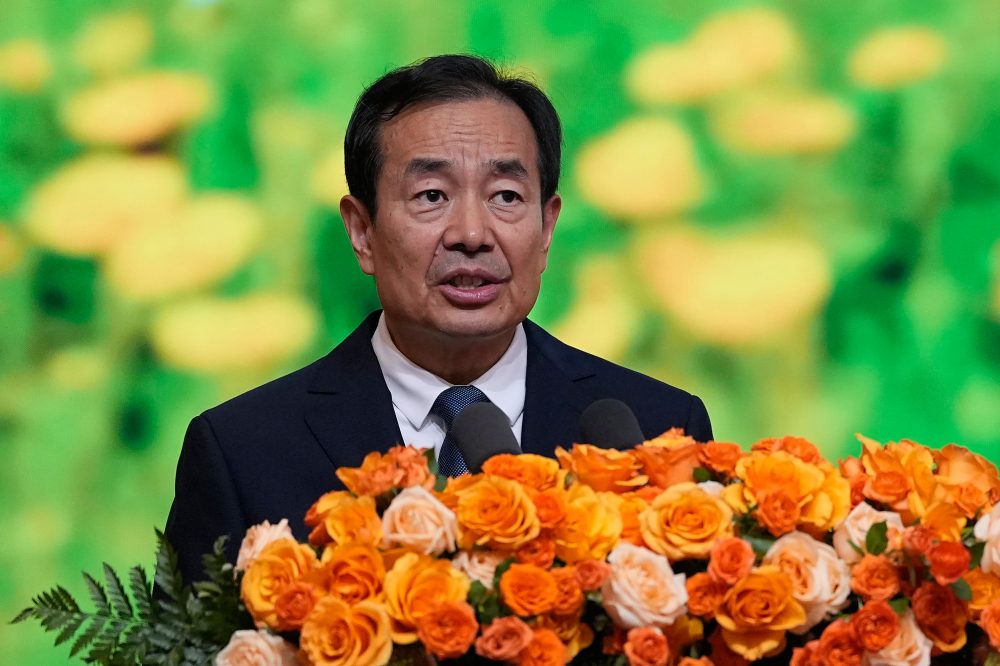

ALTAY, China (AP) — Chinese officials welcomed international delegates to Xinjiang on Wednesday for a conference aimed at showcasing economic opportunities in the northwestern territory that has drawn global attention for its treatment of ethnic minorities.
The International Conference for Trans-Altai Subregional Cooperation took place in Altay, bringing together representatives from Kazakhstan, Mongolia, Russia and additional countries to explore trade partnerships and economic collaboration in the landlocked area. Chinese authorities outlined development strategies for coal, oil and gas extraction, cotton production and other industrial sectors throughout Xinjiang.
“Xinjiang has become a vivid epitome of China’s rapid economic development and fully reflected the significant advantages and vitality of China’s governance,” said Chen Xiaojiang, secretary of the Chinese Communist Party Xinjiang Committee.
Chen also outlined ambitious infrastructure expansion plans, including additional railway lines and increased air travel options for the region.
Xinjiang faces significant economic challenges compared to China’s prosperous eastern provinces. In 2020, rural residents in the territory earned an average of 13,052 yuan ($1,927) per person, while their counterparts in wealthy Zhejiang province averaged 31,930 yuan ($4,714) annually.
This economic inequality contributed to unrest that eventually led to violent incidents by extremist elements within the Uyghur population. Beginning in 2017, Chinese authorities detained one million or more individuals from ethnic minority communities, predominantly Uyghurs. Officials characterized these mass detentions as necessary measures to address the previous attacks.
Chinese authorities announced the closure of most detention facilities by 2021, though several camps were transformed into traditional prison complexes. Documents obtained by The Associated Press revealed that thousands of Uyghurs received lengthy prison terms based on what experts describe as fabricated or inflated accusations.
Human rights organization Global Rights Compliance reports that those not incarcerated, especially in southern Xinjiang areas with substantial Uyghur communities, face mandatory participation in government employment programs that activists say is expanding under China’s current five-year economic strategy.
Chinese officials have previously stated that what they term “anti-China forces” have distorted conditions in Xinjiang by mischaracterizing the government’s counterterrorism and anti-extremism initiatives as discriminatory actions against particular ethnic, regional or religious communities.