
SLAVUTYCH, Ukraine — Hundreds of residents filled the main plaza of Slavutych early Sunday morning, lighting candles arranged in the shape of a nuclear warning symbol to mark four decades since the catastrophic Chernobyl nuclear accident and honor those who died containing its deadly aftermath.
The annual memorial continues each year even as residents face wartime restrictions and official advisories against mass gatherings amid Russia’s ongoing invasion of Ukraine.
The catastrophic event on April 26, 1986 exposed serious safety failures and government cover-ups within the former Soviet Union. Soviet officials concealed the explosion for 48 hours until radioactive material had drifted across Europe and Swedish scientists publicly raised alarms.
Approximately 600,000 individuals, known as Chernobyl “liquidators,” were deployed to extinguish the reactor fire and remove the most hazardous contamination. Thirty plant workers perished within months from either the blast itself or severe radiation poisoning. The catastrophe subjected millions throughout the area to harmful radiation levels and triggered massive permanent relocations of hundreds of communities across Ukraine and Belarus.
Slavutych, located roughly 50 kilometers (32 miles) from the destroyed reactor, was constructed during this era. While most displaced families were relocated to surrounding areas in the Kyiv region, Soviet officials started constructing this new city in late 1986 to accommodate Chernobyl plant employees and their families. The initial inhabitants arrived around 1988.
The community has weathered a temporary Russian takeover during Moscow’s unsuccessful attempt to capture Ukraine’s capital in the war’s early stages, along with brutal winters — particularly the most recent one, when power outages forced some locals to prepare food over open flames in the streets.
Attendees of various ages filled the square, with some families bringing spring tulips and daffodils. They assembled in the wide courtyard surrounded by Soviet-style residential buildings, where a monument sits alongside displays honoring local citizens killed in the current conflict.
Liudmyla Liubyva, 71, attended the service with a companion. She previously came with her spouse, who was employed at the Chernobyl facility but later developed mobility issues connected to radiation exposure and became unable to walk, she explained.
Liubyva emphasized the importance of recognizing those who sacrificed their well-being following the disaster, though Russia’s invasion has rekindled concerns that the threat was never completely eliminated.
“When the drone struck the arch, it felt like the world could return to 1986,” she said, referencing a Russian drone attack in 2025 that damaged the New Safe Confinement structure, the enormous dome constructed to contain radiation from the destroyed reactor. “We all — young and old alike — must protect our land, because it is so vulnerable.”
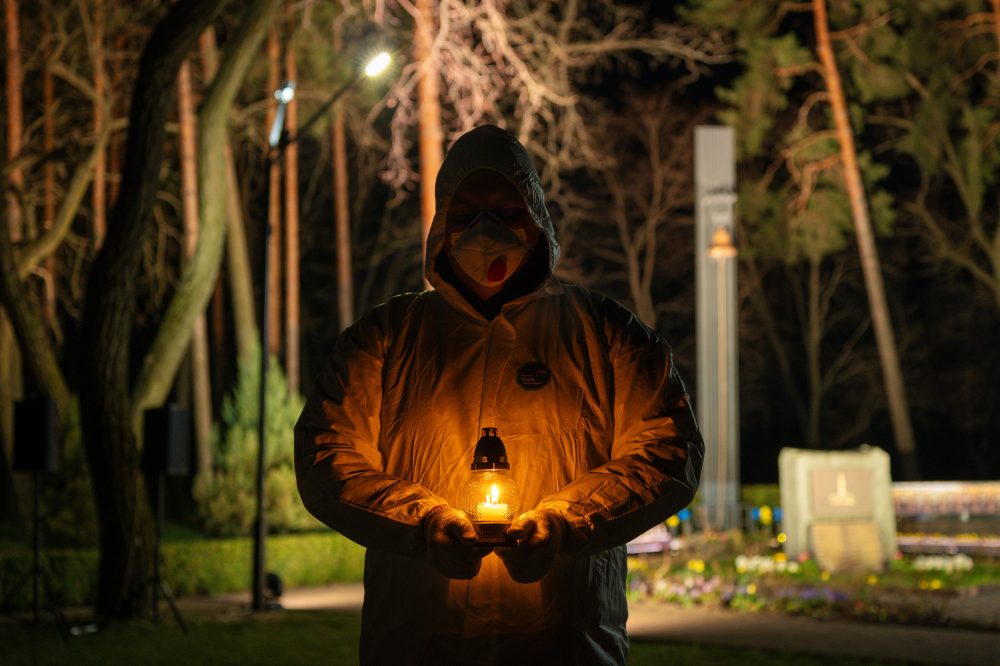
Gentle music filled the air while poetry about the tragedy played through speakers. “Years pass, generations change, but the pain of Chernobyl does not fade,” a woman’s voice recited. As the words resonated throughout the plaza, individuals wearing white hazmat suits and masks, representing the liquidators, stood quietly holding candles.
Larysa Panova, 67, frequently remembers the day of the accident that compelled her to abandon her birthplace of Chernobyl and start over in Slavutych. Although the new community has become her home, she continues to think about the woodlands and natural beauty of the area she left behind.
Prior to Russia’s comprehensive invasion, she routinely returned to see family members who stayed or simply to spend time in her childhood region. However, the war has made the exclusion zone largely inaccessible.
“I never stop thinking of Chernobyl as my homeland,” she said. “You remember your school, your childhood, your youth — everything happened there, in Chernobyl.”