
WASHINGTON – Security protocols for America’s top leaders are facing renewed criticism following Saturday evening’s shooting of a Secret Service agent at the White House Correspondents’ Association dinner, an incident that highlights ongoing vulnerabilities in protecting political figures during a period of heightened violence.
Numerous law enforcement personnel from multiple agencies were deployed to safeguard the high-profile annual event, which featured President Donald Trump as the main speaker this year.
Despite extensive security measures, an individual armed with a shotgun and additional weapons succeeded in reaching a location just one floor above the Washington ballroom where an unprecedented gathering of cabinet officials, senior legislators, and entertainment figures were attending the dinner.
The guest list included Vice President JD Vance, Secretary of State Marco Rubio, Defense Secretary Pete Hegseth, Attorney General Todd Blanche, Treasury Secretary Scott Bessent, Interior Secretary Doug Burgum, and numerous other administration officials, each accompanied by their respective security teams.
While it remains premature to determine whether security lapses or communication breakdowns occurred, the incident underscores persistent weak points in even the most robust protection systems, particularly given the two previous attempts on Trump’s life during his 2024 campaign.
According to Washington’s police chief, the suspect – who carried a shotgun, handgun, and knives – had been lodging at the Washington Hilton where the dinner was hosted.
At an unscheduled White House briefing following the event, Trump commended emergency responders and Secret Service personnel.
The president reflected on the inherent risks of his office, referencing past presidential assassinations while emphasizing that the gunman never came close to “breaching” the ballroom entrance.
“It’s not particularly a secure building,” Trump remarked about the hotel located roughly ten minutes from the White House. The same venue was the scene of the 1981 attempt on President Ronald Reagan’s life.
Although approximately 2,600 guests underwent metal detector screening before entering the basement ballroom, hotel access required only ticket presentation, and the facility remained open to regular guests. With protesters demonstrating outside the entrance, many opposing the administration’s conflict with Iran, attendees were expedited through security checkpoints.
Video evidence shows the gunman rushing through a corridor beyond a security station before shooting the agent and subsequently being subdued and arrested by authorities.
Dinner guests were still consuming their spring pea and burrata salad course when those seated toward the rear reported hearing several gunshots.
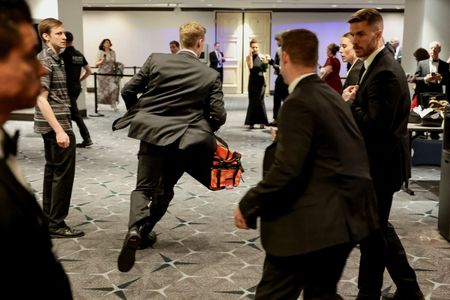
Secret Service personnel immediately evacuated Trump and Vance from the main table, while protection details for other officials and legislators seated among journalists and guests responded with varying approaches. Some agents navigated through the crowded ballroom, climbing over chairs and displacing table settings to reach their assigned protectees as confused attendees sought cover beneath tables.
Security teams for cabinet members, including Rubio, Bessent, and Burgum, forced their charges to the floor while creating protective barriers with their bodies. While most protected individuals were eventually removed from the venue, evacuation timing differed considerably, with some departing immediately while others remained for several minutes.
Trump, who survived a near-fatal 2024 assassination attempt when a bullet grazed his ear during a campaign appearance, reportedly wanted to resume the dinner program, according to White House sources.
He subsequently informed reporters that the Secret Service concluded continuing the event would not be feasible.