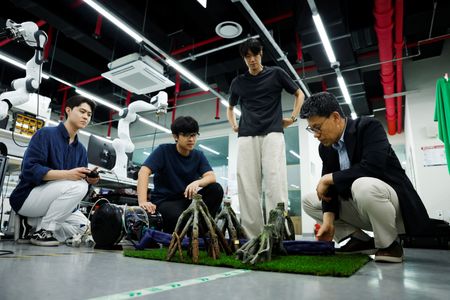

A joint research team from South Korea and the United States has introduced a robotic dressing system capable of suiting up a person in roughly 10 seconds — no hands needed and no help from anyone else.
The technology, developed by researchers at South Korea’s KAIST and Stanford University, relies on soft, bendable structures called “vines” that are built into clothing and powered by air pressure. Once pressurized, these vine-like tubes guide the fabric up and around the wearer’s body — much like an ivy plant wrapping itself around a surface — even while the person is moving.
The idea came to lead researcher Kim Nam Gyun, a postdoctoral researcher at KAIST, during an everyday moment. “When I was riding a bicycle, it started to rain … and I thought it would be helpful if a raincoat could be put on automatically (as I ride),” he said.
Kim explained how the system works: “The vine robot stays close to the person and dresses them by turning the clothing inside out as it moves, allowing it to climb stably along the shape of the body.” He noted that a complete suit can be put on in approximately 10 seconds.
One of the standout features of this technology is that it doesn’t require the person to stand completely still, and it operates without the need for a complicated control algorithm, the research team noted.
Ryu Jee-Hwan, a civil and environmental engineering professor at KAIST, said the design draws inspiration from climbing ivy, which grows from its tip rather than moving its entire body. This allows it to navigate curved surfaces with stability. “It can pass through narrow gaps, grow while adapting to the shape of its surrounding environment, and move regardless of whether the surface is slippery, sticky, or sloped,” Ryu said.
While the technology holds clear promise for helping older adults and people with disabilities, the research team also sees applications in settings where fast, hands-free dressing is critical — such as semiconductor cleanrooms and emergency situations where workers need to quickly put on or remove protective gear.
Ryu also pointed out a broader message behind the invention. With artificial intelligence commanding so much attention these days, he said this self-dressing robot demonstrates that mechanical engineering still has a vital role to play alongside software development.
The findings were published in IEEE Robotics and Automation Letters, a peer-reviewed scientific journal.