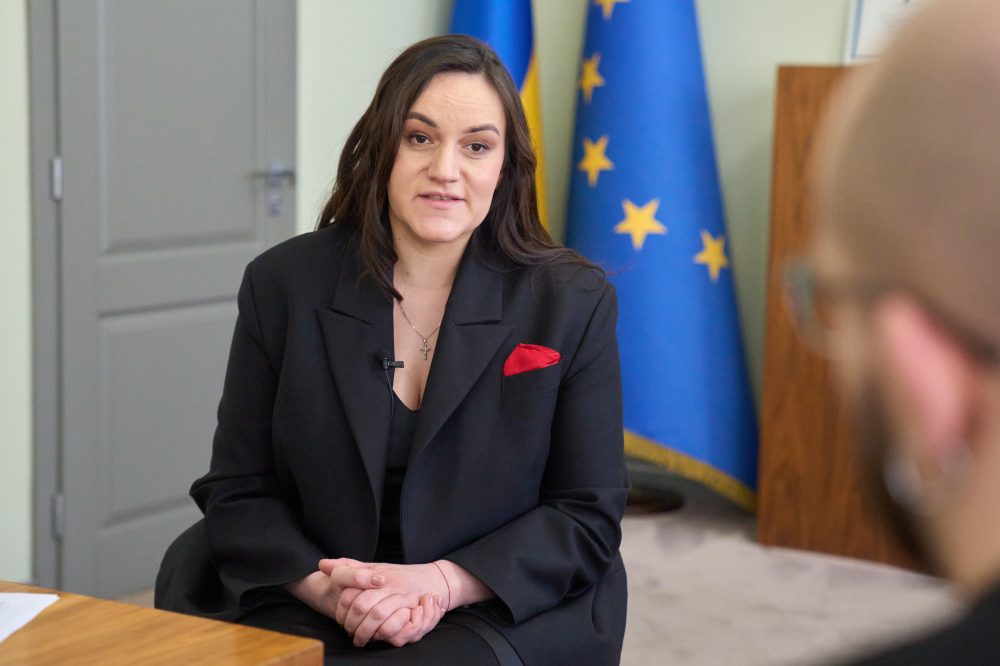

KYIV, Ukraine — Museum director Alina Dotsenko experienced devastating heartbreak when she entered her facility after Ukrainian troops reclaimed the southern city of Kherson from Russian occupation in late 2022. Thousands of precious artworks had disappeared.
“I walked in and saw empty storage rooms, empty shelves. My legs gave way, and I just sat down by the wall, like a child,” said Dotsenko, who heads the Kherson Art Museum.
The museum previously housed more than 14,000 pieces in a diverse collection “ranging from America to Japan” before Russia’s comprehensive invasion began in early 2022. As Russian troops withdrew, they transported much of the collection by truck to Russian-controlled Crimea, according to Dotsenko and footage captured by local residents.
Nearly 10,000 artworks remain unaccounted for.
Ukraine is renewing its protests about cultural theft as Russia attempts to rejoin international cultural events. The upcoming Venice Biennale intends to permit Russian participation for the first time since 2022. Ukrainian officials argue the event “must not become a stage for whitewashing the war crimes that Russia commits daily against the Ukrainian people and our cultural heritage.”
The Kherson situation is unique because Ukraine has precise documentation of what was stolen.
Prior to the conflict, Dotsenko had systematically photographed every piece in the museum’s collection, building a comprehensive digital database. When Russian forces captured Kherson, she concealed the hard drives containing this information. After Ukrainian soldiers returned, she recovered them.
This database now represents the most complete documentation of stolen cultural property during the conflict, enabling prosecutors to collaborate with Interpol in tracking missing pieces and pursuing accountability.
Throughout most of Ukraine, however, similar records don’t exist. Cultural theft cases can only be prosecuted in court when losses can be proven piece by piece.
The Russian Culture Ministry did not reply to Associated Press inquiries about the alleged theft from Ukrainian museums. Previously, Russian-appointed officials in occupied regions characterized the removals as protective actions.
Kirill Stremousov, the former Russia-appointed deputy administrator in Kherson who died shortly before Ukrainian forces freed the city, claimed removed statues would “definitely return” once hostilities ended.
Halyna Chumak, former head of the Donetsk Regional Art Museum, escaped Russian-controlled Donetsk in 2014, taking what she could manage: catalogs documenting a small portion of the museum’s approximately 15,000 artworks.
She spent twelve months moving the catalogs through military checkpoints into Ukrainian-held territory, abandoning most to avoid attracting attention from pro-Russian forces who inspected her at each crossing point.
Those catalogs covering slightly more than 1,000 pieces represent the only remaining evidence. More than ten years later, Ukrainian businessman Oleksandr Velychko is converting them to digital format.
His team required more than three careful months to process roughly 400 works. When finished, the database will be provided to Ukrainian authorities, offering partial legal grounds to claim ownership of missing pieces.
Authorities indicate many situations across Ukraine mirror Donetsk rather than Kherson.
Anna Sosonska, deputy chief of a war crimes division at Ukraine’s Prosecutor General’s Office, said her department is managing 23 criminal cases involving cultural crimes, encompassing 174 instances of theft, damage and destruction.
The Kherson museum case ranks among top priorities, she noted, primarily due to Dotsenko’s digital records.
Sosonska explained that Russian forces frequently take inventory books and other documentation from museums, complicating efforts to establish what was stolen.
Prosecutors sometimes depend on open-source intelligence, following artworks through photographs, auction records and other online evidence — a time-consuming process that cannot rebuild complete collections.
Progress takes time, but Sosonska emphasized that cultural crimes fall under international law and face no time limits for prosecution.
Ukrainian authorities say the extent of theft greatly surpasses what can be documented.
Ukraine’s Culture Ministry reports that Russia had destroyed or damaged 1,707 cultural heritage sites and 2,503 cultural infrastructure facilities including event venues and galleries as of March, most notably the Mariupol Drama Theatre.
The ministry stated that over 2.1 million museum objects remain in Russian-occupied areas. From territories Ukraine has reclaimed since 2022, more than 35,000 museum items are confirmed stolen.
Substantial portions of Ukraine have remained under Russian control since 2014, and much original documentation has been lost, destroyed or taken.
Russia has moved to legally formalize control over captured collections. In 2023, it modified laws to incorporate 77 Ukrainian museums in the occupied Donetsk, Luhansk, Kherson and Zaporizhzhia regions into its national registry, a move critics say effectively prevents the return of stolen works.
Named as Ukraine’s culture minister in October 2025, Tetiana Berezhna said digitization will be a central priority for her office to protect collections.
“If we had digitalized them beforehand, then we would know how many objects were stolen and what they look like,” she said.
A recent European case has highlighted the potential for accountability.
In March, a Polish court determined that Oleksandr Butiahin, a Russian citizen, can be sent to Ukraine over accusations he conducted unauthorized excavations in Crimea, removing artifacts from a site Ukraine considers its cultural heritage.
Butiahin was arrested in Poland last year following Ukraine’s request. The court’s ruling remains open to appeal.
Sosonska described the case as the first instance where a Russian citizen could face prosecution for crimes against Ukraine’s cultural heritage connected to occupied territory.
For museum professionals like Dotsenko, the matter remains intensely personal.
She spoke with The Associated Press at an exhibition in Kyiv displaying reproductions of the paintings stolen from the Kherson museum.
“While these works are still in captivity, we all hope the situation will be resolved in favor of the Kherson Art Museum. I didn’t dedicate 50 years of my life to this museum for nothing,” she said.