
In Ukraine’s northeast region, military crews spend long nights monitoring computer screens from mobile command centers, tracking incoming threats with the help of interceptor drones and caffeine to stay alert.
These operators represent approximately 1,000 similar teams across Ukraine working to counter Russia’s most devastating aerial weapon: the Shahed drone.
“Even if you use 50 drones to shoot down one Shahed, it’s worth it,” explained Borys, a team leader who previously worked as a television news producer before the conflict changed his career path. “One Shahed can fly in and destroy something far more valuable.”
Russia has deployed thousands of these Iranian-designed, cost-effective long-range attack drones monthly against Ukraine. Moscow has modified the original Shahed design, renaming it the Geran, with enhanced navigation systems, improved engines, and more powerful explosive payloads.
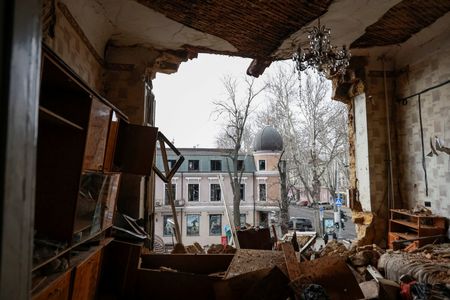
Ukrainian forces successfully intercept most Shaheds and similar long-range drones, but those that penetrate defenses cause significant damage. According to Ukrainian air force statistics, over 1,000 drones reached their targets out of approximately 6,500 launched last month, devastating military installations, urban areas, and power infrastructure while leaving millions without electricity and heat.
Defense Minister Mykhailo Fedorov announced in February an ambitious goal to neutralize 95% of all incoming Shaheds and comparable long-range attack drones from Russia.
Military charity Come Back Alive compiled air force data showing February’s interception rate exceeded 85%. With Russia’s ground offensive stalled, Fedorov emphasized that strengthening aerial defenses could prove crucial for Ukraine’s survival through another year of warfare.
Reuters spoke with twelve Ukrainian officials, defense manufacturers, and military personnel involved in this defensive campaign, who reported steady progress. Fedorov recently stated the interception rate had climbed to 90%.
Reuters could not independently confirm the drone launch and interception statistics. Russia’s defense ministry did not respond to requests for comment.
Moscow consistently denies deliberately targeting civilian populations, claiming its aerial campaigns aim to weaken Ukraine’s military capabilities. Ukraine has also launched thousands of long-range drones, also called unmanned aerial vehicles, against Russian targets including energy infrastructure.
Ukrainian personnel involved in the interception program warn that developing a nationwide defense network with thousands of air defense units will require months, and technological advances may prove temporary in the ongoing arms race with Russia.
The initial interceptor that successfully destroyed a Shahed in early 2025 became obsolete within four months when Russians discovered they could outpace it by boosting the Shahed’s velocity from 170 kilometers per hour to over 200 kph, according to Taras Tymochko, a technology expert at Come Back Alive.
Consequently, interceptors must travel faster than their targets to achieve successful intercepts, requiring upgrades to reach speeds up to 300 kph, Tymochko noted.
Currently, approximately 15-20% of Russian Shaheds use jet propulsion instead of traditional propellers, enabling speeds of 400 kph, said Yuriy Cherevashenko, a senior Ukrainian air force commander.
Fedorov told Reuters that jet-powered interceptor drones, currently under development by Ukrainian manufacturers, would address this speed challenge.
Russia first imported Shaheds from Iran shortly after Moscow’s 2022 invasion began. These aircraft, resembling small planes with pointed fronts and triangular wings, became infamous for their distinctive high-pitched engine noise, earning the nickname “mopeds.”
Russia now produces thousands monthly in domestic facilities, forming the majority of its long-range drone fleet.
“As Russia builds out more and more of these UAVs, they represent an existential threat to Ukraine,” said Samuel Bendett, a senior fellow at the Center for a New American Security, a Washington-based think-tank. “Therefore taking them down is of the utmost importance.”
Production costs remain classified, but the Center for Strategic and International Studies estimated last year that Russian Shahed variants cost $35,000 each to manufacture.
Ukrainian interceptor drones cost several thousand dollars each, with the most affordable models priced under $1,500, according to manufacturers. These typically consist of 3D-printed plastic shells containing explosives and powered by four small rotors.
Field operations prove challenging for Ukrainian interceptor teams. Soldiers have only minutes from when a Shahed appears on radar until it moves beyond range. They must guide an interceptor toward the target until spotting the Shahed through their drone’s camera, then execute a collision course and detonate.
Target identification depends heavily on weather conditions. “We had a night when we had 10 launches and we didn’t find a single (Shahed),” said Borys.
The 47-year-old left television work to enlist after the invasion and now leads three interceptor crews in the 420th Unmanned Systems battalion. He requested his surname be withheld following standard Ukrainian military protocol.
When fog rolled in during a cold March evening, soldiers in Kharkiv region had to abort their mission due to zero visibility through their drones’ cameras.
Fedorov said Ukraine is developing automated drone guidance technology to improve effectiveness during poor weather.
Facing nightly attacks of over 500 drones, Ukraine has rapidly developed cost-effective urban and infrastructure defense methods. The country employs a comprehensive, multi-tier system using electronic warfare equipment, interceptor drones, armed pickup trucks, helicopters, and fighter aircraft.
Air force commander Cherevashenko said the military is applying knowledge gained from Russia’s drone campaigns last summer and winter to defeat the Shahed threat. “We have a great opportunity to do this.”
Electronic warfare systems that disrupt Shahed navigation show varying effectiveness, but can neutralize nearly half the drones during some attacks, said air force spokesperson Colonel Yuriy Ihnat.
Interceptor drones currently eliminate 40% of Russia’s Shahed-type weapons and other long-range attack UAVs, according to Cherevashenko, up from approximately 25% during winter.
Ukraine’s F-16 fighter jets also participate, with each aircraft capable of destroying up to 10 Shaheds nightly, Ihnat told Reuters.
Cherevashenko identified Russia’s use of artificial intelligence to develop new tactics and flight routes as a major challenge, making it difficult for Ukraine to maintain pace.
He also noted the deployment of “mesh networks,” where drone groups function as signal relays in grids extending over 120 kilometers, enabling them to overcome Ukrainian navigation jamming.
Ukrainian interception efforts benefit from an unexpected advantage: remote operations. Elite pilots now control interceptors remotely via internet connections across multiple Ukrainian regions, instantly switching between video feeds, Cherevashenko explained. Ground support teams handle drone preparation and antenna setup, but pilots can operate from any location.