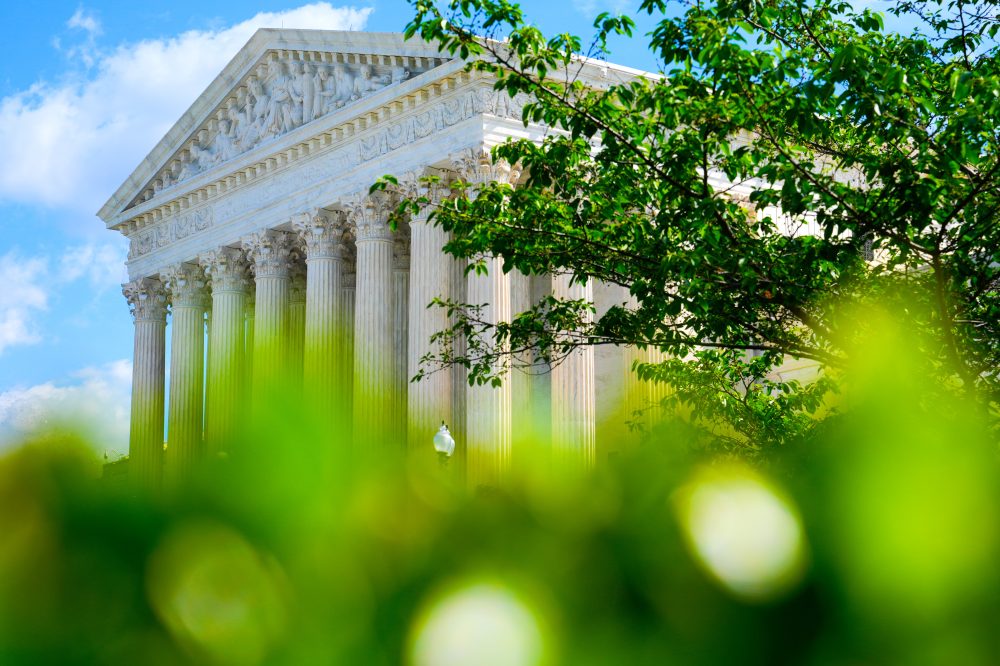

WASHINGTON — The nation’s highest court will consider Wednesday whether the Trump administration has the authority to terminate legal safeguards for migrants who escaped conflict zones and natural catastrophes, marking another significant immigration dispute before the justices during the president’s comprehensive border enforcement efforts.
Federal officials are challenging lower court rulings that prevented the Department of Homeland Security from rapidly terminating temporary protected status for individuals from Haiti and Syria. Should the Supreme Court rule in favor of the Trump administration, officials could remove protections from as many as 1.3 million individuals across 17 nations, making them vulnerable to removal proceedings.
The justices have previously supported the administration and permitted the termination of protections for Venezuelan nationals while litigation continues, though they provided no explanation for their decision.
Government lawyers maintain that the Homeland Security secretary possesses authority to terminate the program called TPS, and that statutory language prevents courts from reviewing such determinations. Federal attorneys stated in legal filings that “‘No judicial review’ means no judicial review.”
However, attorneys representing approximately 350,000 Haitian migrants and 6,000 Syrian nationals argue that courts can examine whether officials adhered to all procedural requirements outlined in federal law. They maintain that in both situations, the government bypassed proper procedures.
Following President Donald Trump’s return to office, Homeland Security has terminated protections for 13 nations. Legal advocates report that some individuals who maintained lawful residence and employment in America for over ten years have lost their livelihoods and homes within weeks. Returning to Haiti and Syria remains impossible for many due to continued violence and chaos in those nations, according to Sejal Zota, co-founder and legal director of Just Futures Law.
“This really is life or death,” she said. Legal documents reveal that four Haitian women deported from America in February were later discovered beheaded and abandoned in a river.
The Trump administration petitioned the Supreme Court after federal judges in New York and Washington, D.C., agreed to postpone the termination of protections. One court determined that “hostility to nonwhite immigrants” likely influenced the decision to end Haitian protections. During his campaign, Trump promoted unfounded claims that Haitian immigrants were stealing and consuming pets. Federal officials have rejected allegations that racial bias influenced TPS determinations.
Syrian nationals received protected status initially in 2012 during a civil conflict that persisted over a decade until President Bashar Assad’s regime collapsed in late 2024.
Haitians entered the program following a devastating 2010 earthquake and have received multiple extensions due to persistent gang warfare that has forced over one million people from their homes, court records show.
Maryse Balthazar was visiting the United States when the earthquake devastated her homeland of Haiti. She has maintained temporary legal status for 16 years, raising two children while working as a nursing assistant for elderly patients. Healthcare industry representatives argue in court filings that the field depends on Haitian immigrants like Balthazar and would suffer significantly if the Supreme Court permits their status to end.
For Balthazar, losing protection would be catastrophic. The earthquake destroyed her Haitian residence, and another potential home was lost in a fire possibly linked to gang activity. “I’d be homeless,” she said. “I’m scared … it’s a fear we are all living with.”
Additional immigration matters before the Supreme Court this term include Trump’s effort to limit birthright citizenship and the administration’s authority to reinstate restrictive asylum policies.