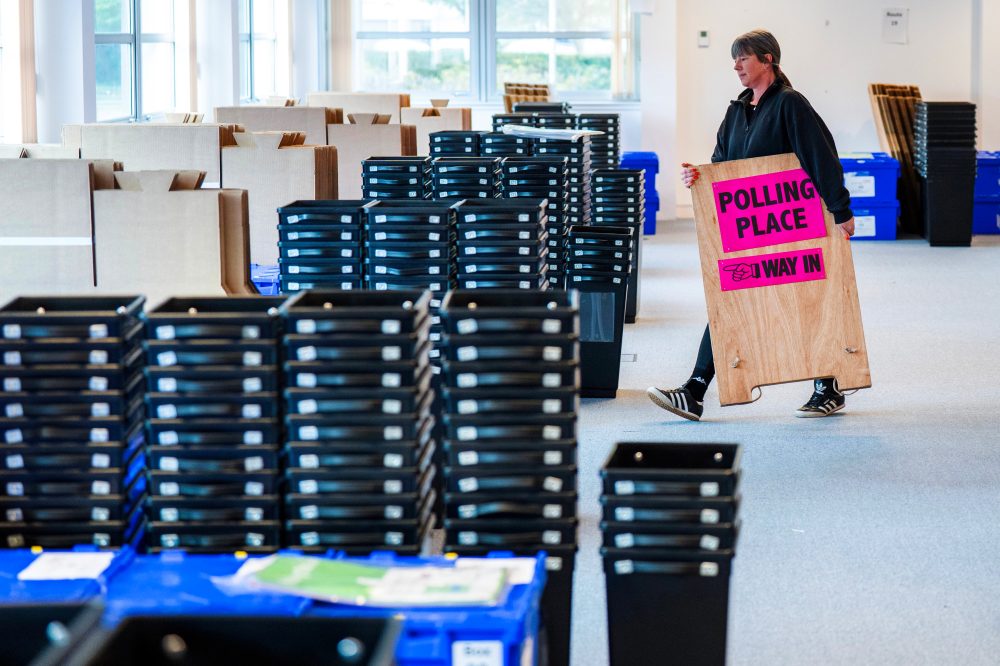

LONDON — Voting stations opened Thursday morning for crucial local and regional elections that political observers believe could severely damage British Prime Minister Keir Starmer’s already weakened position.
The center-left Labour Party, led by Starmer, faces the possibility of significant defeats in contests that will determine approximately 5,000 local council positions and several mayoral races throughout England, along with regional parliaments in Scotland and Wales.
Voting began at 7 a.m. and will continue until 10 p.m. While some local areas plan to tally votes through the night, most results are anticipated to be announced Friday afternoon.
Though local campaigns typically center on municipal concerns such as waste management, vandalism cleanup and road maintenance, Starmer’s political rivals have characterized Thursday’s elections as a judgment on the prime minister’s performance.
Devastating losses could prompt dissatisfied Labour members of parliament to attempt removing a leader who brought the party to victory fewer than two years ago. Even if Starmer weathers this challenge, numerous political experts question whether he will remain as party leader for the next general election scheduled by 2029.
The prime minister’s approval ratings have dropped dramatically following a series of political blunders since taking office in July 2024. His administration has failed to achieve promised economic expansion, restore deteriorating public services, or address rising living costs — challenges complicated by the ongoing U.S.-Israeli conflict with Iran that has disrupted oil transport through the Strait of Hormuz.
Starmer suffered additional damage from his controversial choice to name Peter Mandelson, who has faced scrutiny over his connection to Jeffrey Epstein, as Britain’s ambassador to the United States.
Labour currently holds roughly 2,500 positions on English local councils, and party officials worry they may lose a substantial number of these seats.
Electoral defeats could spark an immediate leadership contest or internal party demands for Starmer’s resignation. He previously weathered a political crisis in February when several Labour parliamentarians, including the party’s Scottish leader, called for his departure over the Mandelson selection.
Luke Tryl from polling firm More in Common predicted the local elections would likely witness “the total collapse of the traditional two-party system” that Labour and the Conservatives have controlled for generations.
The anticipated victor is the far-right Reform UK party, headed by Nigel Farage, which targets working-class communities and former Labour strongholds in northern England and London’s suburbs with its anti-establishment and anti-immigration platform. The Green Party is also projected to capture hundreds of council positions in city centers and college towns.
The primary opposition Conservative Party is similarly expected to suffer losses, while the moderate Liberal Democrats may secure some gains.
In his final campaign appeal, Starmer avoided mentioning the Conservatives entirely, presenting voters with a choice between “progress and a better future” under Labour versus “the anger and division offered up by Reform or empty promises from the Greens.”
Speaking before the election, Farage declared that strong Reform results would mean Starmer is “gone by the middle of summer.”
Reform is also seeking victories in Scotland and Wales, though independence-supporting parties the Scottish National Party and Plaid Cymru are expected to maintain control in Edinburgh and Cardiff.
“Labour’s going to lose to Reform in some places, Greens in others, and here and there they’ll lose one or two seats to the Liberal Democrats and the Conservatives as well,” explained Tony Travers, a government professor at the London School of Economics. “They’re fighting on four fronts in England — five in Wales and Scotland.”