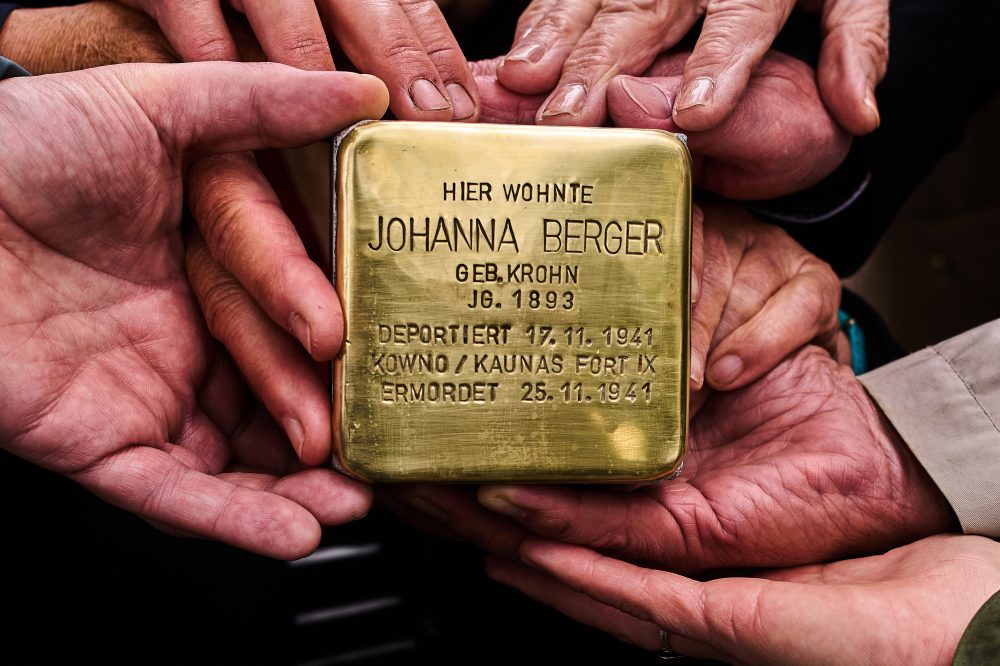

BERLIN (AP) — On a rainy spring afternoon in Berlin, artist Gunter Demnig knelt down to embed a small brass memorial into the pavement at a bustling intersection. The plaque bore the inscription: “Johanna Berger, born in 1893, lived here; deported on Nov. 17, 1941, murdered on Nov. 25, 1941.”
As Demnig brushed away sand from Berger’s memorial and three others honoring her husband and sons, family members gathered around the brass squares known as Stolpersteine, or “stumbling blocks.” They laid white roses and spoke the Kaddish, the traditional Jewish mourning prayer, as city traffic continued around them.
Three decades have passed since Demnig first installed a memorial plaque in Germany’s capital. Today, more than 11,000 of these remembrance stones dot Berlin’s streets. The project extends far beyond the city limits — Demnig and his volunteer teams have positioned 126,000 memorial stones throughout Germany and 31 additional European nations.
The gleaming brass squares, set flush with sidewalk surfaces, create unexpected moments of reflection for pedestrians who pause to read the names of Holocaust victims. Young children frequently crouch down to examine the stones closely, prompting questions for their parents about the inscribed names and dates.
“My basic idea behind this was that wherever in Europe the German Wehrmacht, the SS, the Gestapo, and their local collaborators committed murders or carried out deportations, symbolic stones should be placed there,” the 78-year-old German artist explained during a Wednesday interview with The Associated Press.
Relatives of Holocaust victims often journey from distant countries to witness the installation ceremonies. For many families whose loved ones died in Nazi concentration camps without proper burials, these memorial stones represent the closest equivalent to a gravesite.
“The Stolpersteine are some kind of substitute for the missing gravestones,” explained Michael Tischler following Wednesday’s ceremony. The 72-year-old Berlin resident is Berger’s grandnephew, and several family members were killed during the Holocaust.
“I think this brings the family history to a certain conclusion, or at least a provisional one,” Tischler added.
Beyond providing comfort to victims’ families, the memorial stones have sparked community-driven historical research initiatives. Neighborhood groups, schools, and religious organizations collaborate to investigate their local areas’ wartime history.
Volunteers of all ages examine archived documents and study old residential records to identify former homes of Jews and other Nazi persecution targets, including communists, homosexuals, and Roma people. After confirming a victim’s previous address, communities organize installation ceremonies and commit to regularly cleaning the brass plaques to maintain their visibility.
At Wednesday’s second ceremony on Stierstraße, where many Jewish families once resided, several tenth-grade students from Friedrich-Bergius-Schule witnessed Demnig’s installation of three stones for the Krein family. The new memorials for Michael, Maria, and their daughter Dalila increased the street’s total to 62 Stolpersteine.
While Maria and Dalila successfully fled to the United States and British-controlled Palestine respectively, Michael, who worked as a musician, perished in Berlin during 1940 while performing forced labor under Nazi rule.
Sixteen-year-old student Sibilla Ehrlich observed as violinists performed somber music and elderly neighbors shared stories about the three Jewish family members’ experiences under Nazi persecution.
“It is just so horrible, all this the hatred of others,” she reflected. “I keep thinking: what if this had been my family.”
Prior to the Holocaust, Berlin housed Germany’s largest Jewish population. When the Nazis assumed power in 1933, approximately 160,500 Jewish residents lived in the city. By World War II’s conclusion in 1945, emigration and systematic extermination had reduced their numbers to roughly 7,000.
The Holocaust claimed the lives of approximately 6 million European Jews and other targeted groups.
As Germany marks the 81st anniversary of Allied liberation from Nazi rule on May 8, many citizens express concern about Holocaust memory preservation amid growing far-right political influence in the country.
Tischler shares these worries about Germany’s direction during a period of increasing antisemitism, but believes the memorial stones provide reason for optimism.
“I hope that these Stolpersteine will still give some people pause for thought,” he said.