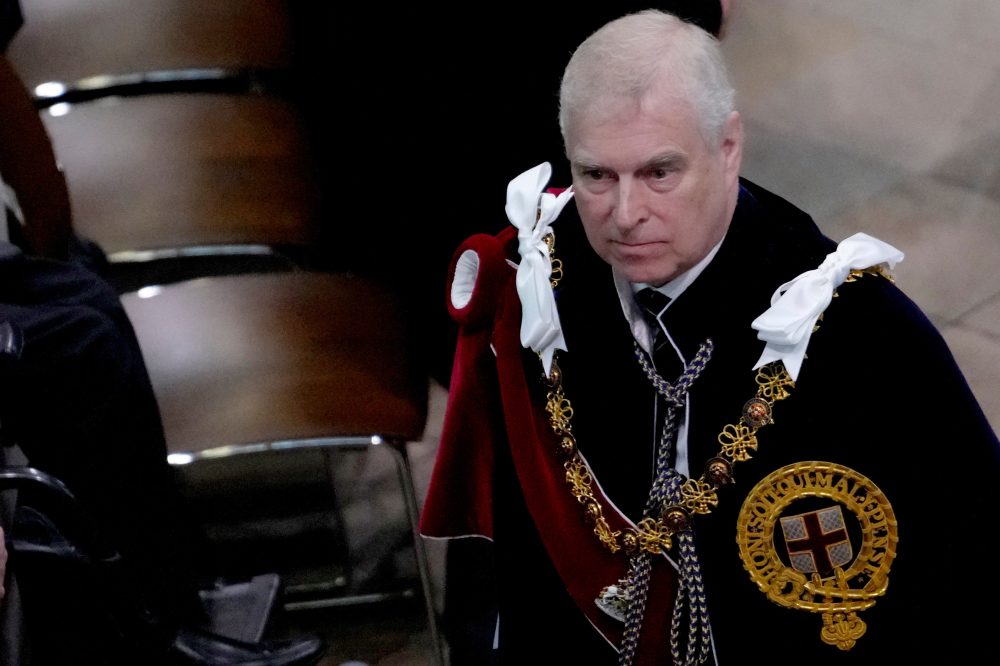

LONDON — For the first time in nine decades, Britain may remove a royal family member from the line of succession to the throne. The UK government announced it’s exploring legal measures to formally exclude Andrew Mountbatten-Windsor from the monarchy’s succession order.
King Charles III’s younger brother currently holds the eighth position in line for the crown, even though he lost his prince title last October due to his connections with deceased convicted sex offender Jeffrey Epstein.
Constitutional experts warn that eliminating him from succession could take considerable time since it would need approval from approximately a dozen nations that recognize the British monarch as their head of state.
However, support for this change appears to be growing following Mountbatten-Windsor’s arrest last week on charges of suspected misconduct in public office. The 66-year-old faces accusations of providing confidential trade secrets to Epstein during his tenure as Britain’s trade representative between 2001 and 2011. These allegations emerged after the US Justice Department released extensive Epstein-related documents last month.
Authorities released Mountbatten-Windsor on Thursday after holding him for approximately 11 hours, though the investigation continues.
“The government is clear that we are not ruling out action in respect of the line of succession at this stage, and we will consider whether any further steps are required in due course,” Chief Secretary Darren Jones informed Parliament members on Monday.
Jones emphasized that any action would wait until police complete their investigation.
The current succession order places Prince William as heir apparent, followed by his three children — Prince George, Princess Charlotte, and Prince Louis. Prince Harry ranks fifth, with his children Prince Archie and Princess Lilibet in sixth and seventh positions respectively.
Mountbatten-Windsor, who held second place at birth, now sits in eighth position. His daughters, Princesses Beatrice and Eugenie, occupy ninth and twelfth places.
Parliamentary legislation would be necessary to remove him from succession, requiring lawmaker approval.
The Liberal Democrats have openly endorsed such action.
“I think it would be intolerable for Andrew Mountbatten-Windsor to succeed to the crown,” party leader Ed Davey stated last week. “It’s not as remote as some people think.”
Commonwealth nations where Charles serves as head of state would also need to approve succession changes.
Australian Prime Minister Anthony Albanese expressed Monday his willingness to support any UK plan to exclude Mountbatten-Windsor.
“These are grave allegations and Australians take them seriously,” Albanese wrote to Prime Minister Keir Starmer. “I agree with His Majesty that the law must now take its full course and there must be a full, fair and proper investigation.”
Starmer’s administration hasn’t received comparable letters from the other 13 countries recognizing Charles as head of state, including Canada, New Zealand, Jamaica, the Bahamas, and Tuvalu.
University College London politics professor Robert Hazell, who established the Constitution Unit, noted that some nations would need formal constitutional amendments while others could act through legislation. He questioned whether governments would invest time removing someone ranked eighth in succession.
“The last time this happened was for the Succession to the Crown Act 2013, which made the law of royal succession gender neutral,” Hazell explained. “It took two years of protracted negotiations for all the different countries to amend their own laws or constitutions.”
Questions remain about whether excluding Mountbatten-Windsor would impact his daughters and their children.
“Not necessarily — it depends how the legislation is framed,” Hazell said.
The most recent royal removal from succession occurred when King Edward VIII abdicated in December 1936 to wed American divorcee Wallis Simpson. That legislation eliminated both him and any future descendants from the succession list.
King Charles hasn’t publicly revealed his position on removing his brother from succession. The monarch has emphasized allowing the legal process to proceed, stating: “My family and I will continue in our duty and service to you all.”
British media reports suggest the palace wouldn’t oppose legislative changes to remove Mountbatten-Windsor from succession. The Times of London reported Saturday that an unnamed palace source said the royal family would “never get in the way” of Parliament’s decisions.