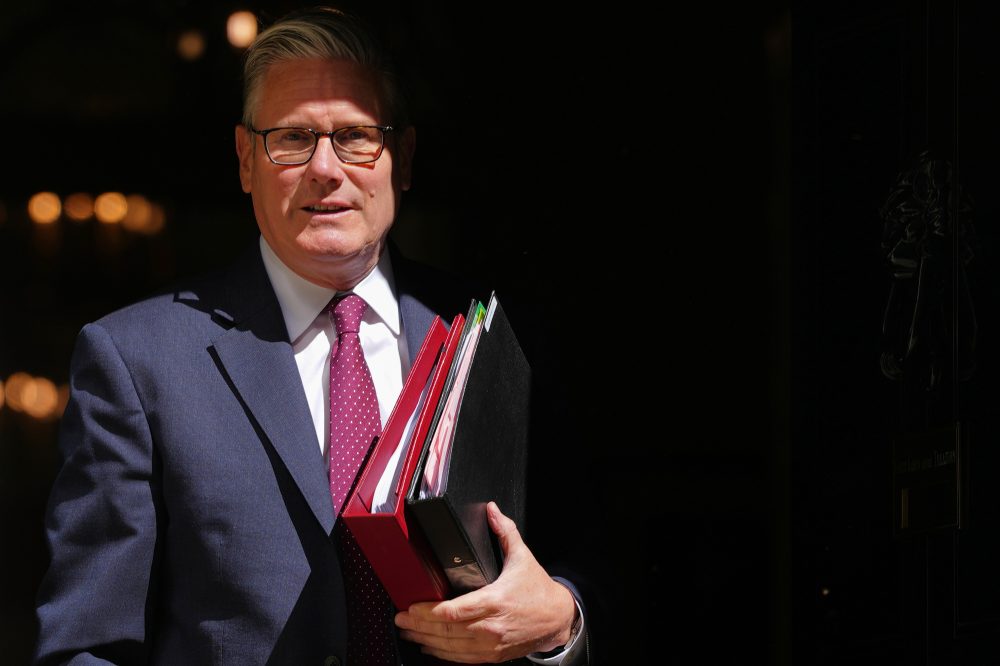

LONDON (AP) — Thursday’s elections across Britain could spell the beginning of the end for Prime Minister Keir Starmer’s struggling leadership, as voters head to polls that may confirm the United Kingdom’s shift toward complicated multi-party governance.
Political analysts predict Starmer’s center-left Labour Party will suffer significant defeats in local government races throughout England, as well as in elections for regional assemblies in Scotland and Wales.
The prime minister’s approval ratings have plummeted due to economic struggles and ongoing questions about his decision-making abilities, leading opposition groups to position Thursday’s mid-term elections as a judgment on Starmer and his administration that began two years ago. Reform UK, a far-right political movement, has adopted “Vote Reform, Get Starmer Out” as their campaign message.
While the next nationwide election isn’t required until 2029, a devastating showing Thursday could spark rebellion within Labour ranks against their unpopular leader.
Following his overwhelming electoral success less than two years ago, “Keir Starmer has become a vessel for people’s disappointment (and) disillusionment,” according to Luke Tryl from polling firm More in Common.
Starmer’s standing has collapsed following numerous blunders since taking office in July 2024. His administration has failed to deliver on promises of economic expansion, fixing damaged public services, and addressing living costs — challenges complicated by the ongoing U.S.-Israeli conflict with Iran that has disrupted oil transport through the Strait of Hormuz.
The prime minister suffered additional damage from his catastrophic choice to name Peter Mandelson, who has scandal-related ties to Jeffrey Epstein, as Britain’s envoy to Washington.
Political observers predict Labour could lose more than half of the 2,500 local council positions they’re defending across England. The party appears vulnerable to losses on multiple fronts — particularly to Green Party candidates in London and Reform UK in working-class areas of northern England that traditionally supported Labour.
“These elections are a perilous, perilous moment for Keir Starmer,” stated Tony Travers, a government professor at the London School of Economics. Following multiple policy reversals and in an economy where “there isn’t much money to spend on anything … his opponents are lining up.”
Starmer previously weathered a February crisis when several Labour members of parliament, including the party’s Scottish leader, called for his resignation over the Mandelson appointment.
A crushing electoral defeat could prompt an immediate leadership challenge from prominent figures like Health Secretary Wes Streeting, former Deputy Prime Minister Angela Rayner, or Greater Manchester Mayor Andy Burnham. Any potential challenger would require backing from 80 parliamentarians — one-fifth of the party’s House of Commons representation — to initiate a leadership race. Burnham would need to secure a parliamentary seat before assuming leadership.
Alternatively, Starmer might face party pressure to announce a departure timeline following an organized leadership transition.
“His parliamentary party are unsure as to whether now is the right time to unseat him,” explained Tim Bale, a politics professor at Queen Mary University of London. “So there might be a stay of execution.”
However, Bale noted, “it’s a case of when rather than if he goes.”
Traditionally, Labour setbacks would benefit their primary opposition, the center-right Conservative Party. However, the Conservatives remain damaged by their chaotic 14-year tenure that concluded in 2024. Instead, Nigel Farage’s Reform UK, the progressive Greens, and regional nationalist movements in Wales and Scotland are positioned to gain the most.
Travers described Britain’s evolution from a “two-and-a-half party system” — with Liberal Democrats typically serving as the third option — “to something more like a five-party one.”
This transformation benefits Rhun ap Iorwerth, leader of Plaid Cymru (the Party of Wales), who has strong prospects of heading that nation’s regional government.
“The old politics is gone,” he declared. “Labour is not going to win this election.”
Labour has controlled Welsh politics for a century and maintained power in Cardiff since Wales established its government in 1999. Current polling indicates Labour may finish third behind Plaid Cymru and Reform UK, who are competing closely for first place.
A Plaid Cymru victory would place pro-independence leaders in three of the UK’s four regions. Northern Ireland operates under Irish nationalist party Sinn Fein in a power-sharing agreement with the pro-British Democratic Unionist Party.
The Scottish National Party, governing from Edinburgh since 2007, promises to pursue another independence referendum if they secure a Thursday majority. Scottish voters previously rejected leaving the UK in 2014.
While Plaid Cymru states that a secession vote isn’t planned for the immediate future, independence remains their long-term objective. Their current priorities include expanded taxation authority and greater control over spending decisions.
“We need a fundamental redesign of Britain,” ap Iorwerth stated. “This is an unequal union.”